Bird 207 – Silver and Copper Pheasant

Lockdown rolls on, and we’re still here and totally not going crazy. In fact, today we’re so sane we thought we’d share our latest brilliant bird-related idea. Follow me on this one:

So, this week we met the Golden Pheasant, and that was pretty fun. But that got me thinking about the Olympics and how we hand out medals to winners (and the first two losers), and I thought, there must be a better way to award athletic excellence. And you know what, there is. What about instead of discs of metal, we gave people Pheasants?
I mean … we already have a Golden Pheasant, right. And who wouldn’t be pleased to walk away from a race with this beauty?

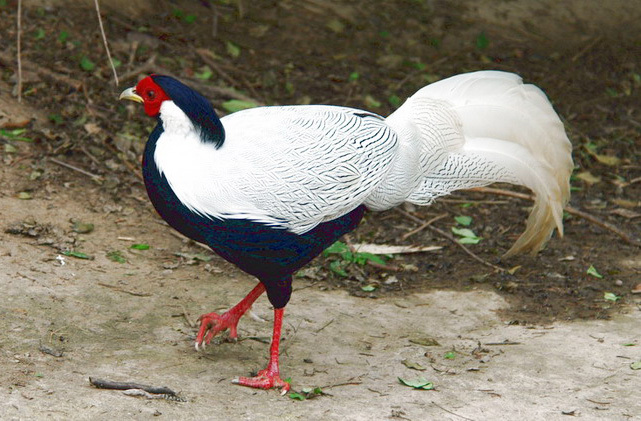
Well, good news, there’s also a Silver Pheasant (Lophura nycthemera). Like their golden cousins, they hail from mountainous mainland China. While they might be less showy, they are no less handsome, with their pure white plumes, red face masks, and delicate black scalloping on their feather tips.
And even better news, not only is there a Silver Pheasant, but there’s a Copper Pheasant as well (Syrmaticus soemmerringii). To mix things up a little, these pleasant pheasants come from Japan, not China. They’re a more compact bird that has a classic pheasant appearance with long, slender, tapering tails. But with their gentle rustic hues, they are just as delightful as their more flamboyant metallic kin.

Copper pheasant (Syrmaticus soemmerringii), male foraging

Now, I hear the naysayers and nit-picker complaining that it should be a Bronze Pheasant, and I take your point. But let’s be fair, bronze is 90% copper anyway … it’s just got a bit of tin mixed in it. On top of which, gold and silver are pure elements, whereas bronze is an alloy, so making the switch to a proper elemental metal is just sound decision making. Also … there’s no such thing as a Bronze Pheasant. 

I understand there is a long tradition of awarding athletes medals instead of pheasants (for some reason). It can be hard to overcome tradition, but let me lay out the pros and cons.

Pros:

  • The athletes get an instant fun pet
  • Anyone that wins multiple events would go home with a flock of pheasants. And yes, the only thing better than one pheasant is dozens
  • I see no reason why you couldn’t attach a lace loop to them and drape them around an athlete’s neck like a medal. I’m sure the pheasants would be super cooperative
  • They’re incredibly handsome
  • We’d free up precious medals for use elsewhere

Cons:

  • There are literally no cons

This is the start of a movement. I’m making the pitch: “Pheasants for First Place (also second and third)” … I’m still working on the slogan. I’d like to invite you all to join me in this totally non-quixotic mission to get more birds into our sporting events. It just makes sense. 

I’m not crazy, you’re crazy

31/08/2021

Bird 206 – Golden Pheasant

This week we wanted to bring a little colour to your inbox, but which colour? There are so many to choose from. Then we thought, to hell with it, let’s go with all of them. Behold the Golden Pheasant (Chrysolophus pictus).

These outrageous birds originally hailed from mountainous western China, but people thought they looked pretty neat, so they’ve been shunted all over the world. Today they’re a common sight in many aviaries and zoo, and there are feral populations roaming free in North America, Europe and Australia. 

The greatest influence the Golden Pheasant had on society came when they served as inspiration for Donald Trump’s iconic hairstyle. I have no doubt he walked into a barber shop, handed over a photo of this pheasant and said, ‘make me fabulous like the bird’. And who can blame him?

As is so often the case, with a particularly fancy male, the females tend to be more of a non-descript grey. Males will attempt to mate with as many females as possible, and they try to impress them by fanning out their black and yellow striped capes that hang from their necks. They flash them out up to their eyes, like a coy lady with a fan … except they’re definitely not coy … if anything they’re the opposite … incredibly arrogant and proud. 

Now, I know what you’re thinking. Can this bird fly? And the answer is yes, and they look spectacular when they do it.

29/08/2021

Bird 205 – Blue-crowned Hanging Parrot

Lockdown getting you … down? Worry not, Bird of the Week is here to bring a little joy. First, exciting news, the latest avian audio story is out. If you ever looked at a map and thought, hey what’s the go is with the birds of Guam and Mauritius (I know I have) then boy oh boy do I have good news for you (also on apple and spotify).

And for this week’s bonus bird I’d like to share one I’ve been saving for just such an occasion: the Blue-Crowned Hanging Parrot (Loriculus galgulus).

Now, as you can plainly see the Hanging Parrot is especially cute. They’ve got it all: vivid green plumes, big black puppy dog eyes, a red rump and bib, not to mention the aforementioned blue crown. They’re a real treat for the eyes.

But you may be wondering, what’s up with this hanging business? Well, Hanging Parrots have a delightful quirk: they sleep hanging upside down.

Why do they do this? Who can say? Maybe they have better dreams when the blood rushes to their head? At any rate, I will leave you with a few more pictures of these odd fellows. I hope they scare away the lockdown blues, and I hope that you too may dream … of inverted parrots.

25/08/2021

Bird 204 – Carunculated Fruit Dove

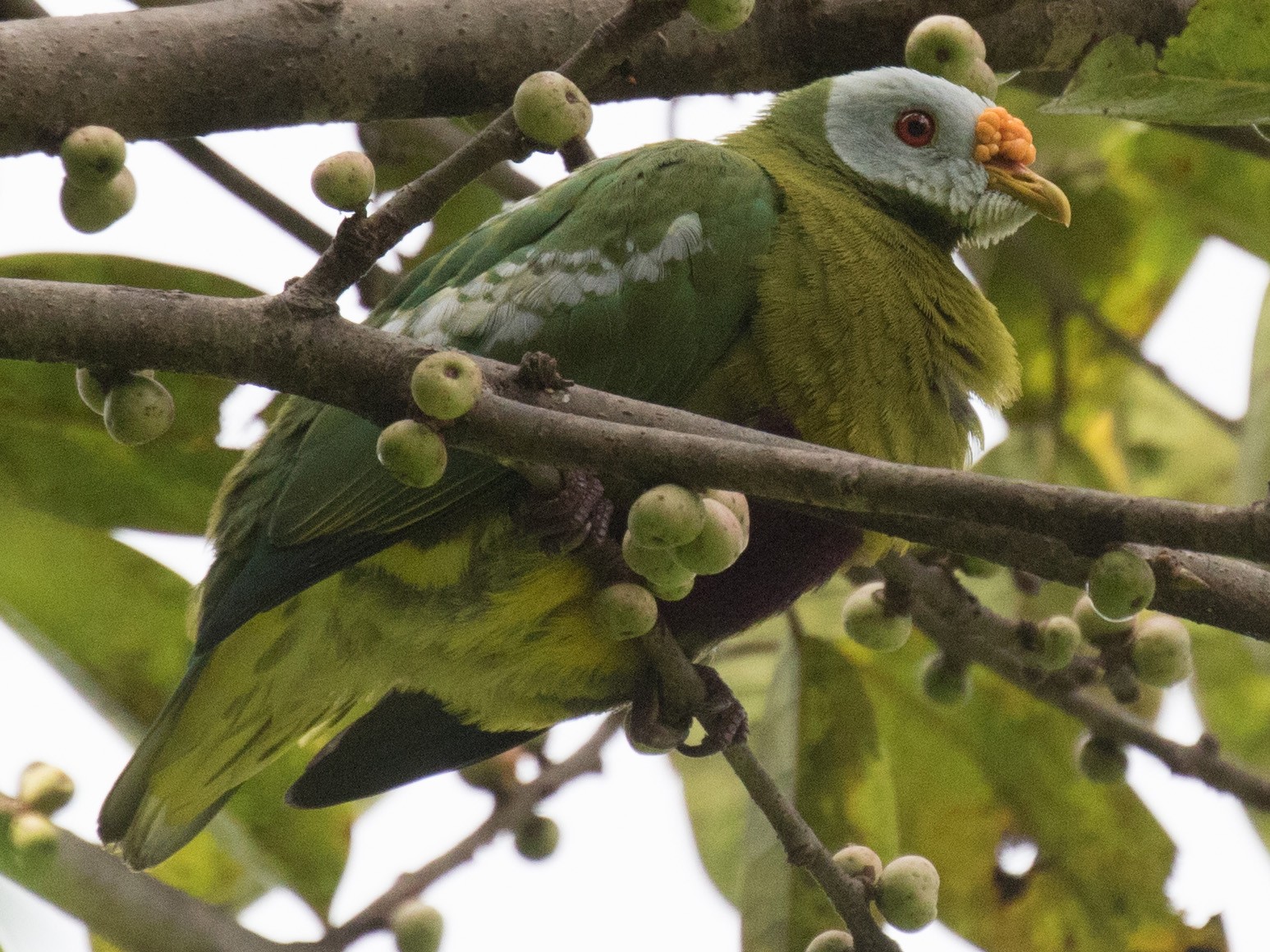
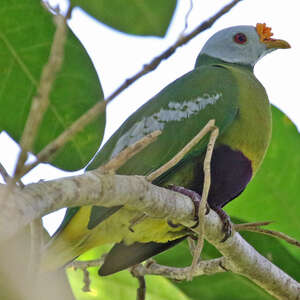
Somehow we’ve made it all the way to August without featuring a pigeon this year. Subscribers who have been with me for a while know how unacceptable this is; because pigeons are ultimate, pigeons are life. So, to make amends, I am dishing up one hellava fancy pigeon, the Carunculated Fruit Dove (Ptilinopus granulifrons).

Carunculated Fruit-Dove - eBird

Like all fruit doves, this bird is handsome as heck, but it is also elusive as heck. They live only on the island of Obi in Indonesia, halfway between New Guinea and Borneo. When I went digging into the literature, I discovered that between 1980 and 2011 they had only been officially documented by ornithologists three times. Obi is a remote island, only reachable by ferry, but does host a lot of primary industry, including nickel mining and logging, so the dove’s home is getting rather degraded.

Carunculated fruit dove - Wikipedia

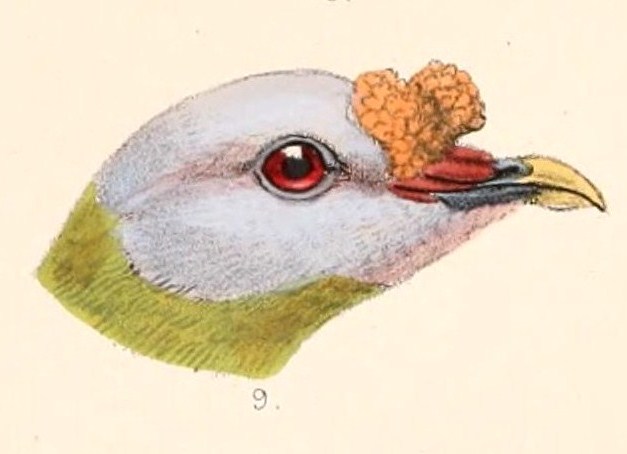
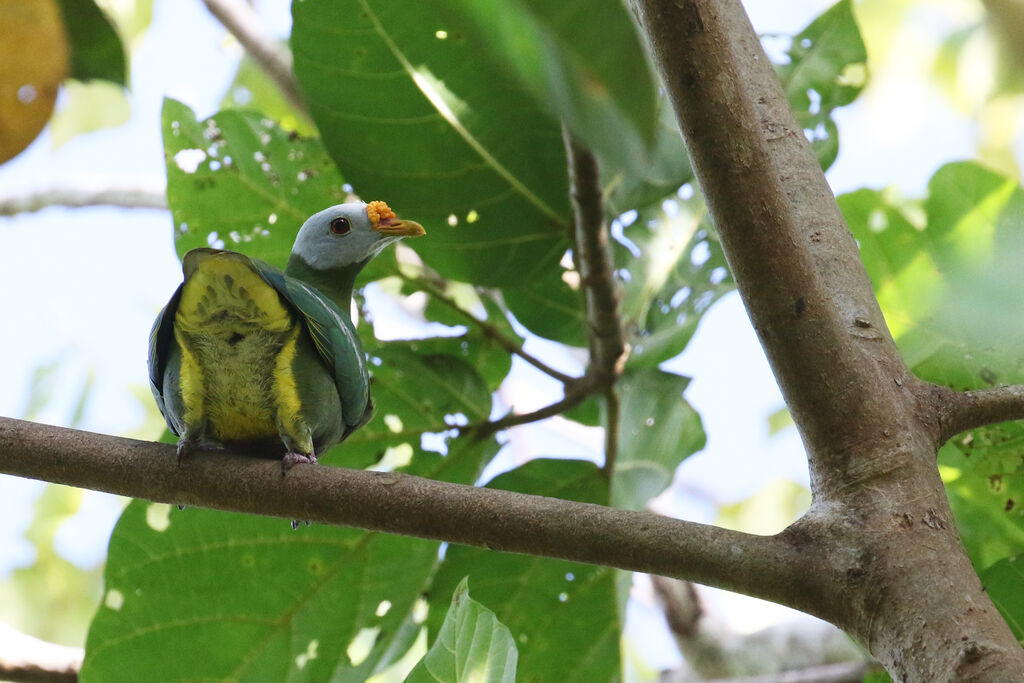
Now, we do get to learn a cool word though, ‘carunculated’. Looking at their picture, you’ve probably worked out what it refers to: that lumpy yellow growth at the base of their beak. Caruncle is a biological term for a fleshy growth, kinda like a carbuncle… except the words have no relation. Technically a Chicken’s wattle is a type of caruncle.

Carunculated Fruit Dove - Ptilinopus granulifrons

Sometimes it surprises me when I come across a kooky looking bird, only to learn that we know next to nothing about them. Why does it have a growth on its face? Does it serve any function? We know it probably isn’t sexually selected for as both males and females have it. So what’s the deal? We don’t know.

It seems strange that in our modern world someone hasn’t already tracked these coy cooing doves down and figured out what they’re about. But I guess that’s a good thing too, because it means there’s a lot of wonderful things left to discover. I hope one day some obscure academic writes a PhD on this obscure, odd looking bird. Preferably before we finish logging the bejesus out of their island.

Ptilope caronculéadulte

In other birding news, The Guardian is once again running The Bird of the Year competition and there’s still time to submit your favourite Australian bird to feature on the short list ahead of the September vote. 

And hey, if you want some bird trivia to break up the day, Bird Life Australia has a couple on their site.

22/08/2021

Bird 203 – Great Egret

So, Bird of the Week is in lockdown, but you know what they say: you can’t cage a bird (that’s not true, all variety of birds are caged with varying levels of success). If you lockdown a bird, more will fly away. So please enjoy something a little different. One of my all-time favourite poems from my all-time favourite poet, Mary Oliver, and this week’s bonus bird, the Great Egret (Ardea alba).

Great egret (Ardea alba) in breeding plumage at Venice Rookery, Venice, Florida
“Great egret (Ardea alba) in breeding plumage at Venice Rookery, Venice, Florida” by diana_robinson 

Egrets

Where the path closed
down and over,
through the scumbled leaves,
fallen branches,
through the knotted catbrier,
I kept going. Finally
I could not
save my arms
from the thorns; soon
the mosquitoes
smelled me, hot
and wounded, and came
wheeling and whining.
And that’s how I came
to the edge of the pond:
black and empty
except for a spindle
of bleached reeds
at the far shore
which, as I looked,
wrinkled suddenly
into three egrets–

Great egret
“Great egret” by Shawn Harquail

a shower
of white fire!
Even half-asleep they had
such faith in the world
that had made them–
tilting through the water,
unruffled, sure,
by the laws
of their faith not logic,
they opened their wings
softly and stepped
over every dark thing.

Great egret (Ardea alba) in flight at sunrise at Venice Rookery, Venice, Florida
“Great egret (Ardea alba) in flight at sunrise at Venice Rookery, Venice, Florida” by diana_robinson

If you’d like a bit more Oliver for the soul, we’ve featured her before:

Bird 59 – Northern Gannet

Bird 95 – Black Vulture

Or if Emily Dickinson is more your thing, there’s always:

Bird 125 – Musician Wren

17/08/2021

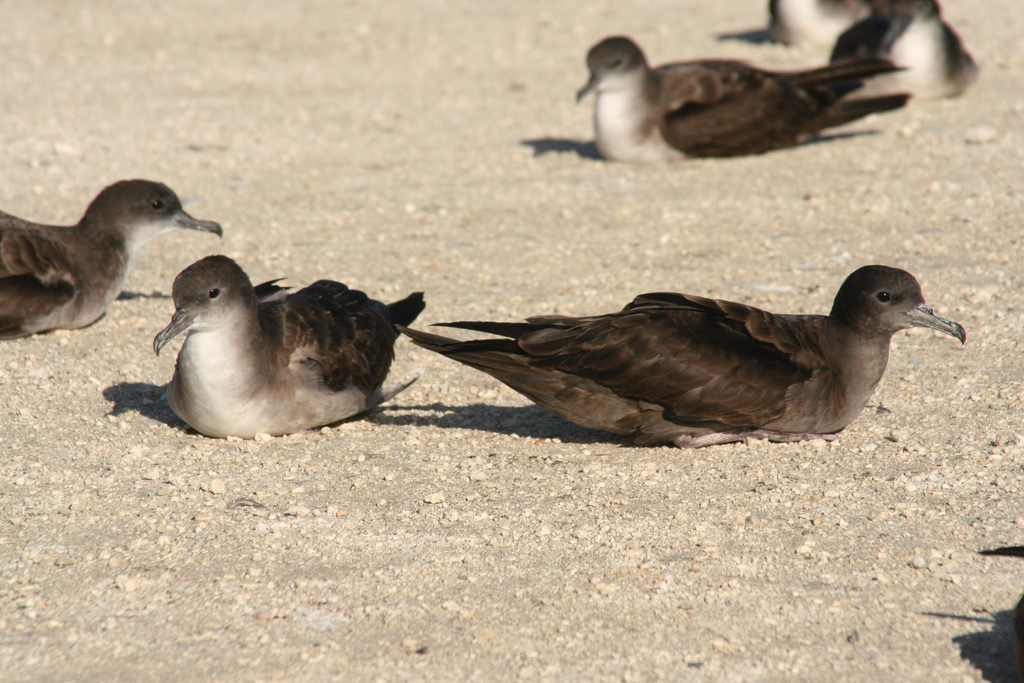
Bird 202 – Wedge-tailed Shearwater

Anyone who’s visited Coffs Harbour would be aware of the city’s famous landmark, Muttonbird Island … although given you can walk to it without getting your feet wet, I guess it’s less of an island these days. But what is a Muttonbird? Well… it kinda depends on where you’re standing, but if you’re on that island (peninsular?) then it is the Wedge-tailed Shearwater (Ardenna pacifica).

By MyName (Sabine’s Sunbird) – self-made while working for USFWS, Public Domain

You see, a ‘Muttonbird’ is more of a cultural thing, than any specific type of bird. The term was first applied by malnourished settlers on Norfolk Island who saw these birds as a great source of food. So much so they described them as ‘flying sheep’, hence the mutton. The first bird given this moniker was the Providence Petrel, but it has since been applied to the Sooty Shearwater, the Short-tailed Shearwater, as well as our new friend, the Wedge-tailed Shearwater.

Like their larger cousins the Albatross, Shearwaters spend most of their lives out at sea, returning to land to breed. This is where Muttonbird Island comes into the picture: it’s their rookery site. The Shearwater is a monogamous, burrowing bird. Males and females pair up to dig a burrow. They take turns performing excavation, then incubation, followed by hunting and feeding (regurgitation). They make great little teams; however, if Shearwaters have an unsuccessful breeding season and their chick doesn’t make it, they will usually get a divorce and try again next year with a different partner. 

In Hawaii, to make the effort of digging a burrow easier, Shearwaters enter into a time-share arrangement with Bonin Petrels. The Petrels arrive on the islands first, breed in the burrows and then move out before the Shearwaters turn up to take over the property. The Shearwaters don’t take kindly to stragglers though. If a Petrel chick is still in the burrow when they arrive, they will either kill it or forcibly evict it. The Shearwater signed up to very specific terms on their time-share, they don’t appreciate Petrels impinging on their rights.     

So that’s the story of the flying sheep … well, one of them anyway. But don’t worry, the others are birds for another week… maybe, probably, I mean, who can say?

15/08/2021

Bird 201 – Black-browed Babbler

Last year there was some big news that took the birding world by storm, and it centred around this rather unassuming fellow, the Black-browed Babbler (try saying that ten times fast) (Malacocincla perspicillata). 

Now, there isn’t much I can tell you about this bird, aside from the fact that it has a black brow and lives on Borneo. The reason for that is because it has only been officially sighted twice. The first time was in the mid 1840s, the second was in October 2020. For well over 170 years, this little Babbler was a mystery, presumed to be long extinct. But no, it is alive and flappin.

Here’s the story. Way back in the 1840s German geologist and naturalist Carl Schwaner was travelling around Indonesia (well, I suppose they were called the Dutch East Indies back then) performing a range of surveys on the geology and topography of the islands, when he caught our black-browed friend. Not being a bird specialist, he sent the specimen back to Europe where famed ornithologist Charles Lucien Bonaparte identified it as a new species. (Charles was a nephew of Napoleon Bonaparte. He wasn’t interested in the family business of warring and empriring and instead went into the exciting world of birds. He’s quite famous (in birding circles), we’ve actually touch on him before.)

For 170 years that’s where this Babbler’s story began and ended. The specimen was packed up and sent to the Natural Biodiversity Centre in the Netherlands, where it remains to this day. 

Enter Muhammad Suranto and Muhammad Rizky Fauzan, two Borneo locals who were tramping about the forest one day when they came across a bird and thought ‘Hey, I ain’t never seen that one before’. So they did the natural thing: caught it, did a photo shoot, gave it a metaphorical pat on the bum and sent it on its merry way. They posted their pictures to some local avian appreciation groups and were shocked to learn they’d rediscovered a long lost bird.

Somehow these little guys had remained hidden in the thick jungles of Borneo for over a century. Naturally, today their home is at risk of deforestation, but now that we know they’re still out there, efforts are being made to protect it.  

Islands can harbour all sorts of unique life, and some odd birds call these isolated spits of land home. If you want to learn more about what makes islands such a hotbed of biodiversity, then why not swing past the latest Bird of the Week audio story, you probably won’t regret it. (Also on Apple, Spotify and now Google).  

Bird 200 – Bird of the Week Q&A

To mark our 200th edition, let’s do something a little different. Instead of the usual bird we thought a brief Q&A on some of the questions we get would be in order. So, we all took a moment to sit down and have a one-on-one with our harshest critic: me. Please enjoy our candid conversation.

Nate: Well first, thank you, Nate, for taking the time to do this. Sorry, may I call you Nate?

Nate: I’d actually prefer if you didn’t. I think we should keep this professional, so Dr Finger, if you please.

Nate: Oh… ummm… Okay, sorry.

Dr Finger: Not at all.

Nate: … So, where did Bird of the Week come from?

Dr Finger: It’s an interesting story actually. It came about during the dying weeks of 2017. I’m sure you remember those heady days.

Nate: I do, I do.

Dr Finger: I was walking home from work and I passed one of the local Magpies and our eyes locked. It had a murderous glint, and I knew it had nothing but ill intent in its heart. But I stared right through its eyes, into its soul and then out the back of its skull. We had a moment … it was intense, like we were communing with each other. It was almost transcendent.

Nate: You went deep.

Dr Finger: I felt, right then and there, that me and this Magpie were having the exact same thought. And I heard a voice say, ‘people need to know, there are birds.’

Nate: They’re a thing that exists, sure.  

Dr Finger: Next day, I go into work, open an email and write in the subject line, ‘Bird of the Week 01‘. I sent that email to ten people. None of them, can I add, asked to receive it. But I made it clear, there was no way to get off this mailing list.

Nate: You passed the point of no return.

Dr Finger: There was no going back.

Nate: Were you trying to achieve anything with those early emails?

Dr Finger: Can I be honest?

Nate: Please.

Dr Finger: I was trying to mildly annoy some friends. It kinda backfired, because it turned out they liked the emails and shared them with other people, who then shared them with more people.

Nate: It snowballed on you.

Dr Finger: It did. Then I’m thinking…

Nate: Dang, this is a thing!

Dr Finger: This is a thing.

Nate: People demand birds.

Dr Finger: I guess I have to keep doing it. So… that was, what, 200 weeks ago.

Nate: Can I ask you a question that’s maybe a little … below the belt? If you could be any bird, what would it be?

Dr Finger: I’d be like a big old Bearded Vulture.

Nate: That is a genuinely surprising answer.

Dr Finger: Those guys don’t mess around, you know what I’m saying. They literally eat the bones of other animals.

Nate: The other Vultures don’t cross them.

Dr Finger: No, they get out of the way. Bearded Vulture comes in and it’s like … hey, you better watch yourself.

Nate: Majestic creatures.

Dr Finger: They’re like a big Puma that learned to fly.

Nate: You know what bird I hate?

Dr Finger: I do not.

Nate: You ever seen this freaky thing called a Sea Robin?

Dr Finger: What is that, like a Robin that lives near the ocean?

Nate: No, it’s a whacked-out fish. It thinks it’s a bird, but it’s a fish. It ain’t a Robin, okay, it’s a fish.

Dr Finger: That’s as bad as those Flying Fish.

Nate: Exactly, because now fish … out there thinking they’re birds, and they’re not. It pisses me off.

Dr Finger: I can tell.

Nate: Here’s another question everyone wants to know. What’s up with the California Quail?

Dr Finger: The Quail is just cool. It’s got a great little head plume, it’s plump, it’s really …  it’s got a pleasing shape. Lives in the desert, lives in the snow … flies. What can’t it do?

Nate: I love it! I love that you’re not pulling any punches.

Dr Finger: This is the real deal. This is … I’m leaving it all out there.

Nate: Mhmm, so can people … can they request for you to do a bird … feature a bird?

Dr Finger: Sure, we take requests. You know, we can’t promise they get done in any timely sort of way, but we get there eventually.

Nate: There are a lot of birds.

Dr Finger: There are like 10,000 birds.

Nate: Literally.

Dr Finger: So how do you pick what birds get featured?

Nate: I’m glad you’re asking the questions now. A bird has to speak to me.

Dr Finger: Sure, sure.

Nate: I have to hear its voice, its story. Its squark, if you will.

Dr Finger: That sounds kinda weird.

Nate: It’s got to grab me by the scruff of the neck. There’s a list, there’s a schedule. You know … plan a few weeks in advance. I’m always on the lookout for the next bird.

Dr Finger: That sounds both freewheeling and rigid.

Nate: It happens how it happens.

Dr Finger: Well, this has been a real treat. A peak behind the curtain and an insight into how a truly troubling mind works … when it works.

Nate: This has been fun. We should hang out more. Make this a regular occurrence, you know.

Dr Finger: You are a witty, charming, and if I may say so, devastingly handsome man.

Nate: Well, it’s my pleasure. Thank you.

Dr Finger: No, thank you.

And from all of us here at Bird of the Week, a very sincere thank you for staying with this madness for 200 weeks.

01/08/2021

Bird 199 – Rhinoceros Auklet

Okay guys, I’ve saved the best for last, the Rhinoceros Auklet (Cerorhinca monocerata).

I’ve said it before and I’ll say it again, Auks be crazy, yo. The Rhino Auklet is no exception. I’m sure you’ve already spotted what makes this bird zany: those ridiculous eyebrows.

No, naturally I’m talking about the horn on the front of its face. This odd appendage is only present on adult birds during breeding season. It is then shed and re-grown each year. Both males and females grow these unicorn-esque horns above their beak. It is suspected they play a role in mate selection; however, the horns have a secondary fancy function that’s hiding in plain sight. You see … well, you don’t, but I’m about to show you … you see, these horns are also florescent in ultraviolet light.

Fluorescent ornamentation in the Rhinoceros Auklet Cerorhinca monocerata -  Wilkinson - 2019 - Ibis - Wiley Online Library

Studies have shown that there isn’t any difference between male and female florescence; however, each individual bird seems to glow slightly differently. Birds can see UV light and it is suspected they use this to identify each other when they gather in their large breeding colonies. Hence why they shed them again when the breeding season is over. 

Rhinoceros Auklet
Non-breeding bird just has a little nubbin. “Rhinoceros Auklet” by jvhigbee

During breeding season, they pair up to raise their single chick, bringing back bills filled with fish, just like a Puffin. Once the chick has fledged, they part ways and head back out to sea.

And that concludes our tour of birds that are named after other animals. Join me again next week as we finally arrive at the 200th edition of Bird of the Week.

25/07/2021

Bird 198 – Turkey Vulture

In our exploration of birds that are named after other animals we’ve met insectsmammals and molluscs, but today we’re meeting a bird that is named after a different bird: the Turkey Vulture (Cathartes aura).

Spreading His Wings. Cathartes Aura (turkey vulture)
“Spreading His Wings. Cathartes Aura (turkey vulture)” by RS2Photography

They’re so named because their red wrinkled head supposedly resembles a Turkey. Of course, Vultures lost their head feathers some years ago as an evolutionary adaptation to stay clean while getting all up in the guts and viscera of dead things.

Curiously enough, Vultures that live in the Americas are not related to Vultures from Africa and Asia. These two bird linages evolved independently to be scavengers in their own habitats. Their similar appearance is an example of convergent evolution: this is where environmental factors cause similar traits to evolve in unrelated creatures, because they provide clear survival benefits. In this case, not having feathers on your face is great if you want to dig around in carcases.

The Turkey Vulture was also at the centre of a famous argument in ornithology. In one corner was Charles Waterton who believed Vultures found their prey by sniffing out rotting flesh. In the other corner was John James Audubon who believed it was all down to their keen eyesight. Their disagreement was public and nasty, as all great disagreements about birds should be, with Audubon saying that Waterton should be ‘horsewhipped for his gross exaggerations and errors in ornithology.’

Maybe Audubon had the better claim because most birds have a notoriously bad sense of smell. But in the case of the Turkey Vulture, he was dead wrong. After years of research, it was finally discovered that their nose is sensitive enough to sniff out a needle in a haystack … if needles smelt like rotting flesh. They can pick up the scent of ethyl mercaptan, a gas released at the beginning of the decay process, from up to a mile away. 

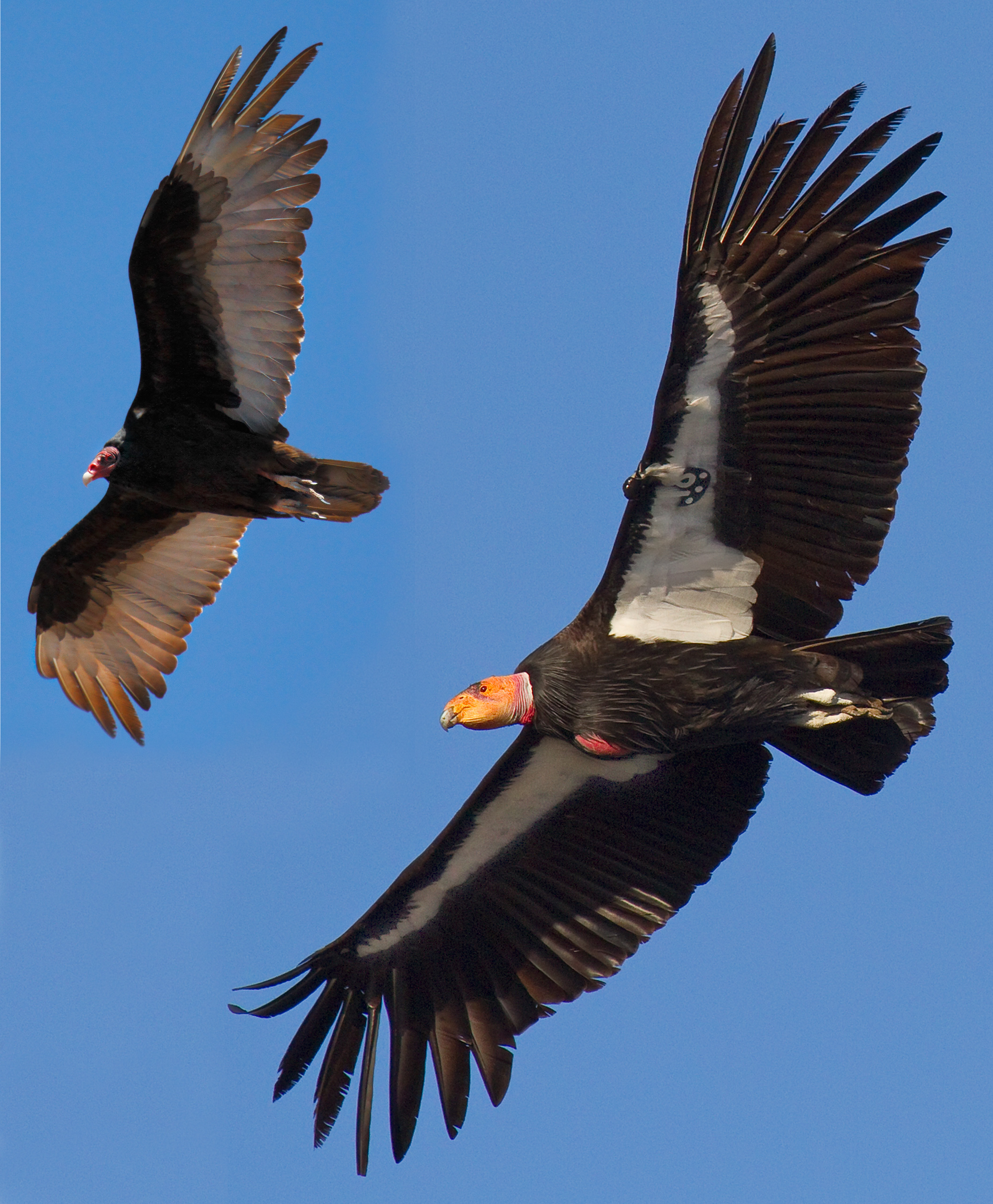
But as it turns out, both men may have been right. Because while the Turkey Vulture finds food via smell, other Vultures, like the Condor and Black Vulture do not. In fact, they follow Turkey Vultures around, waiting for them to spy (smell) a feed and then swoop in to snag some offal. But it isn’t a one-sided relationship. The Turkey Vulture relies on these bigger birds to come in and rip open the tough hides of animals. They have smaller, weaker beaks that can’t cut through thick skin, so they need their buff buddies to help them access to the sweet, sweet rotting organs within. It’s a mutualistic relationship.

Condor Viewing Tips - Pinnacles National Park (U.S. National Park Service)
Turkey Vulture with California Condor

Now, I’d like to leave you with one last fun fact. If you didn’t think eating the pungent remains of rotting roadkill was gross enough, Vultures also have a delightful way of cooling themselves in hot weather. You see, birds can’t sweat. For us humans, when sweat evaporates off our skin the process cools our blood. To get the same benefit, Vultures urinate on their legs, and as the pee evaporates that cools their blood instead. It’s a process known as urohidrosis. So, I guess there is one or two downsides to being a Vulture. Unless you’re into that kind of thing … no judgment.       

18/07/2021

Design a site like this with WordPress.com
Get started