Bird 35 – Night Parrot

So after last week’s, ‘yeah we killed them all’, this week a bird that we thought was extinct but then came back!

So here’s your first fun fact, Australia is home to what is considered to be the world’s most elusive bird: the Night Parrot (Pezoporus occidentalis).

Image result for night parrot

(All parrots belong to the order Psittaciformes. Our friend the Night Parrot is a ground parrot, that’s the pezoporus part; not totally dissimilar from our old buddy the Kakapo [see Bird of the Week 18]. I told you back then we’d do the Night Parrot, well here it is).

Now, I can’t show you too many pictures of these guys, because they’re super sneaky. They were first documented by westerners in the 1860s during exploration of the Australia’s desert interior. They hide in shrubs through the day and go ranging at night, because they’re … you know … Night Parrots. Even though they are excellent flyers, they mostly stick to the ground, unlike fatty Kakapo that’s too fat to fly.

When they were first discovered they appeared to have been quite common, but then they mysteriously vanished *cue mystery music*. From 1912 to 1979 no one saw one, leading to the belief that they were extinct. Even the one found in 1979 was a dead. It was a decapitated body found near a barb wire fence, the theory being it flew at the fence so fast it took its head clean off. The head was never found *cue more mystery music, with ominous undertone*.

In 1989 everyone’s favourite purveyor of peanut butter, Dick Smith, offered a $25,000 reward for anyone who could find evidence they were still alive. One year later some ornithologists happened on another dead one by complete coincidence, (they hadn’t been trying to find it, they’d just stopped to take a roadside toilet break). There were a few unsubstantiated sightings, but because they look really similar to the closely related Ground Parrot (Pezoporus wallicus), most sightings were false alarms.
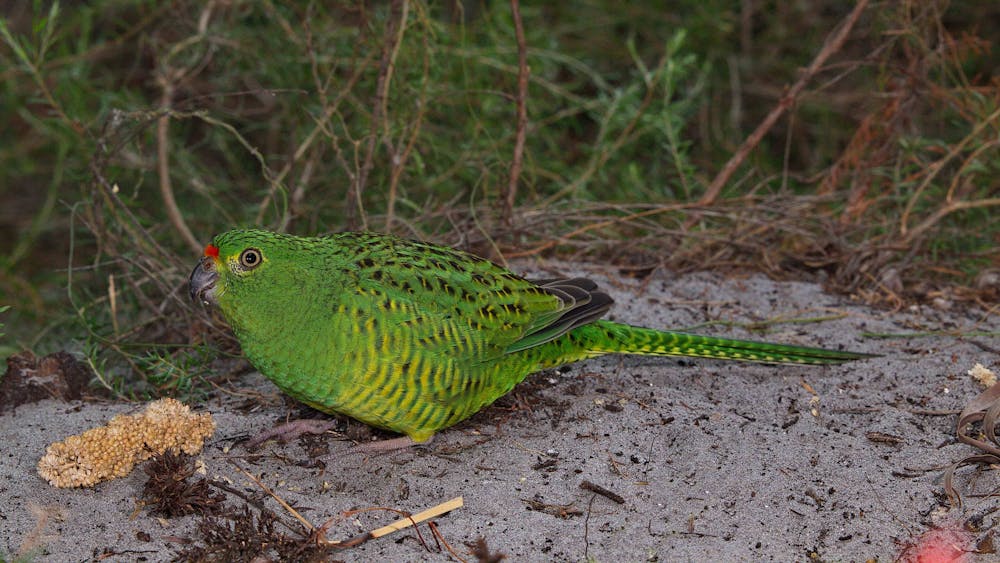
Image result for ground parrot
Ground Parrot. They have a red patch above their beak, but otherwise look almost identical.

It wasn’t until 2013 that the first live one was caught on camera, the photograph John Young said it took him 15 years of searching to track it down.

Image result for night parrot

So … it’s kinda like a fat budgy.

Since then, there have been more sightings, nests have been found,* they’ve even captured and tagged one.

But it is a fun fact that there are currently more people who have walked on the moon then there are people who have seen a live Night Parrot. 

Image result for night parrot

No one actually knowns how many are out there, estimates range from 30-200 with some even speculating that there could be many more, they’re just ace hiders, what with their camouflage and loathing of the sunlight.

Either way, there are a lot of efforts underway to conserve them: 56,000 hectares of land in Queensland has been bought by the government to protect their habitat, but the exact location of this protected area isn’t publicly available. So there is a 56,000 hectare national park in the middle of Australia, and almost no one knows where it is *mystery music*. 

Image result for night parrot

Keep on flyin little buddy.

23/07/2018

*2019 update. It was later reported that many of John Young’s subsequent claims were faked, such as the nesting site. These revelations came as a blow to the science community. Nevertheless, the Night Parrot was legitimately rediscovered and conservation work is underway to protect it.

Bird 34 – Passenger Pigeon

Annnnnnnnnnnnnnnnd the Pigeons are back.

But this week we have a story to tell and it’s about the Passenger Pigeon (Ectopistes migratorius). (Pigeons and doves belong to their own taxonomical order, Columbiformes, which have a lot of unique features [see Bird of the Week 06]. Also, fun fact, just like Crows and Ravens, there’s no technical difference between a Pigeon and a Dove.)

But the Passenger Pigeon:

Image result for passenger pigeon

In 1800 it was estimated that the Passenger was the most common bird in the world, with a population thought to have been around 5 billion. They would form into massive flocks, said to be so dense they would literally block out the sun. They were super nomadic and were constantly on the move to find food and nesting grounds. Hence the name Passenger, from the French passant, passing by. These large numbers were their defence against predators. Anything that wanted to kill them would be completely overwhelmed. It’s a tactic called predator satiation – just be so numerous that nothing can eat all of you. It was a tactic that worked super well, right up until 1914, when they became extinct after the last one died in captivity. What happened to these little guys? One guess. That’s right, it was us. The deadliest predator of all.

But why did we do it? Because apparently they were 1) super tasty, and 2) super easy to kill. Because they formed in such thick flocks, one only had to point a gun vaguely at the sky, shoot indiscriminately, and it was easy to bring down dozens in seconds. Some trappers, would also use birds they had caught, blinded and tied to stools as decoys to lure in other pigeons to kill. Fun fact, this is where the term stool pigeon comes from.

Image result for passenger pigeon

It wasn’t taken seriously that a bird which was so numerous could be driven to extinction. The last mass nesting site was found in 1878; over a five month period 50,000 birds were killed a day (that’s around 7,500,000 total). After that they were only found sporadically here and there. And when found … generally killed anyway. They must have been so tasty.

The last Passenger Pigeon was a female called Martha. She lived alone in Cincinnati Zoo for six years where she became famous as the Passenger endling. As she got older she became slower and lethargic, so visitors would throw sand at her to make her move. When she died she was stuffed and to this day is on display the Smithsonian National Museum of National History. Four years later, the last known Carolina Parakeet was to die in the same cage, but that’s a bird for another week.  

Related image
Martha while alive

The extinction of the Passenger Pigeon did lead to the introduction of a number of conservation laws in the US which are believed to have saved other animals that were at risk of dying out. So maybe not all bad. But still pretty bad.

Hurray for uplifting Bird of the Week!

16/07/2018

Bird 33 – New Caledonian Crow

No bird on Monday! Worry not, they didn’t go far – the birds never go far.

This week, we’re talking Crows, but not just any Crow, oh no. The New Caledonian Crow – Corvus moneduloides (I’m going to start include the taxonomy because I’ve been getting into that. Corvus means that it’s a member of the Crow and Raven family [fun fact, there is no technical difference between a Crow and a Raven, there are 45 different species world-wide and it’s a bit arbitrary as to whether it’s called a Crow or Raven. General rule of thumb, though, Raven’s tend to be bigger]. Corvus birds are members of the order Passeriforms, a group which accounts for half of all birds worldwide, and they are known as being the “perching birds”).

Image result for new caledonian crow
Look at how well it perches there, classic Passerifrom.

Now the thing you need to know about the New Caledonian Crow is that it is super smart, actually one of the smartest animals we know about. Even though it’s got a small brain, what is actually important for intelligence is the brain to body size ratio. For this Crow it has a ratio that is similar to that of a chimpanzee, so really they’re more like flying monkey’s than anything else.

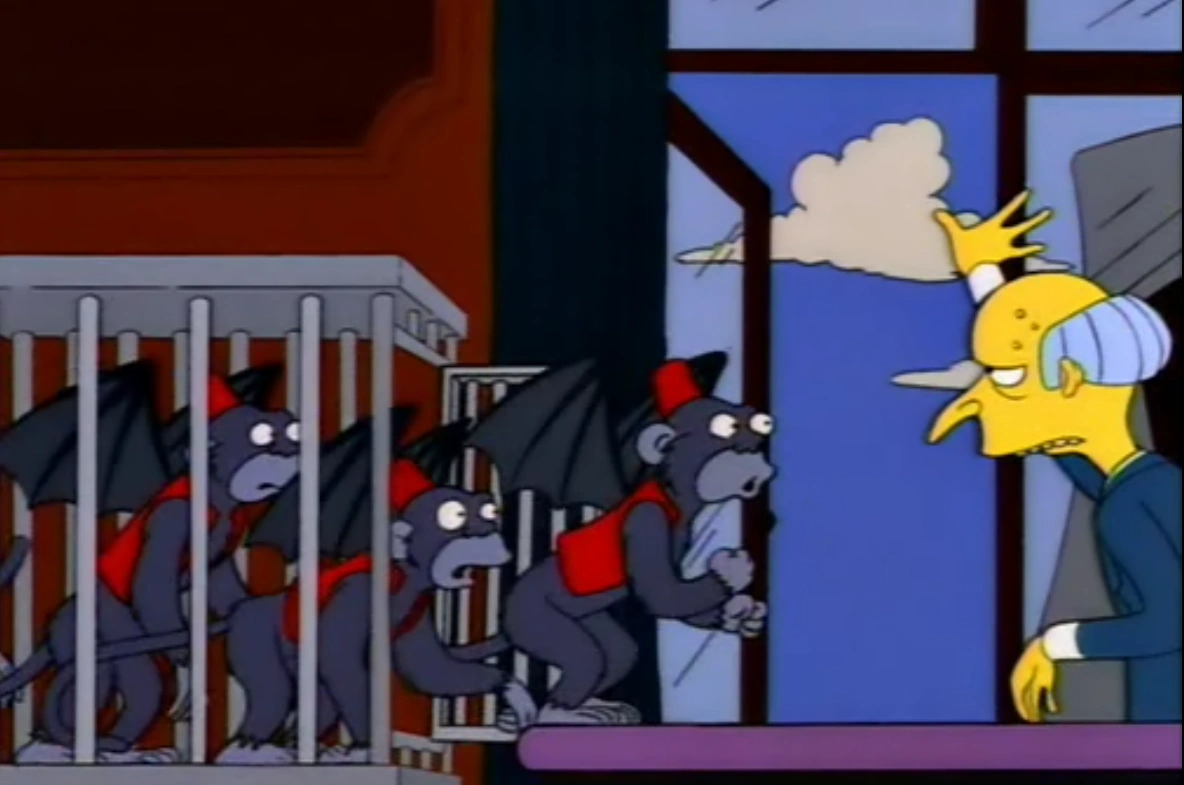
Image result for fly my pretties burns
Fly my pretties!

So what can they do? They use tools; for example they can learn to use sticks to extract food from crevices.

Image result for new caledonian crow

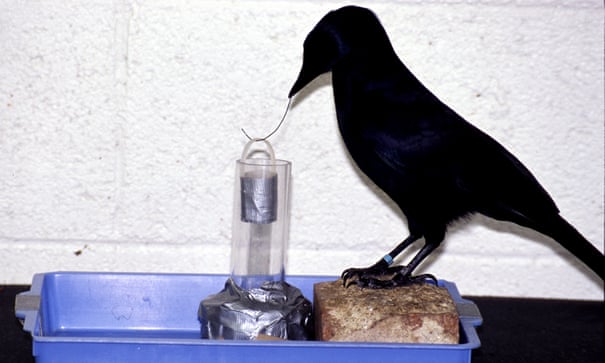
They can learn to use rocks to change water levels in tubes to make food float up to them.

Image result for new caledonian crow

They can also solve problems that take more than one tool, eg, they’ll be given a short stick that can’t reach their food, but it can reach a longer stick, so first they use the short stick to get the long stick, then get the food. They’re also one of the only animals that manufactures tools. They can twist and bend sticks into hooks so they can left things out of holes. Pretty neat!

Image result for new caledonian crow

They’re also one of the few animals that can learn by observation: if one Crow watches another bird solve a problem that it’s never seen before it can then perform the same task. Even more freaky, the birds also seem to display a theory of mind, which is the ability to attribute mental states onto others and recognise that another person has different knowledge and experiences. Children tend to develop this around age 4.

Let me explain how this one works. These Crows have a habit of hiding food in little caches. So one Crow will spy on another to work out where its cache is and then raid it when the coast is clear. However, if the Crow with the cache realises it’s being watched it will act in a way to imply its cache is in one place, when really it is hidden somewhere else, to throw the spy Crow off the trail. Pretty sneaky, Crow.

So yep, these birds are smart, they’re organised and they definitely have murder on the mind.  

Image result for new caledonian crow

Look at those eyes, you know it’s working things out, discovering your weaknesses, plotting, so much plotting.

10/07/2018

Bird 32 – Luzon Bleeding-heart

As many of our devoted subscribers know, we like a good pigeon here at Bird of the Week, (see Bird of the Week 06 and 24). Well this week I’ve got a real beauty for you.

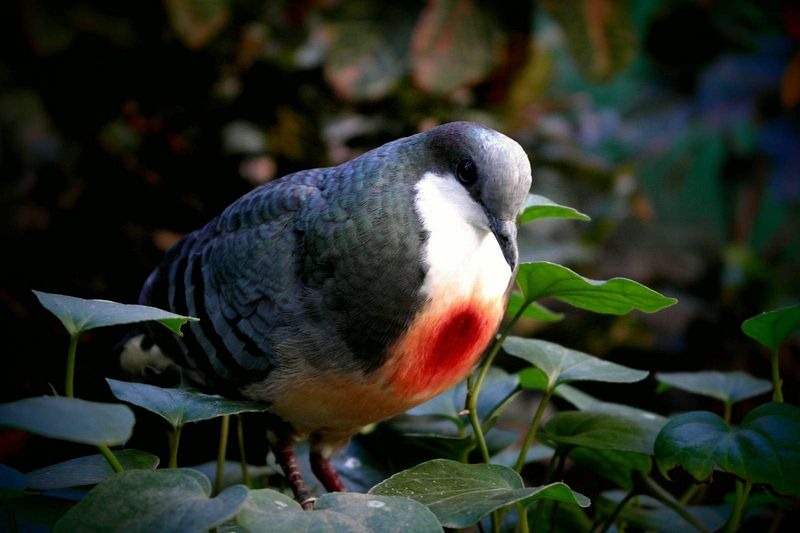
Say hello to the Luzon Bleeding-heart Pigeon:

Image result for luzon bleeding heart

So named for reasons that are too obvious and numerous to point out. They are one of three types of Bleeding-heart Pigeon, but it’s hands down the best, because the bright red on its breast fades out gradually, making the bleeding illusion seem even more realistic, because that’s what the people want.

These little guys hang out in the Philippines where they forage about on the ground mostly. They’re quite shy, and like to spend their spare time pretending they’ve just been shot.

Image result for luzon bleeding heart

They are somewhat threatened in the wild, thanks to deforestation. They are also frequently trapped by people who want them for their excellent plumage.

As with all birds featured on Bird of the Week, they’re especially amazing.

I tell you though, there are a lot of really fun pigeons out there, so expect more. You’ll never know when (probably a Monday), you’ll never know where (100% your inbox), but more pigeons will be coming at you soon.

02/07/2018

Bird 31 – Vulturine Guineafowl

Now after the last two weeks I know what you’re all thinking. What would happen if you crossed a vulture with a chicken? I know it’s a thought that’s long plagued my mind. Well, wonder no longer, for today Bird of the Week answers the questions that keep you up at night. Or maybe terrifies you so much that you never sleep again …  it’s honestly hard to keep track of what my objectives are.

So, you take a chicken, you take a vulture, and wham bam what do you get? You get the Vulturine Guineafowl.

Related image

Check that freak out. It’s also super regal, with its royal blue feathers and white highlights.

So what’s this bird about? Well, it has no relation to vultures, and is only distantly related to chickens, which honestly is a bit of a let down. But we’ll get over it. They like to live on the African Savannah where they get about in gangs (see below), generally being amazing and pointedly not flying even though they totally could if they wanted to. Interestingly, their chicks start off with some head and neck feathers, but as so often happens as they grow they’re forced to conform to social convention, so they get rid of them.

Check out that gang. You know they’re up to hijinks.

Image result for vulturine guinea fowl

Until next week, this has been Bird of the Week.

25/06/2018

Bird 30 – Chicken

This week’s bird is maybe one of the most important birds you have ever come across.

The humble Chicken. Giver of eggs and sweet sweet meat.

The Domesticated Chicken, of course began life as the Red Junglefowl. Native to South East Asian, presumable its jungles.

But of course, when we domesticate an animal, we just don’t make it useful, oh no, we have to make it gaudy as all hell (see Bird of the Week 24, Fancy Pigeon). Because you better believe we also have fancy Chickens. Well … ridiculous Chickens anyway. Here’s a sample pack:

I call them the Fluffer, Tail-head, Handlebar Moustache, and Holy Shit Check Me Out!

People who know me, know I’m a big fan of the chicken. We used to have some, three Chickens named Bennie, Andthe and Jets. Jets was a trouble maker chicken, always escaping, Bennie was the stable leader of the troop, and Andthe had no personality … probably because we called it Andthe. If it’s one thing you learn living with chickens it’s that they would totally eat you if they were big enough, because woo-nelly, they’ll eat anything that will fit down their throat. They are cold blooded killers, and it is literally the only thing they care about.

Anyway, that is certainly a bird, and this has certainly been Bird of the Week.

18/06/2018

Bird 29 – Griffon Vulture

Okay people, I think we all know there’s a bird that’s been neglected by Bird of the Week for far too long. Hang on to your tail feathers, because today we’re talking about vultures. And not just any vulture, oh no, the Griffon Vulture.

Vultures are pretty special. As I’m sure you know, they like to scavenge dead things. Of course, putrid meat tends to have fun things like botulinum and anthrax hanging out in it, and yet these birds don’t seem to care. How do they do it? Why, with stomach acid ten times stronger than ours, which is super acid. Like, let’s dissolve some steal, kind of acid. 

So that’s pretty impressive. But Griffon Vultures also have a special religious role for the people of Tibet.  Now, in the high country of Tibet where the ground is hard, and resources scarce the local people have developed a type of funeral known as a sky burial. It’s a practice whereby the dead are taken up to a mountain top and offered to our old friends the Griffon Vultures. The birds are encouraged to descend upon the body, eat it, and then the remaining bones are mashed up into a pulp and fed to other animals. It’s considered a bad omen if the birds don’t finish the job, as it’s believed that’s a sign the person sinned too much in life, making their body unfit for Vulture consumption. The Vultures know if you’ve been bad or good, they’re like a real life Santa Clause, who’ll eat your body if you’ve been good… so I don’t know, do what you want with that information.

So majestic.

Let me tell you, there are some grisly pictures on the internet for Sky Burial, but I’ll let you find those yourself if ya’ll keen for that.

Just remember, the Griffon Vulture knows what you did. They’re always watching.
So be evil, and they won’t eat you.

This advice has been provided by Bird of the Week, come back next week for more life advice.

12/06/2018

Bird 28 – Anatidaephobia

It has recently been brought to my attention that there are some people in the world who do not like birds!! Even worse, some people in the world who are afraid of birds. This is a big problem and one that Bird of the Week takes very, very seriously.

So this week I would like to take time to better understand the very real, and not at all made up* condition of Anatidaephobia, as documented by noted psychiatrist** Gary Larson.

For those of you not familiar with this condition, it is the fear that at all times, somewhere, somehow a duck is watching you. Like most phobias, Anatidaephobia generally stems from a traumatic childhood event. Maybe a duck or a goose stole a loaf of bread from you when you were a child. Maybe it laid in wait under a shrub, watching, waiting for its moment before it sprung out wielding a vintage Smith & Wesson revolver, handkerchief tied around its beak in the classic duck stagecoach heist manoeuvre . How did the duck get a vintage revolver in this day age? That’s hardly the question here. All you remember is handing over the bread, which it later used to bride a gang of Grebes for the US nuclear launch codes. The ducks had heard the codes were carried around on something called a biscuit, and they wanted in on the biscuit action. And really, who can blame them?

Now, even though ducks are perfectly evolved for a life a crime:

The important thing to remember is that the action of one duck is not reflective of the duck population as a whole. Although, ducks do have a propensity for stalking people, and will watch you whenever they have a chance, the likelihood that they’re able to have eyes on you at all times is very low. Unless they’ve become organised, which they almost certainly have.

The take away point is that you’re crazy to fear our duck overlords and should comply with all their demands in a timely fashion.

Stay tuned for next week when Phobia of the Week will be looking at Luposlipaphpbia: the fear of being chased by Timberwolves while wearing socks on a newly waxed kitchen floor.

04/06/2018

*It could be a little made up.

**And sometimes cartoonist.***

***Almost certainly cartoonist.

Bird 27 – Edible-nest Swiftlet

Gosh it seems like a while since Bird of the Week last roosted in your inbox, but have no fear, the birds are never far away. They’re always waiting.

After last week’s little excursion into the strange world of edible birds, I thought we would keep the theme rolling this week with this little guy:

It’s got a really helpful name too, because it tells us exactly what part of it is edible. This is the Edible-nest Swiftlet. Now, while they do look very similar to Swallows (see Bird of the Week 21), Swifts and Swiftlets actually aren’t related to Swallows at all. That they appear similar is the result of convergent evolution, I guess their body design must just be super efficient.  But that’s all boring taxonomy; I know what you’re really here for, and it’s this:

The aforementioned edible nest. So these little guys hang out in caves in South East Asia, these caves don’t offer great nesting options, so the Swiftlet looks after itself by making its own nest, which consists of its own hardened saliva. Takes them a couple of weeks of spitting to build up a good nest on the cave wall.

Now, if you’re anything like me, when you start thinking of hardened bird saliva used for nesting purposes, you think ‘dang, I could really eat that’. And you wouldn’t be alone. The nest is harvested (sometimes commercially) for use in Bird’s Nest Soup. The nest is soaked in steaming water, and it is said to have an exquisite flavour.

The Chinese love it, because of course they do, and apparently a kilo of bird’s nest can fetch up to US$2,000, so it isn’t a bad little money spinner if you were looking to get into a new business.

If you wanted to tuck into this one yourself, import of bird’s nest to Australia is prohibited, so will have to go to the source for that one.

What a bird!

30/05/2018

Bird 26 – Ortolan Bunting

What’s this, a Bird of the Week on a Friday. What’s happening, has the world gone mad? No, I am on leave next week and I didn’t like the idea of depriving you of bird goodness for a whole week, so just pretend it’s Monday, and this little guy should hold you over until I return.

This week’s bird is the Ortolan Bunting.

Lives in Africa and Europe. Fairly nondescript little guy, pretty cute, looks kinda like a Sparrow. But don’t let that fool you, they actually have no relation to Sparrows whatsoever.

So what’s distinctive about this bird? Well, it’s less what they do, and more what people do to them.

You see in France they are something of a delicacy. And they are prepared for consumption following these steps:

  • First, place your live Ortolan in a dark cage. The constant dim light will trigger their desire to eat, and they will gorge themselves for a couple of weeks, growing nice and fat.
  • Next, once your Ortolan is sufficiently plump, take it and put it in a vat of Armagnac. This will have the double advantage of one, killing the bird, and two, marinating it.
  • Next, roast for 8 minutes.
  • Remove from oven and pluck.
  • The Ortolan is then consumed whole, head and all. The larger bones are spat into a bowl.
  • Traditionally, when eating Ortolan, one should drape a towel over one’s head.

It isn’t clear why this is the tradition, but I mean … the French, am I right. My favourite theory is because you need to shield your eyes from God for eating such a sweet little song bird after having treated it in such a monstrous way.

It was being eaten to such a degree in France that it’s population dropped so low that in 1999 a law was introduced to restrict its capture. Then in 2007 France took another step and announced that they also intended to enforce said laws, because … the French, am I right.

So… now you know about that.

Until next bird, I wish you good bird.

18/05/2018

Design a site like this with WordPress.com
Get started