Today’s bird comes to you in two parts — a story of wrong-headed intervention and then an exciting announcement. But first, let’s meet our bird, the House Sparrow (Passer domesticus).
Now, I don’t think there’s anyone reading this who hasn’t seen a House Sparrow, because these little buggers are literally everywhere. And I use the word literally in its literal sense. The House Sparrow actually has the odd distinction of being the most widespread wild bird in the world. You can find them in Australia, Asia, Africa, Europe, North and South America, but not Antarctica, so I guess I lied a little.
The original meaning of the word, domesticus meant ‘belonging to the house’, and this a reflection of this little grey and brown birds’ association with humans. For wherever we have gone the Sparrow has followed. They started out in the Middle East, where they made a living eating grass seed. The agricultural revolution proved to be as much of a boon for the Sparrow as it was for us. As our farming practices slowly spread into Asia and Europe the House Sparrow followed. But how did they get to the Americas?
Enter the hero of our piece, Eugene Schieffelin. My favourite description of Schieffelin is that he lived the American dream, in the sense that he was born rich and remained so. During the 1850s the trees of Madison Park were infested with moth larva and Schieffelin wasn’t about to have a bar of that, so he introduced 8 pairs of House Sparrows in the hope that they would solve the problem. They ate the bugs and then noticed there was a whole continent out there to populate, so they hopped to it. Of course, the Sparrow was introduced numerous times after that, which really helped them to take over, but Schieffelin is often credited (damned?) as being the first.
He was a member of an Acclimatisation Society. Their theory was that by introducing certain species from Europe to America they could improve living standards. It’s a theory that’s easy to mock today, but basically all modern food production is based on moving one plant or animal from one part of the earth to another where it might thrive and feed us all. So maybe there was something to it.
Of course, the Sparrow probably wasn’t the best thing to introduce as there are now 80 million of them in the US and they cause all sorts of damage. It’s a little reminder, though, that even when we want to do good our efforts can sometimes inadvertently cause harm. I guess the best we can do is just recognise when we have done wrong, despite our good intentions, and hope for forgiveness. Schieffelin though, was committed to introducing birds to the US. He introduced Bullfinches, Chaffinches, Nightingales and Skylarks, all of which died. But the Starling turned out to be another raging success, and today causes about a billion dollars worth of damage each year in crop destruction. So you know … don’t give up, it is possible to cause widespread ecological harm, you’ve just got to stick at it.
There is a delightful, although probably untrue, rumour that Schieffelin was attempting to introduce all the birds that Shakespeare mentioned in his plays. And the Sparrow of course features in that famous line from Hamlet, “Not a whit, we defy augury. There’s a special providence in the fall of a sparrow.” Augury was the Roman practice of trying to interpret omens from the observed behaviour of birds. Taken in full context, Hamlet rejects the idea that he can defy fate, because the unknowable consequences of the smallest act, like the fall of the Sparrow, could lead to far greater outcomes. Which kinda sounds like Shakespeare invented chaos theory.
As ubiquitous as the Sparrow is, you may have heard that in recent years their populations have collapsed. While they are in no way at threat of extinction, this has given a lot of ornithologists pause to ponder, because no-one is quite sure why this is happening. All sorts of theories have been put forward, from climate change, better grain storage and sanitation practices in cities and farms, right through to declining insect populations. What bigger story the fall of the Sparrow is telling us about our changing environment, we’re not quite yet sure, but no doubt there will be a special providence to it as well.
And now for an equally special announcement. If you’ve ever found yourself saying, gee whiz, these posts are great and all, but I wish they were longer and that someone would just speak the words to me, then you are in luck. Starting from today Bird of the Week is now available in audio form. We’re going to be sporadically releasing podcasts to bring you some longer bird stories. So, if you’d like to get the dulcet tones of yours truly into your ear holes, then click on through. The first three eps are up and waiting, and more will be coming whenever we can get around to making them. But worry not, you will be duly notified.
After watching one too many Old Spice aftershave ads this duck thought, hey, that sounds like a great strategy, I’m going to produce a distinctive scent and the ladies are going to love it. It’s actually unclear how enamoured female Musk Ducks are by their partner’s odour, but nevertheless, this duck is known for the musky smell it produces during mating season.
The other thing you’ve probably noticed is the leathery, pendulous lobe hanging from its beak. This is another feature of the males, and apparently they can even inflate it. It’s good to know that if the strong musk smell doesn’t work, they’ve always got a beak lobe as back up. It’s like I always say, when musk fails get some beak lobe.
These big ducks favour calm, deep lakes where they can dive for their dinner. For a long time, it was thought they might be flightless, but it turns out they’re just really lazy. They hate leaving the water for any reason. They’re clumsy buffoons on land, and although they can fly long distances if they have to (like if their lake dries up), they’d just really rather not. To escape most predators they dive underwater, and even to sleep, they’ll just float out into the middle of their lake to catch a couple of winks.
In the right environment they’re familiar common, we even have a couple in Canberra. And if you’d like to find one all you have to do is follow your nose.
I’ll be the first to admit that at a glance they’re a tab unassuming with their brown plumes, large beak and odd, pointy head feathers. This strange head shape is where they get their name from, Hamerkop being the Afrikaans word for hammer head. It’s thought that their closest relatives are Pelicans and Herons, but genetically, they’re kinda out there on their own. They spend most of their time wading in shallow water, hunting for small fish and anything else that might fit down their throat.
The truly remarkable thing about this bird though is the nests they make. They construct huge mounds in trees, often big enough and strong enough to support a person’s weight.
Inside they build chambers large enough for both parents and their eggs. It can take up to 14 weeks to build a nest, but they really love doing it. So much so, that even outside of the breeding season they compulsively construct nests and can build up to five a year, often without ever using them.
Other animals have been known to take advantage of their efforts. Sometimes lager owls will push the Hamerkops out of their nests. They’ve also been known to share their nest with other animals like snakes, lizards and small mammals. Because people have sometimes seen a Hamerkop enter its nest and a different creature exist, a folklore sprung up that they were shape-shifters, able to take any form.
The Kalahari Bushmen also believe they’re the manifestation of a magical creature known as the lightning bird. The story goes that if you harm their nest, you will be struck down by lightning. Some myths also say they’re vampiric and can take human form to drink people’s blood. Others associate them with witches and say that they’re a familiar. Strangely enough the Hamerkop does perform its own odd ritual. Up to ten birds will gather into a circle and run rings around each other, flutter their wings and jumping on each other’s back. No-one is quite sure why they do this… Maybe it has something to do with forming bonds prior to mating, but we really don’t know.
The thing I love about Hummingbirds is that they have such impossibly cute little names that I wouldn’t blame you for thinking they came straight out of a fairy tale. The Horned Sungem (Heliactin bilophus) is no exception.
Far from being an exception, if anything, they’re the rule. Check out this cute critter’s sun-gemmed horns. Like most Hummingbirds, they live their life in South America, flying from flower to flower, sucking down nectar and spreading pollen about. But as cute as these little devils are, and they are cute, Hummingbirds live life in the fast lane. They flap their wings so fast them hum, and beat their hearts so fast you’d think they were fibrillating (fun fact, Hummingbirds actually have the largest heart relative to body size of any animal).
So how do they keep up the tempo? For Hummingbirds, it’s all about getting that next nectar hit. As you can imagine, their metabolism is off the charts; they’ve basically evolved to live on pure sugar. And even though the sweet stuff packs a powerful punch, they also burn through it almost as fast as they eat it. To get by Hummingbirds have developed a whole raft of adaptations to help them find flowers.
This includes everything from being itsy-bitsy, having an ace memory, possessing intensive aeronautical prowess, to being … well … kinda agro. Hummingbirds aren’t afraid of confrontation. They would seriously stab you through the heart if given half a chance, and they’ve got the beak to do it too.
But of course, the story of how Hummingbirds became what they are is far too grand a tale to be contained in a single post. That’s why I’ve gone away and done a deep dive on these little glitter balls of the jungle. If you’d like to learn everything you could possible ever want to know about them hummers, then join me over here, and let the journey begin.
From the remote reaches of Alaska, to the thick jungles of the Amazon, there is a family of birds so tiny they’re sometimes mistaken for moths. We know them as Hummingbirds: so named because of their indecisive nature.
Huummmm … The flowers are identical, just pick one.
They also flap their wings so fast they hum. There are over 300 species, each more diminutive than the last. They’re delicate and delightful and have impossibly cute names like sungem and woodstar. Their unusual manner of flight and jaw-dropping beauty has intrigued and enchanted people for hundreds, if not thousands, of years. But don’t let those things fool you: Hummingbirds are twigged out junkies who would knife you in a back-alley if given half a chance. They’re on a 24/7 sugar high, and just like a dragon that jealously guards its golden horde, Hummingbirds will breath fire and death on anyone who even thinks about looking at their pretty, pretty flowers.
So, what are we dealing with here? Well … there is no other way to begin than to say that they are utterly unique. They belong to the order Apodiformes (the name means ‘without feet’ for reasons that will become apparent). The only other birds that belong to this order are, in a surprise twist, Swifts. So, even their closest relatives bear no real resemblance to them. Their next closest relatives are the Owlet-nightjars … and, holy hell, they look nothing at all like them. So yeah, Hummingbirds are out there on their own.
Meet the relatives. Yeah … Hummingbirds are kinda a thing unto themselves.
Their most distinctive feature by far is their bizarre method of flight. It’s a common piece of trivia that they’re the only birds capable of flying backwards. But that’s only the tip of the iceberg when it comes to their aeronautical prowess. Not only can they fly backwards, by they can hover perfectly in place, and even fly upside down if they want to, because hey, why not?
It ain’t no thing.
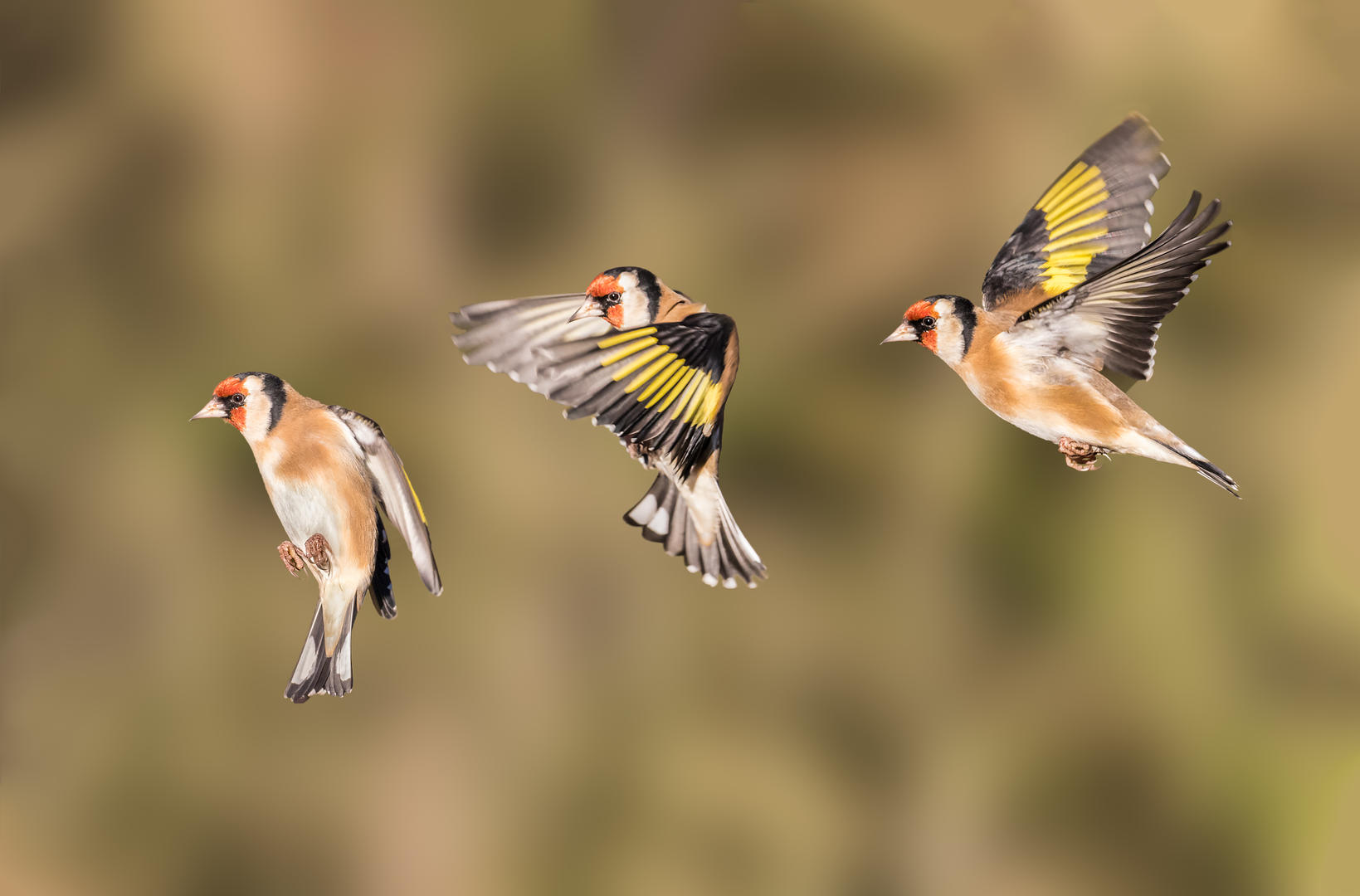
So how do they manage that? Well, it isn’t just because they can flap their wings mighty fast. Although, they do flap their wings mighty fast. Up to 30 or 40 times a second. But that ain’t the half of it. When other birds fly, they flap their wings down to generate lift. They then tuck them into their side, pull them back up and flap again. See below:
See how this Finch tucks its wings in at intervals as it flaps.
Doing this, most every other bird is only capable of generating lift on the downstroke. But a Hummingbird don’t do that. Hummingbirds oscillate their wings about their shoulder and don’t tuck their wings in, instead keeping them outstretched at all times. By doing this, Hummingbirds generate lift on both their forward and backward stroke and it is this feature that gives them their amazing, aerial, acrobatic abilities. Only their closest relatives, the Swifts, flap their wings in a similar way, and I don’t know if you’ve noticed, but Swifts are pretty swift as well.
Notice how their wings are always held out straight.
Now, nothing in nature happens by accident… Actually, that’s a lie, almost everything in nature happens by accident. But nothing will stick around unless it provides some sort of evolutionary advantage (or at the very least isn’t a disadvantage). For Hummingbirds everything comes down to nectar. Now, I don’t know if you’re taking notes at home, but you should probably italicise that last bit: everything comes down to nectar. It’s their primary food source, and without their humdinger wings they’d have no way to get it.
But wait, we’re getting ahead of ourselves. Let’s jump across the pond for a moment and visit Africa. We won’t find any Hummingbirds here, but we will find another bejewelled beauty that relies on nectar, the Sunbird. Superficially at least, these bright birds bear a striking resemblance to our South American friends. they have long curved beaks, bold iridescent plumes and long slender tails.
In part, this is because they have similar feeding habits. They are all about that sugar hit. But Sunbirds don’t hum. They don’t hum because they don’t have to. That’s because in Africa the flowers are more cooperative. They grow in such a way that a bird can perch next to them and drink their fill before moving on to the next bloom. The flowers in South America aren’t so accommodating. They have an annoying habit of growing tall, having long tubes (corolla is the technical term but I’m going to keep calling them flower tubes) and hanging out in the middle of empty space. Essentially, there isn’t anywhere for a bird to alight while it drinks. If you want to get to that nectar, you’re going to have to do it while being airborne, and the only way you can drink while you’re flying is if you can master the hover. Hummingbirds wanted that sugar, so Hummingbirds mastered the hover.
Nowhere to land to get that flower.
Now, the next problem our birds had to overcome is the fact that while nectar may pack a massive, knock-your-socks-off, energy punch, it also burns really fast. If your heart is beating at a thousand times a minute, you’re probably having a panic attack, unless you’re a Hummingbird, in which case it’s par for the course. But if you’re doing that and beating your wings 40 times a second … you may not be transferring any of that energy to weight. As such, Hummingbirds burn through energy as fast as they eat it. And so, they have had to make some extreme decisions. They live right on the edge of what’s possible. It’s exactly this sort of fast-paced living that has lead them to become the smallest birds. The Bee Hummingbird weighs just 2.6 grams. Here’s one sitting on a penny so you can get an idea of just how hard it is for them to open a bank account.
These little guys have had to strip everything back. Like a boat in a high speed chase that has to lighten the load, they’ve thrown everything they don’t need overboard. They even tossed out the ability to walk. Their leg bones are fused together, meaning they can only perch and kinda shuffle awkwardly. This is where that ‘Apodiformes’ (feetless) name came from. They also have to feed constantly. Because they run so fast and hot, they have the highest metabolic rate of any animal, and if they can’t get a hit of the sauce at least once every 15 minutes they drop dead from starvation. If we humans had the same metabolism we’d have to drink the equivalent of a can of Coke every minute… So I guess you could say they’re motivated feeders.
That does raise a rather interesting question, though. How do these tiny buggers sleep if they have to feed so frequently? Well, Hummingbirds don’t so much sleep, as they go into a kind of coma every night called a torpor. It’s pretty hardcore. It’s like a temporary hibernation. They basically shut their body down. Their heart rate grinds to a halt, their breathing reduces, and they let their body temperature fall to match the ambient air around them. Once in this state, they are incapable of responding to any external stimulus. Their little legs lock into place to keep them from falling off their perch. When the morning comes, it takes them about 20 minutes to warm up before they can start their day. And you know the second they do get going they’re straight back on the sauce, I mean, sugar. They go to these extreme lengths all to conserve as much energy as possible and make it through the night without starving to death.
What all of this means is that the Hummingbird has an incredibly intimate relationship with its food. And I don’t mean it has sex with it, get your mind out of the gutter. Although … actually it kinda does, more on that later. But for the moment, no, this has more to do with the fact that if they aren’t chugging down nectar like a frat boy with a yard ale glass they tend to turn up dead. Physiologically, they’ve made a lot of evolutionary changes to guarantee they can always find their food.
Maybe one of their most impressive, but least flashy, feats is their memory. A Hummingbird can not only remember the location of every flower in its territory, but it can also remember how long it’s been since it last visited. This means our little friends can plan out their day, and make sure they visit every flower at the right time to ensure there is always a tasty treat on offer. This is called trap-line feeding. To us humans, that may not seem extraordinary. But, this behaviour means Hummingbirds have what is known as an ‘episodic memory’. This is a type of memory that relates to location, and how events are sequenced temporally.
It’s like if I asked you to recount your day from dawn to dusk. That’s episodic memory, and without it, our Hummingbird couldn’t plan out their day, knowing how long it had been since they last visited any particular flower. But so what, you say? Well, for a long time, it was believed only we humans possessed the ability to form episodic memories. It wasn’t until 2006 that we came to recognise that Hummingbirds do it as well. This is part of a much broader point about intelligence in birds that I’m not going to go into right now. But just remember: birds = smarts.
Now, that’s the nicest thing that can be said about Hummingbirds and their sugar addiction. Everything else I’m about to say really only goes to how argo these jerks can be. But let’s begin with their most appealing feature: their pretty, pretty feathers.
Undoubtedly you would have noticed that Hummingbirds are drop dead, I’m-like-a-disco-ball sparkly. They’re covered in iridescent feathers that catch, reflect and refract light in just about any hue or shade you could possible want. Some are decked out tail to beak in vibrant feathers, while others have gorgets about their neck. Think of them as tiny built in ascots.
As is the case with many birds, the females tend to employ a less flamboyant tailor. Usually the reason for this revolves around sexual selection. The females will only mate with the prettiest male, and so the males will use whatever assets they have to woe the ladies. This is true of Hummingbirds, and we will come back to it. But right now, I want to talk about the other thing Hummingbirds use their beauty for: war.
Because this is life and death stuff. Hummingbirds need to lock down their flowers and keep them safe. So, males will establish a territory and guard their favourite flowers greedily. They use their ornamental feathers as a warning sign, flashing them at any who dares trespass, to let them know that these flowers are spoken for and they better move along if they know what’s good for them.
Hummingbirds doing battle.
By controlling a food source, it also acts as bait for the ladies. A male with a large territory and the best blossoms will bring all the girls to the yard. And when you’re a Hummingbird every day is ladies day, because the females get to drink for free, while rival males are shown to the door. It’s that age old adage: in America, first you get the flowers, then you get the power, then you get the women.
Of course, sometimes a bold ascot isn’t enough to deter a would-be thief. In these cases, Hummingbirds aren’t above getting physical to protect what’s theirs. For the most part, their long beaks are used to probe into the deepest recesses of flowers to extract the nectar. But, they can also come in handy for jousting. They will fly at their rival and attempt to skewer them. They will grab them by the scruff of their neck, pull their feathers and throw them about. For such tiny, adorable birds, they can be incredibly violent.
Have at thee!
Some even take it to a whole other level. Allow me to introduce the Tooth-billed Hummingbird. The name says it all: their beaks are equipped with hooked spurs that they use in battle.
Several species have a similar adaptation, including the Saw-billed Hummingbird and the Sparkling Violet-ear Hummingbird. Going down this evolutionary path has meant they’ve had to give up optimal efficiency when feeding, because these beaks don’t have the perfect design for extracting nectar. But they are better able to defend their patch. So don’t let a Hummingbird fool you, they may look like bejewelled mini fairies, but they are psycho junkies that will take you down if you look at them funny.
Okay, so you’ve locked down your food source, well done. The next step is to find a mate. And here, for the males, this is where their fancy feathers come into play again. Their bright plumes may work to ward off other males, but they also work to attract the ladies. Some males even go to extreme lengths. I mean … are you surprised, nothing about these birds so far has said mild and chilled.
Meet the Marvellous Spatuletail … well, the name says it all. They have a marvellous tail, shaped like a spatula.
The males use their fancy ornamentation to woe their partners, flying around them in a dazzling display of prowess. For a little bird that has to use most of its energy in the mission to acquire food, this is quite a feat. The longer they can maintain a display, the greater testament it is to their worth as partner. Costa’s Hummingbirds, which have royal purple and flared gorgets also perform displays where they rotate their bodies side to side while keeping their heads still, and the females will make them do it for as long as they can before agreeing to mate.
The males deliberately orientate themselves so the females get a full hit of their dazzlingly feathers.
Other Hummingbirds use different displays. Male Ruby-throated Hummingbirds will fly up high into the sky and then dive down over the female’s head. As he makes his final approach he will open out his tail feathers and as the air rushes over them it will emit a tiny squeak. Apparently, the squeak is a vital part of the display, and if they don’t get the tail squeak just right the female won’t be impressed. They’re hush judges, but they have to be.
You see, there is a general rule of thumb when it comes to birds: the greater the difference in appearance between males and females, the less chance there is that the male will have anything to do with raising the chicks. This is no different for Hummingbirds. Once the male has done the deed, he will bugger off, and the female will be left to make the nest, incubate, hatch and feed the chicks all by herself. She starts by making the most adorable little nest you ever did see. She uses soft moss and lichen and stitches it all together with spider silk. They have spongey floors and elastic sides, and can even stretch as the babies grow. Which is a good thing, because these wee nests start out awful small.
The females really do have it rough, though. In order to incubate the eggs they will avoid going into torpor during the night to keep the eggs warm. And when they finally do hatch, for the first several days the chicks aren’t capable of regulating their own body temperature. So the female is torn between having to go out and find food for the chicks (and herself) while also not being able to stay away for too long, less they freeze to death. Meanwhile, the male is presumably off chasing more tail. I don’t know how the lady hummers manage to raise any living chicks when they’re already living on the edge of what’s possible, but somehow they do.
But if you thought that was the last insane thing our tiny birds had to do, well think again, because I haven’t even told you about migration. That’s right, these birds are also migratory … to the extreme!
This probably comes as a bit of a surprise. I don’t think many people would look at a Hummingbird and say, oh yeah totally, I bet these tiny birds do long distance flying. But it does kinda make sense. Once again, it all comes back to the flowers and how reliant they are on having a 24/7 food source. If the flowers ain’t blooming our birds are going to have to move to where they are. For some species that live in the Amazon, this isn’t a problem, because all year round there is a constant supply. But Hummingbirds live all the way up to Alaska, and I don’t know if you’ve noticed, but Alaska isn’t exactly famous for its winter wild flowers.
And so, many Hummingbirds that make the northern half of the Americas their home will undertake a yearly migration, from breeding grounds in the north to feeding grounds in the south. Anna’s Hummingbird, the Rufous Hummingbird and the Black-chinned Hummingbird all make annual pilgrimages from Mexico to the United States. But there is one species who’s migration path is especially astounding: the Ruby-throated Hummingbird.
These little guys spend the winter in Mexico, Central America and the southern tip of Florida. But when the summer comes they hightail it up to the east coast of the United States and can even make it as far as Canada. But this isn’t the incredible thing. What makes their migration truly mind blowing is the route they take. Many of these tiny hummers opt to strike our across the Gulf of Mexico. Nearly 1,000Km of open ocean, and they do it in one non-stop 20-hour flight. For an animal that usually can’t go more than fifteen minutes without needing to feed, this shouldn’t be possible. Yet, each year, without fail, hundreds of them make the perilous journey.
To pull the trip off, in the months leading up to the journey they will pack on the kilos … well, I guess in their case it’s more a matter of packing on the grams. Either way, they double their weight ahead of the journey. They will burn all of their extra fat in that one flight, and when they finally do make landfall, you better believe the first thing on their mind is getting their grub on.
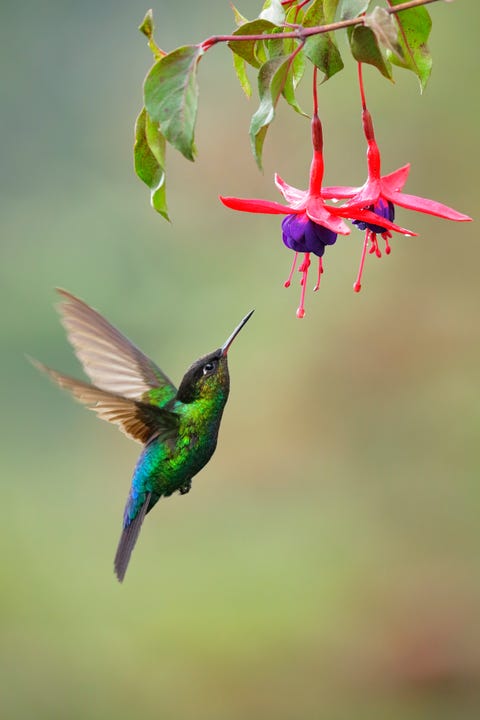
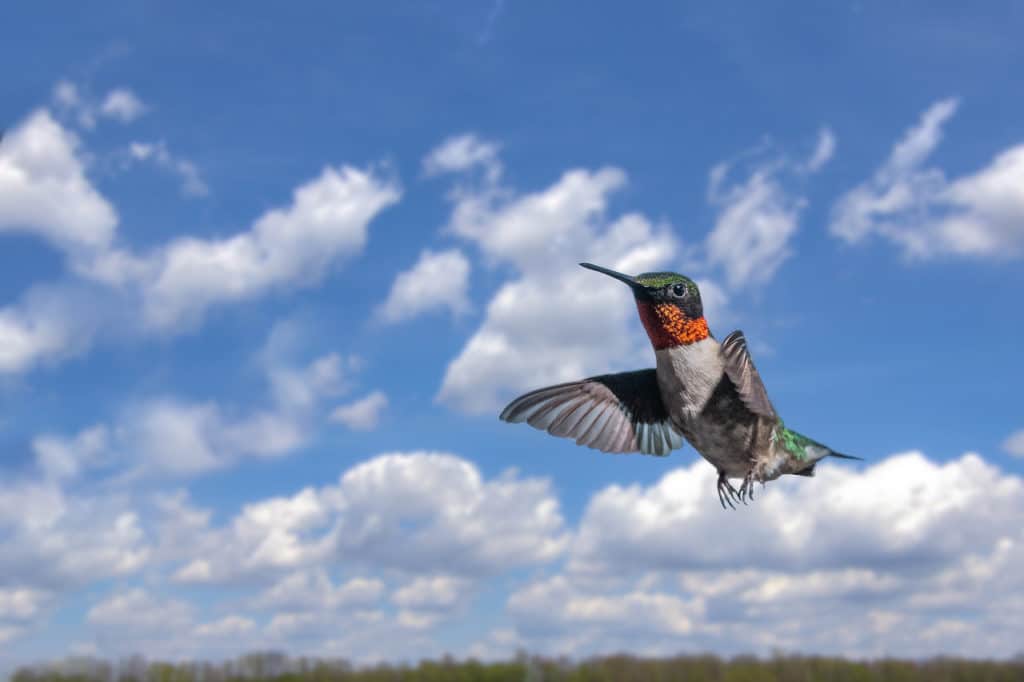
By now you should be suitably convinced that flowers dominate every aspect of a Hummingbird’s life. But it goes so much deeper than that. The flowers have in effect been the driving evolutionary force that has made the Hummingbird into the creatures they are today. The flowers and the birds have an intimate mutualistic relationship and rely on each other for survival. The birds need to eat, and the flowers need pollinators. Many flowers have evolved in such a way, that as the Hummingbird pushes its face into the blossom to get the nectar it will get pollen deposited on its head, which it will then pass on to the next flower it visits. It’s a kinda circle of life type thing.
Notice above how the flower’s stamen is touching the Hummingbird’s head.
I’ve already mentioned how Hummingbirds changed their bodies physically to allow for an all nectar life-style, but for some spices they take it yet another step further. You see, flowers can be diabolical. For an ordinary plant, relying on Hummingbird pollinators, they are running a small risk. There is a chance that after visiting their flower, the Hummingbird may move onto a plant of a different species, and if that happens, their pollen is wasted. So, some sneaky flowers have found a way around this. Essentially, they have forced a couple of species to evolve in such a way that they have become trapped and are only able to feed off a few select plants.
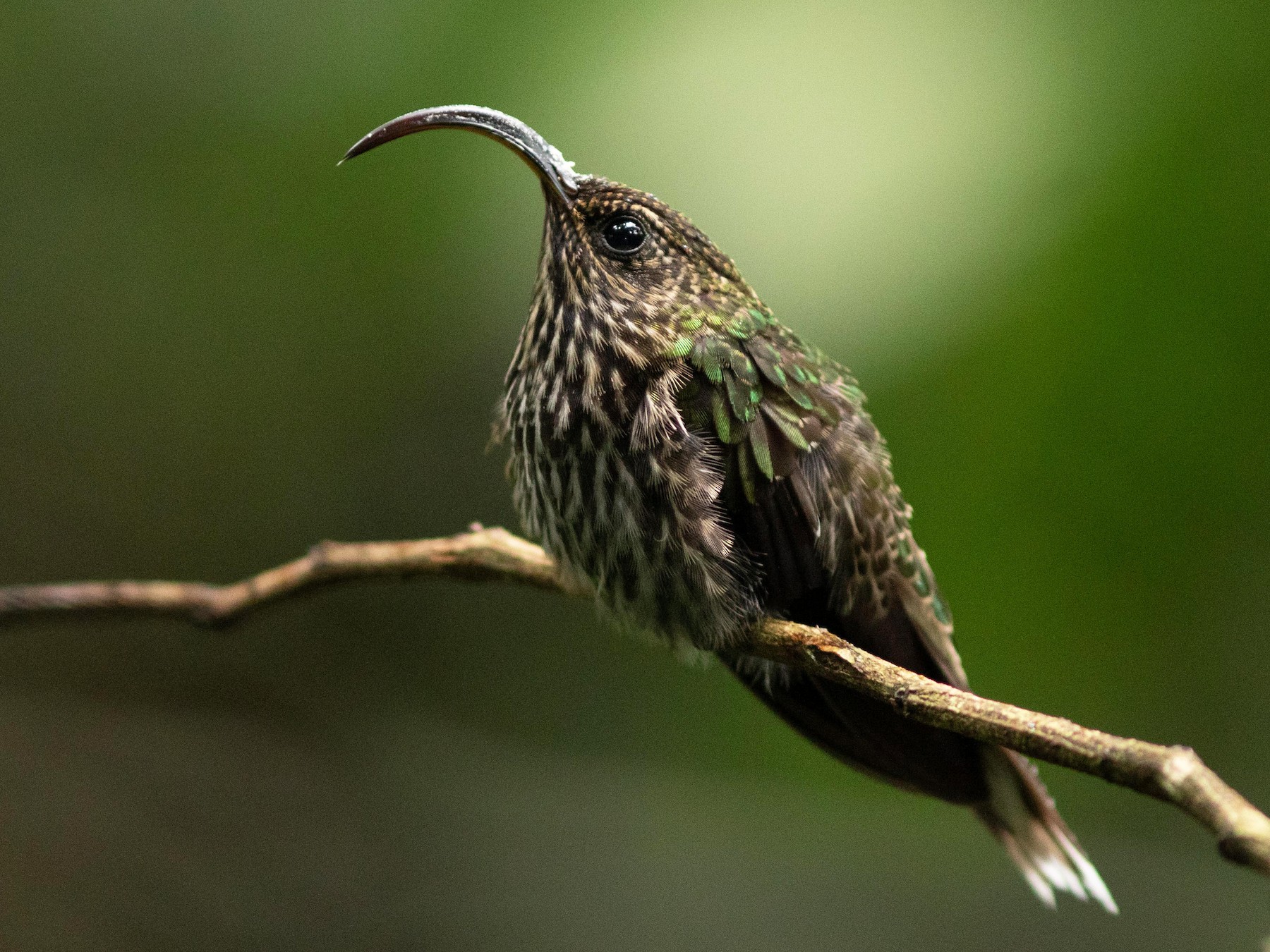
Meet the Sicklebill Hummingbird.
These are a rather large, Peruvian species. But I’m sure you’ve noticed its most distinguished feature, that sickle-shaped bill. These aggressively downturned beaks evolved specifically so they could feed on select species of flower from the genus Centropogon. Their flowers have curved tubes that need to be navigated before anyone can reach the nectar.
And so, our little hummers evolved a beak to match. While that beak is quite handy for getting at these harder to reached honey pots, it isn’t as useful with other flowers. In this way the Centropogons can be assured that when someone comes to take their nectar and pollen they are only going to pollinate the right flower. In one sense, the Sicklebill is trapped as this flower’s exclusive pollinator, but in another sense it does get exclusive access to nectar no-one else can get.
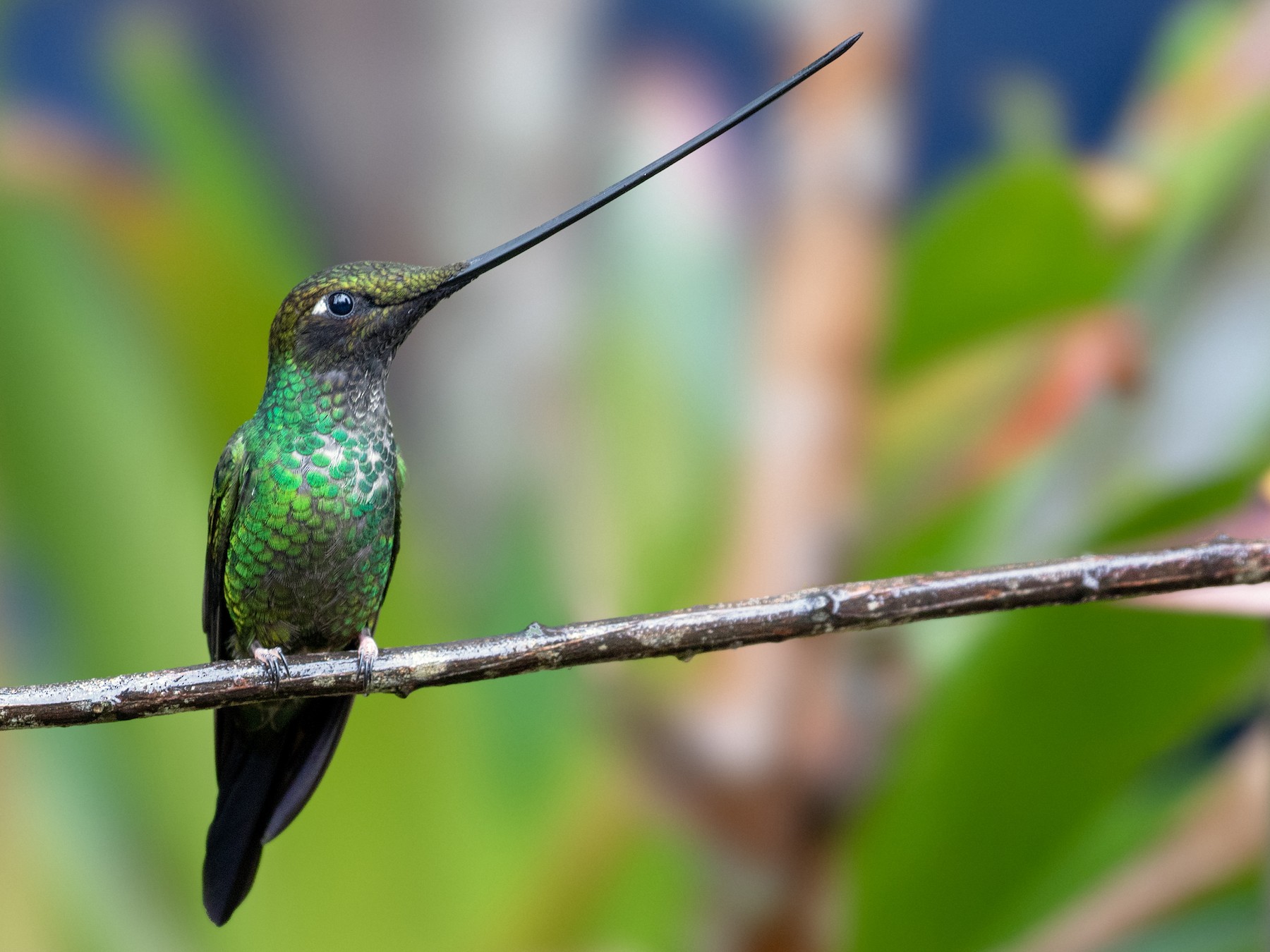
But there is one Hummingbird that has taken this strategy to the extreme. This is the Sword-billed Hummingbird, a bird with a beak longer than the rest of its body. The Sword-bill actually holds the record for the bird with the biggest beak relative to body size. It is as impressive as it is ridiculous.
Just like the Sicklebill, the Sword-bill went down this evolutionary road so it could feed on flowers with exceptionally long tubes, in this case the Passiflora mixta. Now, in exactly the same way, our flower gets and exclusive pollinator, and our hummer gets an exclusive food source, so win-win, right. Well, kinda, but there are some draw backs to have a bill that long. For starters, the Sword-bill can’t groom itself like a normal bird, so it had to work out a way to keep its feathers neat using only its feet. And the bill is so heavy and oversized that whenever they perch they have to keep their bill lifted up, otherwise they’ll overbalance and fall of their branch. So … it kinda sucks having a beak that big. But somehow the Sword-bill makes it work.
For me, what this highlights once again, is just how reliant these guys are on the flowers, in some cases, very specific flowers. If they were to lose these species it would likely spell their doom. And for many Hummingbirds, they’re already clinging to the edged of extinction. Cute little fellows like the Gorgeted Puffleg, The Dusky Starfrontlet and the Juan Frenandez Firecrown.
Firecrown male on the left, female on the right.
The Firecrown is quite the extraordinary bird, for while Hummingbird males and females are usually quite different, typically the female is just a less ornamented version of the male. Not so for the Firecrown, because the female is just as dazzlingly as the male albeit in completely different clothes. But these tiny guys are under threat of extinction because of land clearing on the only island they call home.
If you’ve got a spare penny or two and would like to help protect these tiny jewelled marvels, Oikonos is working to protect the Firecrowns island habitat, and of course the American Bird Conservancy is always collecting and doing great work to save Hummingbirds everywhere.
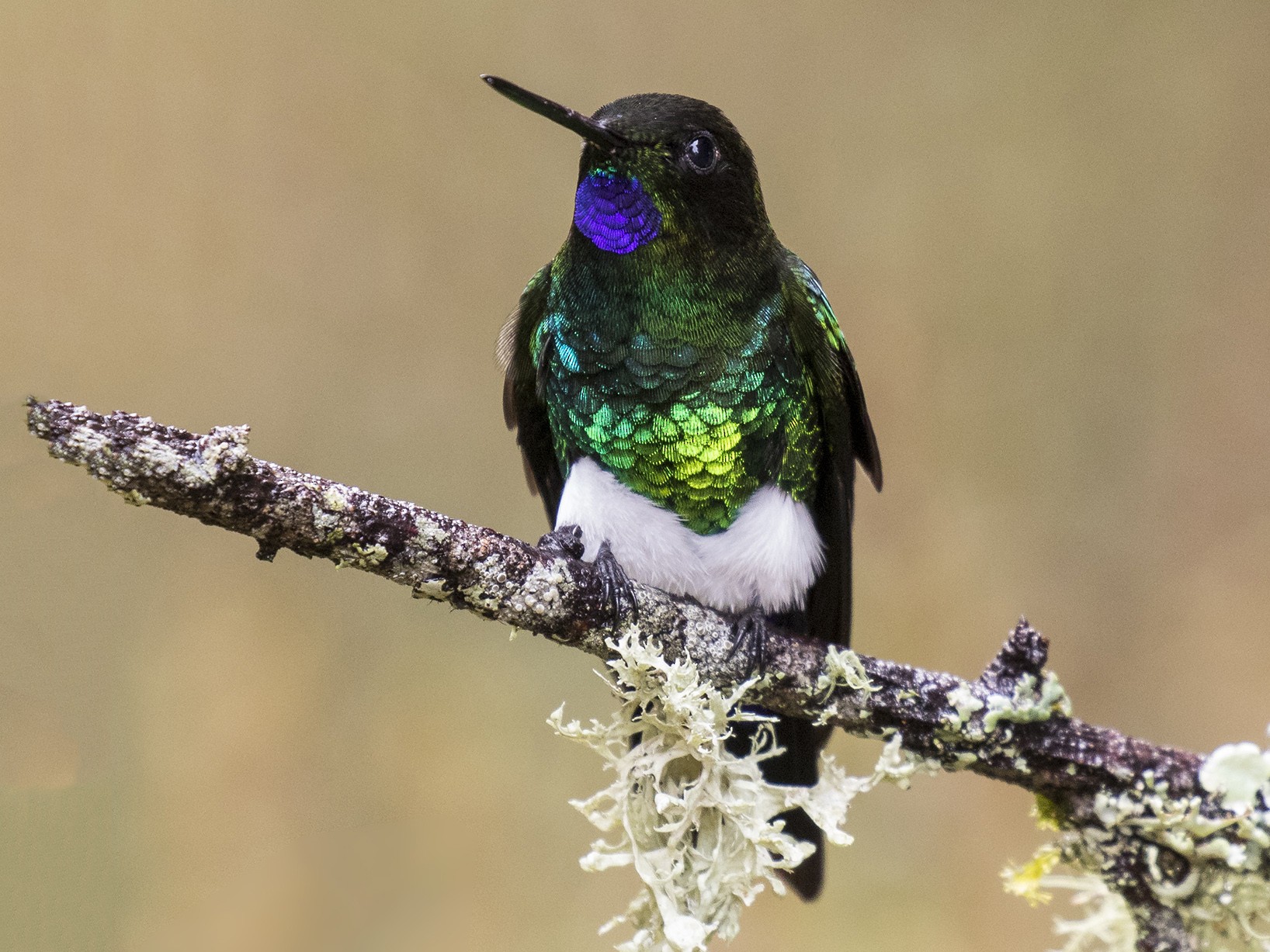
These are incredible creatures, and maybe the most remarkable thing is that we’re still finding new species. In only 2017 a never before seen species, the Blue-throated Hillstar was discovered high in the Ecuadorian mountains.
How can you hear that name and not want to protect this little Hillstar
These pint-sized fellows may be feisty, fighty, sugar junkie pyschos, but they still need our help. They took an aggressively left turn when it came to evolution, but they worked out a way to live on the edge of what’s possible. I mean, if you don’t believe that Hummingbirds made a lot of crazy evolutionary choices in order to get to the nectar, than look no further than the Rusty Flowerpiercer. They’re a bird that wanted to get at the sweet nectar, but they saw what the Hummingbirds were doing and decided that seemed like a bit much. So, they came up with a strategy where they just poke a hole in the base of a flower and steal the nectar. I don’t know how the Hummingbirds feel about that…
Freeloader!
But for my money, they are adorable, extreme little nymphs that live life in the fast lane; they are glittered up to the max, will stab you as soon as look at you, and I love them to pieces.
As many long-time subscribers will know, I’m a big fan of pigeons. I mean … they’re beautiful perfect creatures, and I don’t know why anyone would ever think any different.
Majestic
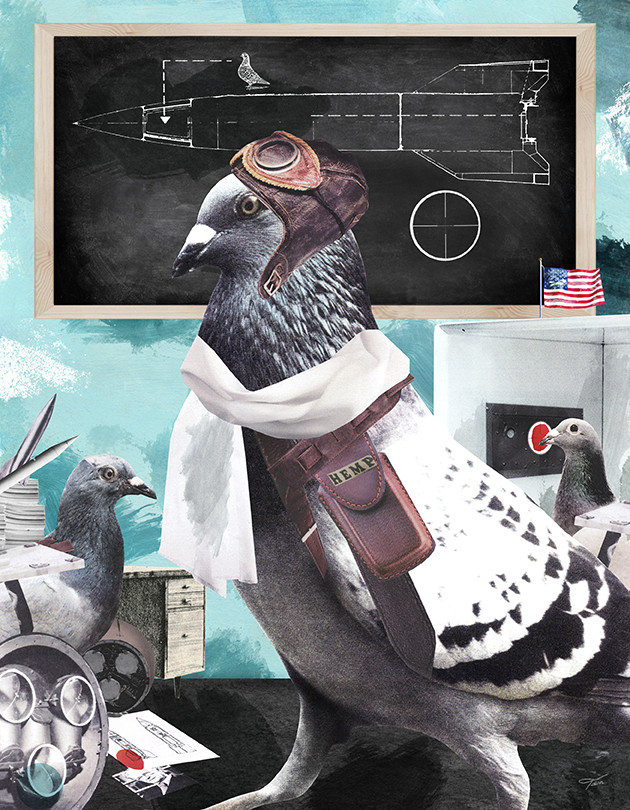
Well, today I want to bring you the story of Project Pigeon. Picture this: it’s the 1940s and war is raging. The US Air Force had a problem on their hands: they needed to develop a guidance system for their bombs. After all, having something that blows up is a very fine thing, but it’s a much finer thing if it also blows up on the enemy.
Enter world-renown behavioural psychologist and pigeon fancier, B. F. Skinner. He kicked down the door to the Pentagon, slammed a pigeon on the table and said, ‘guys, I can totally train these birds to pilot a missile.’
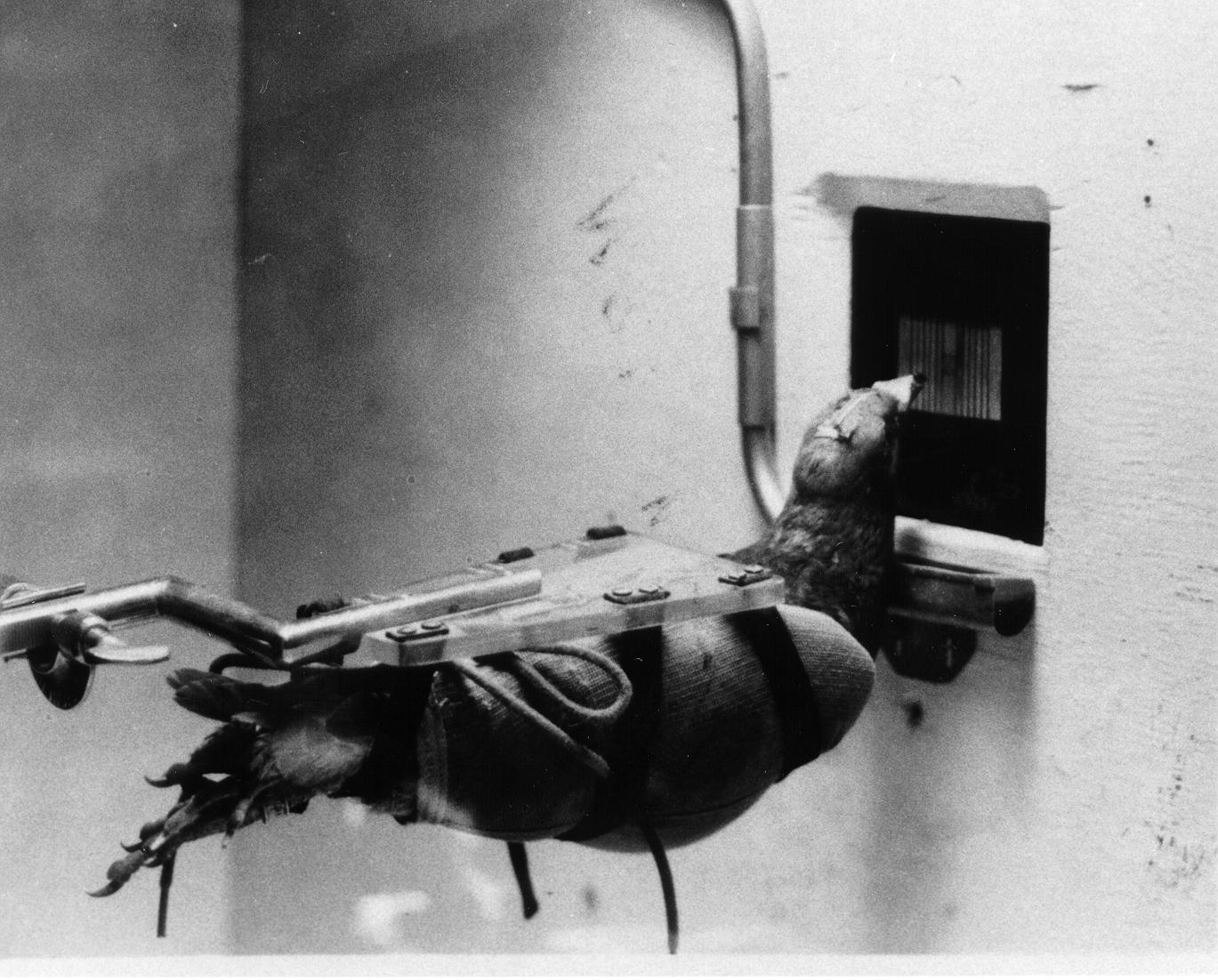
Naturally, no-one took him seriously. But undeterred Skinner stole away into a corner to work on his hairbrained scheme. Here’s the deal. He trained the pigeons to peck at a screen displaying a battleship.
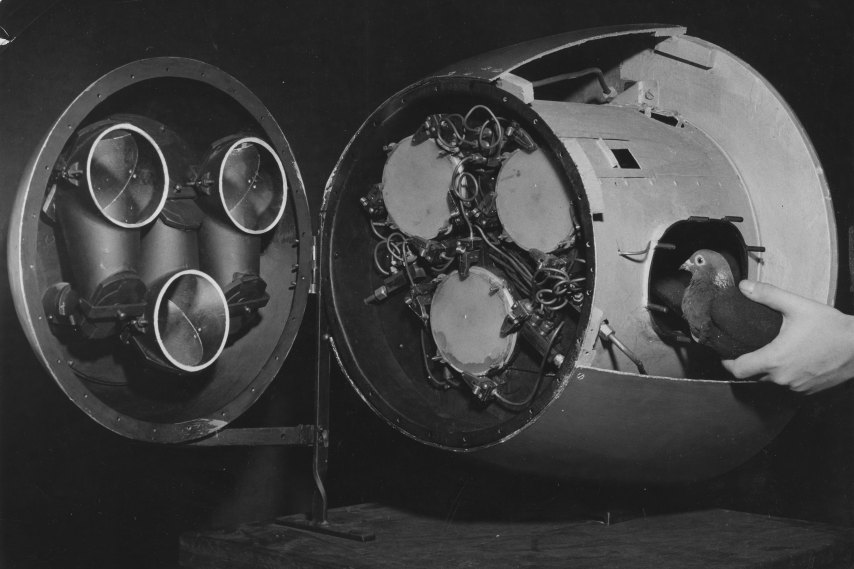
He then had a missile made up with a little compartment in the front that a pigeon could sit in. Once launched the pigeon would peck at a hinged screen displaying the target, and this in effect would guide the missile straight to it, where it would then explode. I understand there was no ejection button for the pigeons to press before they blew up along with the bomb…
It was an insane idea. But Skinner actually pulled it off and managed to show that the pigeon piloted missile would work. Thankfully, the top brass continued to not take the idea seriously and the avian weapons were never deployed. The project finally got shelved for good in the 1950s once it was shown that electronic guidance systems worked better than birds.
But I mean seriously, you look at this thing and tell me it isn’t the obvious choice to make.
Birds aren’t real. For the last 181 weeks I have been feeding you lies, drawing you deeper and deeper into the conspiracy of birds to keep you away from the truth. And what is that truth? I hope you’re ready for this.
Every bird was destroyed by the American government between 1959 and 1971 and replaced with surveillance drones to keep a closer eye on all of you. The pigeon is a lie!
I was employed by the CIA to help spread their misinformation and further pull the wool over your eyes. But I can no longer in good conscious mislead you.
Where do you think birds go when they migrate? What’s more likely? That nature compels them to fly thousands of kilometres for food or whatever? No, they’re returning to bunkers under the corn fields of Nebraska for annual maintenance.
That duck that followed you for three weeks, it wasn’t your imagination, there was a duck that followed you for three weeks. It knows your PIN and your email login. And if you didn’t notice that duck, then I have news for you… there was a duck that followed you for three weeks.
Now that I’ve exposed the conspiracy it is only a matter of time before I’ll be taken down by a flock of fairy wren lookalikes. They’re the assassin drones. You’d think they’d use something like an eagle to do their killings, wouldn’t you, but no. You get enough fairy wren drones in one place and nothing can stop them.
Do you think nature could come up with anything that cute on its own? Birds aren’t real! Wake up, people, you’re living in a dream world.
One of the great regrets of living in Australia is that there aren’t enough birds. It is impossible for us to enjoy some of the common but brilliant birds of the northern hemisphere. And there is none more brilliant than the Northern Cardinal (Cardinalis cardinalis).
Famously, they’re the only bird who gets a vote to elect a new Pope. Actually, that’s a lie, the Vermilion Cardinal also gets equal representation in the college of cardinals, and crucially, as a South American bird, held the necessary swing vote that got Pope Francis over the line. But we don’t need to dig into the complicated religious leanings of birds, lest we cause another schism.
The Northern Cardinals stay true to their name and inhabit the northern latitudes of the Americas and can be found from Canada down into Mexico. These are an especially handsome bird, sporting flame red feathers and a distinguished crest. Cardinals use a fancy piece of chemistry to produce their red feathers. Their diet doesn’t naturally contain red pigment, but they have a special enzyme in their body that can convert the yellow pigments they do eat into a red one. Sometimes males are born with a genetic mutation that loses this enzyme, causing them to stay yellow.
Cardinals are one of only a handful of songbirds that don’t migrate during the winter. It makes them a great favourite for backyard birders, as their bright plumage delivers maximum impact when set against an otherwise wintery-white backdrop.
Cardinals are also territorial and will perch high on exposed tree limbs to sing their songs, ward off competing birds and maintain their home range. Combine this behaviour with their already eye-catching appearance and you’ve got one of the most conspicuous birds getting around. But let’s be honest, if you were this incredibly good looking, you’d make sure everyone knew about it, too.
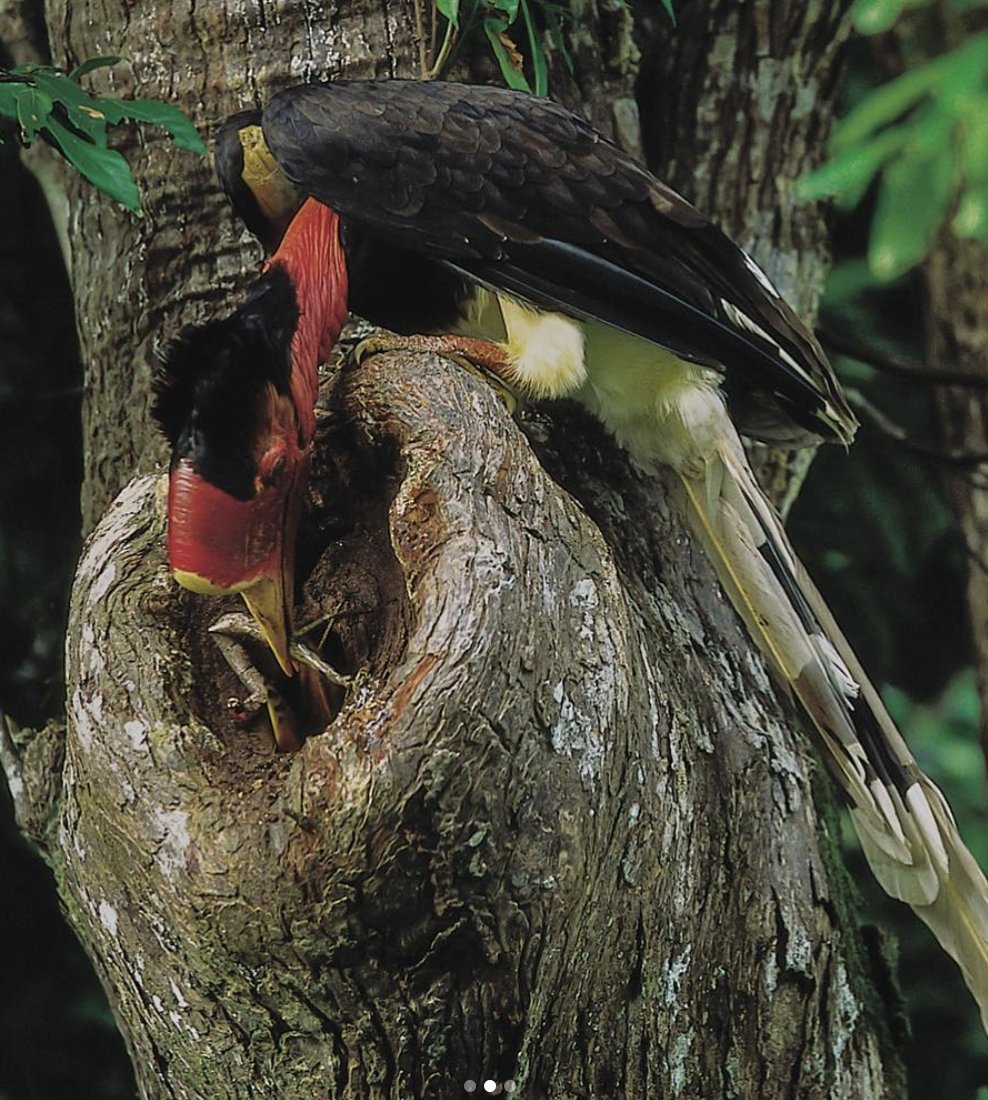
There are many freaky birds flappin’ about out there, but maybe none more so than the Helmeted Hornbill (Rhinoplax vigil).
I mean … look at that face. Need I say more?
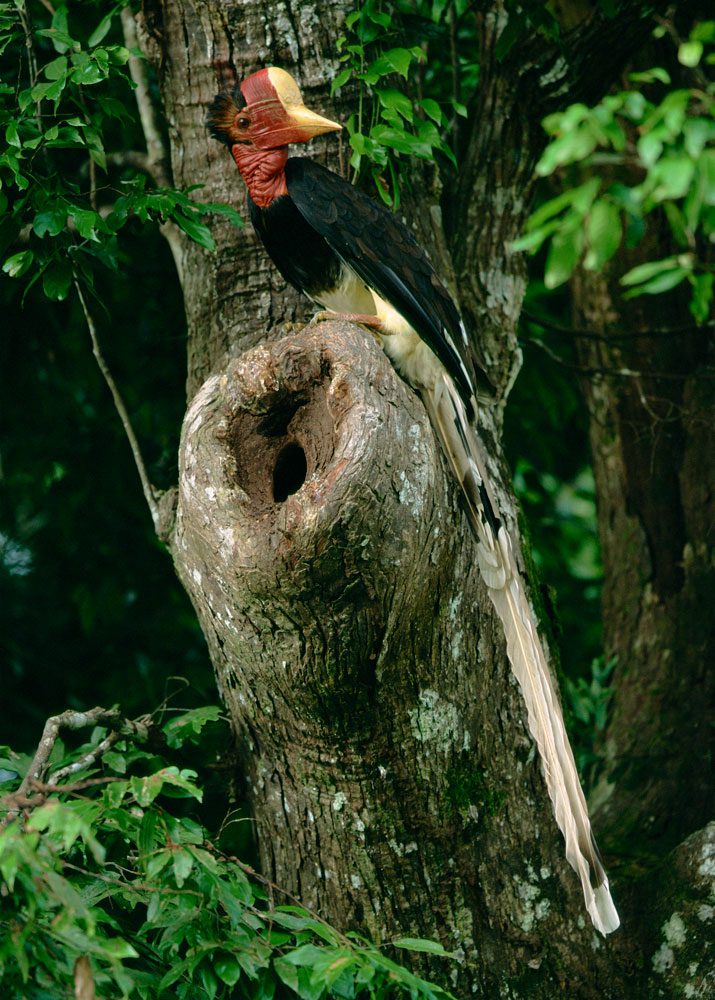
These giant birds of the jungle live in Malaysia and the islands of Sumatra and Borneo. You’ve probably noticed their most distinguishing feature, that big old horn … or helmet? (It’s actually a casque, so really neither of those things). That head gear is quite unique, for although there are other Hornbills getting around in Africa and Asia, they’re the only ones whose horn (casque) is solid the whole way through. Other Hornbills have a hollow casque which they use as a kind of resonance chamber, to make their calls louder. But not our guys; they use their horn for dramatic aerial combat. The males fly at each other, crashing heads, as they fight over the best fruit trees.
The Helmeted Hornbill also has a freaky nest building strategy. They favour high hollows, some 30 metres off the ground. Once they find a suitable location, the female seals herself inside using regurgitated food, mud and faeces … so only the finest building material. Locked inside her new home, the female lays a single egg, and she won’t come out again until the chick is ready to fledge. The process means she’s inside a tree hollow for about six months. And you thought our lockdown was bad. At least your front door wasn’t made outta poop.
They leave a small opening in the hollow, just big enough for the male to pass food to her and the new baby. It’s a whole thing.
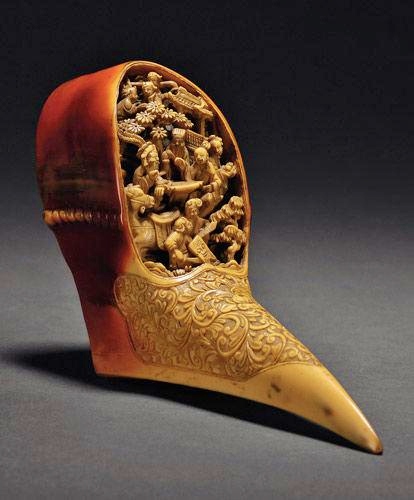
Sadly, the Helmeted Hornbill is at critical threat of extinction. For hundreds of years the local peoples hunted these birds for their unique casques. The Hornbill ivory would be carved into all sorts of intricate and beautiful figures.
Also known as Red Ivory
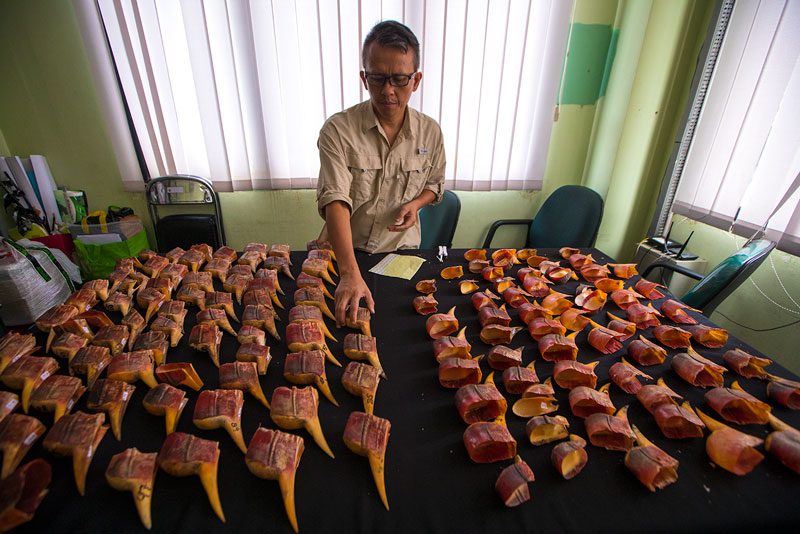
These sculptures have recently gained attention in China, and now there is high demand for this new luxury item and status symbol. Between 2010 and 2017 over 2,000 casques were seized by customs officials, and it’s believed this was only a tiny fraction of the true slaughter going on.
To make matters worse, because of their odd breeding strategy, if a male is taken while the female is sealed inside a tree it can mean starvation and death for both her and the baby too.
Helmeted Hornbills are now listed as Critically Endangered (one step above extinct) and major efforts are now in place to try and protect the few remaining in the wild. Birdlife International has a major action plan in place, so hopefully this bizarre but wonderful bird can be saved.
Strangely enough, this isn’t even the only bird killed for jewellery. The show-stoppingly beautiful Nicobar Pigeon is also killed for its stomach gizzard. Truly, this is a odd world we live in.
I had a different bird planned for this week, but then something exciting crossed my radar and I had to drop everything to bring you this good news story. But first, this is a Laysan Albatross (Phoebastria immutabills).
These giant birds of the sea live in the northern Pacific Ocean. They spend almost all their time on the open water, hunting squid and other cephalopod type things. When they do come to land, they choose the Hawaiian Islands as their breeding ground of choice. The former US naval base on the Midway Atoll is one of their go to places. Millions flock to the semi-abandoned base each year to make their nests and raise their young. Street view pictures of Midway are always entertaining because it is completely overrun by Albatrosses.
But I said I had good news. A Laysan Albatross named Wisdom is one of the world’s most famed birds. This grand old lady was first banded on Midway way back in 1956. At the time, she was conservatively estimated to be 5 years old. Since then, she has returned every year or two to raise another chick, and on the 1st of February this year she hatched her latest baby at the venerable age of 70.
Wisdom with Wisdomlet
John Klavitter/U. S. Fish and Wildlife Service
Wisdom is the oldest wild bird we know of, and she’s been making headlines for over a decade now. Each year, the birding community is always on edge, waiting to see if she will return. So far, she always has.
Laysan Albatrosses mate for life. Wisdom’s current mate is chap named Akeakamai, but over her lifetime she’s had to find several new partners because she keeps outliving them. She’s kind of a cougar.
She even outlived the scientist who first banded her, Chandler Robbins who died in 2017 at the age of 98.
No-one really knows how long these Albatross can live for. No-one knows if Wisdom is an outlier freak who keeps trucking, or if getting to the age of 70 is just par for the course. Either way, she has beaten a lot of odds. Albatrosses face constant threats thanks to all the plastic in the ocean which they mistakenly take for food. Midway Atoll is also a bad place to raise chicks, as the old buildings are covered in flacking lead paint which kills the babies if they eat it. Somehow, Wisdom keeps dodging these bullets, so she really has earned her name.









:max_bytes(150000):strip_icc()/hummer-pollen-58a6d2b05f9b58a3c90885df.jpg)







 Bird of the Week