If you want to set a haunting scene, nothing does the trick like the mournful, solitary hoot of an owl emanating from an all-consuming darkness. As we continue our tour of spooky birds, not only do we have an owl, but we have the creepiest owl getting around, the Stygian Owl (Asio stygius).
Stygian is a fun little word that refers to the River Styx from Greek mythology, the watery boundary between the world of the living and the world of the dead. Naturally, these Owls were the companion of Charon, helping to ferry souls across the river to the underworld. Or … the word could just refer to their dark plumage, but hey, who’s keeping track?
Personally, I like to think they have a connection to the underworld. With ear tuffs that look like devil horns, and golden eyes that have a habit of flashing bright red during sunsets, the Stygian Owl certainly has a demonic bearing.
I’d like to take your soul on a little boat ride.
The South American peoples certainly agree. Their name for this bird is Coruja-Diabo: the Devil’s Owl. And honestly, even when their pupils are fully dilated, they look like demons anyway, so take your pick.
Real chat: are these guys guardians of the underworld? Like … probably not. But do you want to take that chance? I think the best course of action is to just assume that all birds are magical and show them the respect they deserve.
As we enter October we come to a special time of the year, the month of Halloween. To celebrate we’re going to have a month of spooky birds. Are there spooky birds? You bet your bottom dollar there are spooky birds, and to start us off we’re going with a classic, the Carrion Crow (Corvus corone).
If there’s a more ominous sign of desolation and death than a crow perched in a skeletal tree on a lonely country road, I haven’t heard of it. They’re an omen of death, a harbinger of doom, a handsome boy with glossy plumes… I mean … eviiilllll.
For thousands of years, and across multiple cultures, the old crow has been a sign of doom and gloom. Being decked out in black, having a taste for rotting flesh, and a less than malodourous croak for a voice certainly hasn’t help. Their penchant for eating carrion has given them an association with death, and in many mythic tales they came to be seen as a link between the physical and spiritual worlds. They’re often depicted as guides for the newly dead, showing them the way to the afterlife.
Alright rabbit, time to guide you to the afterlife. But … like … before we go. You don’t need your intestines … right? Don’t mind me, I’m just going to have a nibble.
In the Qur’an’s telling of Cain and Abel, it is said a Crow instructed Cain on how to murder and bury his brother. So, if you’re ever at a family reunion and a Crow whispers murder advice to you … probably take it. That’s a talking Crow, you better believe it knows what’s going on.
So, whether you’re a witch in need of a familiar, a hangman in want of a companion or a newly murdered sibling trying to find your way to the afterlife, why not consider a Carrion Crow. They’re smart, helpful, probably not responsible for your death, and awful pretty to boot.
To further celebrate a month a spooky birds, I have put together a little (long-ish) piece on parasitic birds. Wait, what? Parasitic birds? You heard me right, the bird world is rife with parasites, pirates, changelings, cheats and vampires. In other words, perfect Halloween companions. So, why not flap on by and check it out.
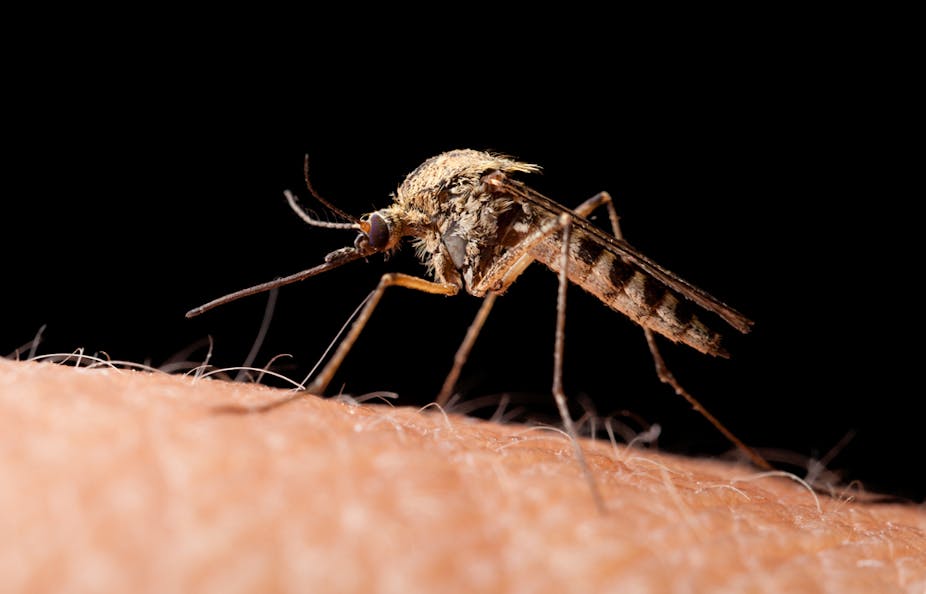
When we think of a parasite the first thing that springs to mind might be a mosquito, or a tick, or a leech. Something that latches onto you and drinks your blood; usually a tiny insect … even though ticks are arachnids and leeches are a type of worm, but never mind about that. You might even think of some sort of gross intestinal bug, like a tapeworm or a heartworm,1 or maybe even a virus.2 Something that invades the body to feed on its host without killing it. Maybe, if you really press your mind, you might think of some more exotic parasites, like wasps that lay their eggs inside living caterpillars, whose larva consume them from the inside out (although I guess they kill their host, so maybe it doesn’t count … still hardcore).
That caterpillar is not having a good day.
Any one of those creatures may come to mind when we think of parasites. But maybe the last thing we’d think of would be a bird. Birds aren’t parasitic creatures. They don’t invade the body of other animals, live off hosts, rob them of their essence while providing nothing in return. That just ain’t what birds are about.
Except, sometimes they are. They may not invade the body of other animals … but some of them do suck blood.
I’d like to take you on a little tour of a rarely visited corner of the avian world. A place of cheaters, thieves, kidnappers, vampires and changelings. Monsters from mythology maybe, but all of them represented by birds. Turns out when you go poking about in odd places nature reveals itself to be more complicated and interesting than we sometimes imagine.
What is a Parasite?
Before we begin, though, we have to figure out what a parasite is. In the simplest sense, a parasite is a creature reliant on another being for survival: its host. It causes the host harm, but usually doesn’t kill it. The ecologists E. O. Wilson once famously described a parasite as a predator that eats its prey in units of less than one. It may be a pretty lousy way to make a living, but the world is full of them, and they exist in every kingdom on the tree of life. There are parasitic bacteria, fungi, plants and animals. In fact, we know that for the majority of living beings, the parasitic way is the lifestyle of choice. And if that isn’t a depressing thought, I don’t know what is.
The mosquito is a great example of how pesky a parasite can be. These nasty little buzzers seek out an unsuspecting host to feed upon their blood. Once they have their fill they leave behind an irritating bite to let you know where they’ve been. Of course, that’s the best case scenario. In a worse case scenario they also inject some tropical disease that sickens the host, and in even worse case scenarios the disease kills the host.
Plants aren’t much better. That mistletoe you hang up at Christmas is a parasite. These plants attach to a host via a special structure called a haustorium, which penetrates into the host plant to extract water and other minerals.
At least mistletoe does its own photosynthesis, though. A species of orchid known as the Phantom Orchid evolved to lose its chlorophyll, meaning it is incapable of performing photosynthesis and so cannot feed itself. Instead, it parasitizes fungi, tricking them into feeding it for its entire life.
No green leaves means no photosynthesis. This plant parasitizes fungi.
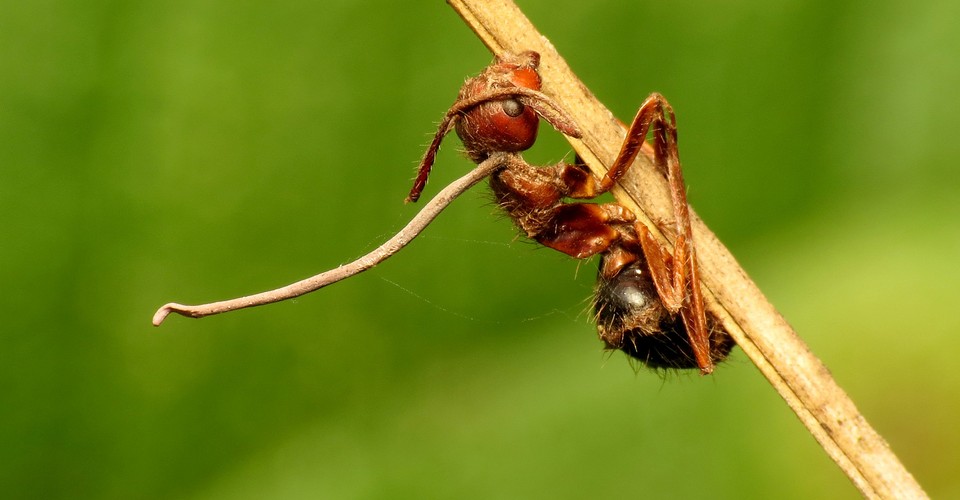
But don’t worry too much, the fungi get their own back. In the Amazon Rainforest there’s an odd species of fungi that makes a living by invading the body of ants. Once inside an ant it hijacks the poor critter’s brain, causing it to act in erratic ways. First, it compels the ant to climb a tree, then it’ll direct the ant to use its mandibles to latch onto the underside of a branch. Once firmly affixed, the ant dies. The fungi is now free to mature. It feeds off the ant’s body, and as it grows it sprouts from the back of the ant’s head, forming a long fruiting body which releases spores to the wind, starting the whole process all over again. It’s called the zombie ant fungus.
Dead ant with fungus growing out of the back of its head.
Arguably this parasite is a little more deadly for its host than many others. But it certainly isn’t alone in the sense that it can control its host’s behaviour. Some parasites compel their usually water-phobic hosts to submerge themselves. Another parasite that infects rodents will make them wildly attracted to cats. They do this because the parasite needs to be ingested by a cat, so it can mature and complete its life cycle before being passed on to the next victim through the cat’s droppings. It’s a whole awful, complex thing.
Then, there are crustaceans that live inside fish, and bite off their tongue so they can live on the stump inside the mouth, basically becoming the fish’s prosthetic tongue. And then there are barnacles that attach themselves to the underside of crabs, tricking them into caring for it as if it were the crab’s own young.
It’s all disturbing and disgusting and all behaviour that falls way outside what we would consider normal for a bird. But let’s just pause for a moment to consider the different kinds of interactions animals can have with each other. Any inter-species interaction can be thought of as occurring on a spectrum. On one side we have mutualism, where both animals benefit in some way: maybe a service or a resource gets exchanged between them – everybody wins. On the other side of the spectrum is predation, here one animal eats the other. This is a zero sum game – someone eats, someone dies. But between the two extremes are other types of interaction. There is commensalism, where one animal benefits and the other is largely unaffected. And there is parasitism, where one benefits to the detriment of the other. So before we dive into parasites, let’s take a look at some other examples of avian interactions.
Mutualism
One of the best examples of mutualism is between bees and flowers. Bees travel from blossom to blossom collecting nectar and pollen to feed their hive. In exchange, they serve as the flower’s pollinator, fertilizing their seeds so a new plant will sprout. The more fertilization, the more flowers, the more nectar, the more bees, everyone wins. It’s a virtuous cycle.
But there are birds who do the same job. You can tell Hummingbirds do this, because some of them aren’t much bigger than bees. The Bee Hummingbird being a prime example. Much like their insect counterparts, Hummingbirds rely on flowers as their chief food source, and many plants have evolved to ensure that when a bird comes to feed they will pick up a packet of pollen to take to the next blossom.
Here you can see the flower grows specially so that its pollen gets deposited on the Hummingbird’s head when it feeds.
In some examples, individual species of Hummingbird and plant co-evolved to have an exclusive mutualistic relationship. Take the Sword-billed Hummingbird and the flower Passiflora mixta.
As you can see, the Sword-bill has a ridiculously long bill. In fact, it has the longest bill as a ratio to body size of any bird. It needs it to reach the sweet nectar hidden at the base of the long tube on the Passiflora blossom.
No other bird has a beak long enough to reach this treasure trove. While the Sword-bill is lumped with an awkward appendage on the front of its face, it does gain exclusive access to a coveted food source. For the flower’s part, it gets a reliable pollinator. This also means it can avoid the risk of its pollen going to waste in instances where a bird might visit its flower and then move on to a flower of a different species. That would be a waste of pollen, but in exclusive relationships, this never happens. The two are completely reliant on each other, and it’s a win-win for both plant and bird.
Another curious partnership exists between Screech Owls and blind snakes. While blind snakes are reptiles, they’re more like an earthworm than any snake you would be familiar with. They live almost their entire lives underground, burrowing about, and as the name suggests they are indeed almost totally blind. Now traditionally, when a Screech Owl is out hunting for prey to bring back to its babies, they kill what they catch and deliver it dead. But, if they happen upon a blind snake they bring it back to the nest alive and wriggling. Now, it must be said that on occasion the chicks will eat the snake. But if they don’t, the snake will set up shop inside the nest. Once burrowed in, the snake will eat insect larvae, which if left to develop would eventually parasitize the owlet. Recent research shows that owlets who grow up in nests with a pet snake are healthier and grow quicker than owlets who are left to fend for themselves. So the owl benefits, and in this arrangement the snake also benefit by getting all the pests it can eat. Not a bad deal … you know, as long as they can avoid being eaten by accident.
As far as partnerships go, that is one of the odder, but I think it gives you an idea of what a mutualistic relationship looks like in the animal kingdom.
Commensalism
Next are the relationships where one animal benefits and the other is largely unaffected. My favourite example is between the Cattle Tyrant and the capybara. Capybara are a large type of rodent, in fact they are the largest rodents in the world. You can think of them as being like a giant Guinea pig. The Cattle Tyrant is a South American flycatcher, and despite the name, rarely terrorises cows. But they do team up with capybaras to form an unlikely duo.
The original odd couple.
Cattle Tyrants like to ride atop capybaras. As the large rodent grazes and moves about they disturb all manner of insects, and as these bugs take to the sky, the Cattle Tyrant darts about snatching them out of the air. In this relationship the Cattle Tyrant gains an easy meal and the capybara gains … nothing. But then, that’s the definition of a commensal relationship. Although, for my money, the biggest benefit is that the two look drop-dead adorable together.
But now we’re starting to get closer to a relationship that may not be so healthy. Animals can take advantage of each other in a myriad of different ways. So let’s start with some more familiar ones and work out way up from there.
Kleptoparasitism
One of the easiest ways you can cheat your opponent is to steal their resources. The bird world is rife with thievery. This is sometimes referred to as kleptoparasitism. It may be a fancy word, but it basically boils down to stealing food.
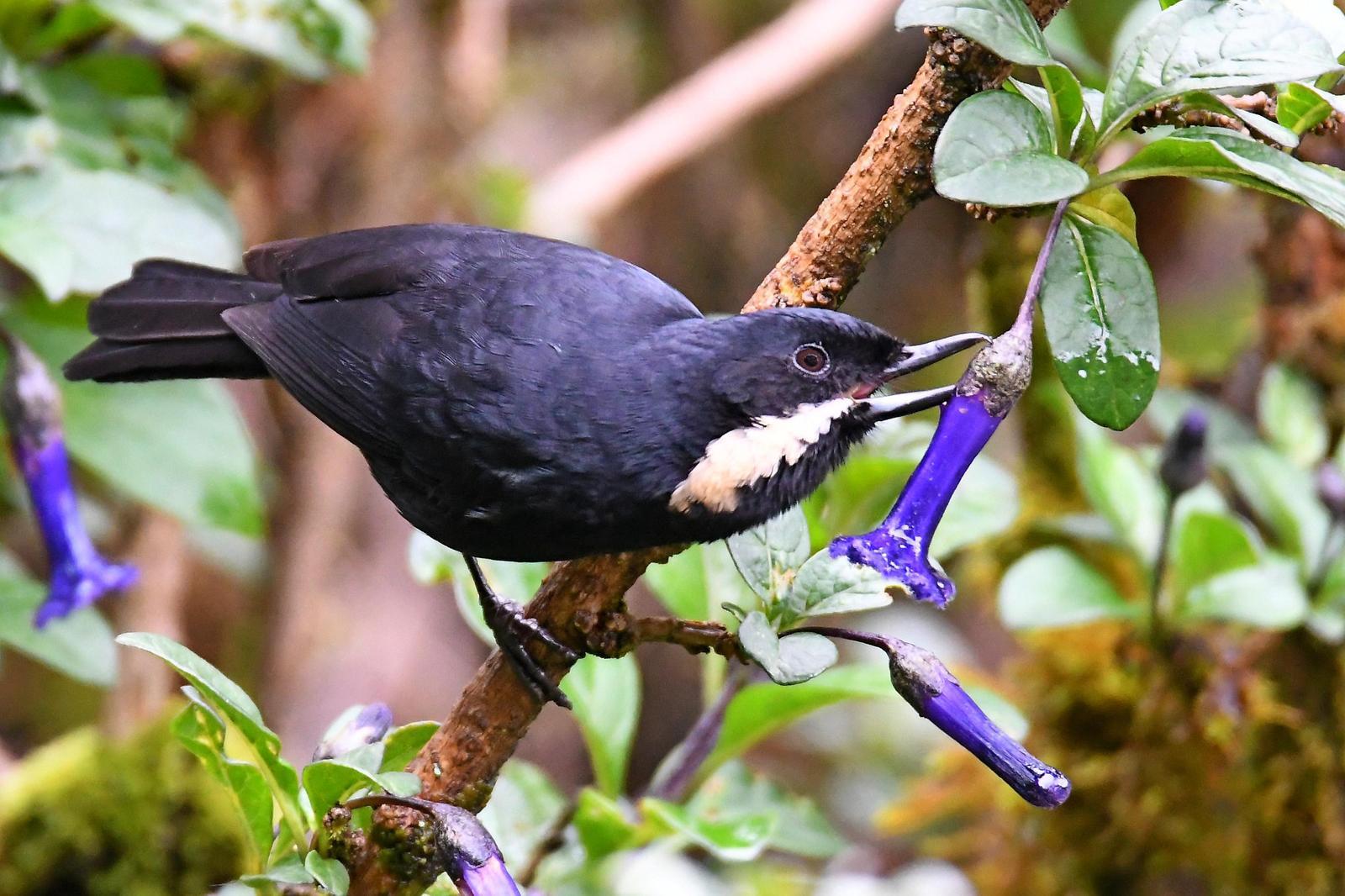
We began with the mutualistic relationship between Hummingbirds and flowers, so let’s return to the jungles of South America. As I mentioned, many flowers have evolved in such a way as to make their nectar unattainable to anything that isn’t a Hummingbird. They grow their blossoms at the end of hanging vines, far away from any place where a bird might perch to feed. This is my Hummingbirds hover: it’s literally the only way to reach the nectar. This set up our mutually beneficial scenario, where the plants get an exclusive pollinator and the birds get an exclusive food source. Everyone wins. But I was kinda lying when I said hovering was literally the only way to get the nectar. Because there is one group of birds who figured out a way to cheat the system. They’re called Flowerpiercers, and based on the name alone I’m sure you can work out how they do it.
The Flowerpiercer watched the Hummingbird going to all the evolutionary trouble of learning how to hover, stripping down weight and being backed into a corner where they had to feed once every 15 minutes or starve to death, all so they could get a bit of sugar water. The Flowerpiercer watched this and thought, guys, that seems like a lot of effort. What about instead of doing that, we just peck a hole in the base of the flower and get the nectar that way? And so, that’s exactly what they did.
Flowerpiercer caught in the act of piercing a flower.
There are 18 species of Flowerpiercer and they’ve all developed a modified beak to help them break into a flower’s treasure chest. Of course, in doing this they bypass the pollen and so serve no function in helping the flower to reproduce. They cheat the plants, steal their nectar and offer nothing in return. Maybe we wouldn’t naturally think of this behaviour as parasitic, but it ticks all the boxes. This is a losing situation for the plant.
Of course, theft can happen in a number of different ways. Plants might be a bit of a passive target when it comes to thievery.3 But trying to steal from another bird … now that presents a different kind of challenge. On the world’s high seas there is a great avian pirate: the Skua.
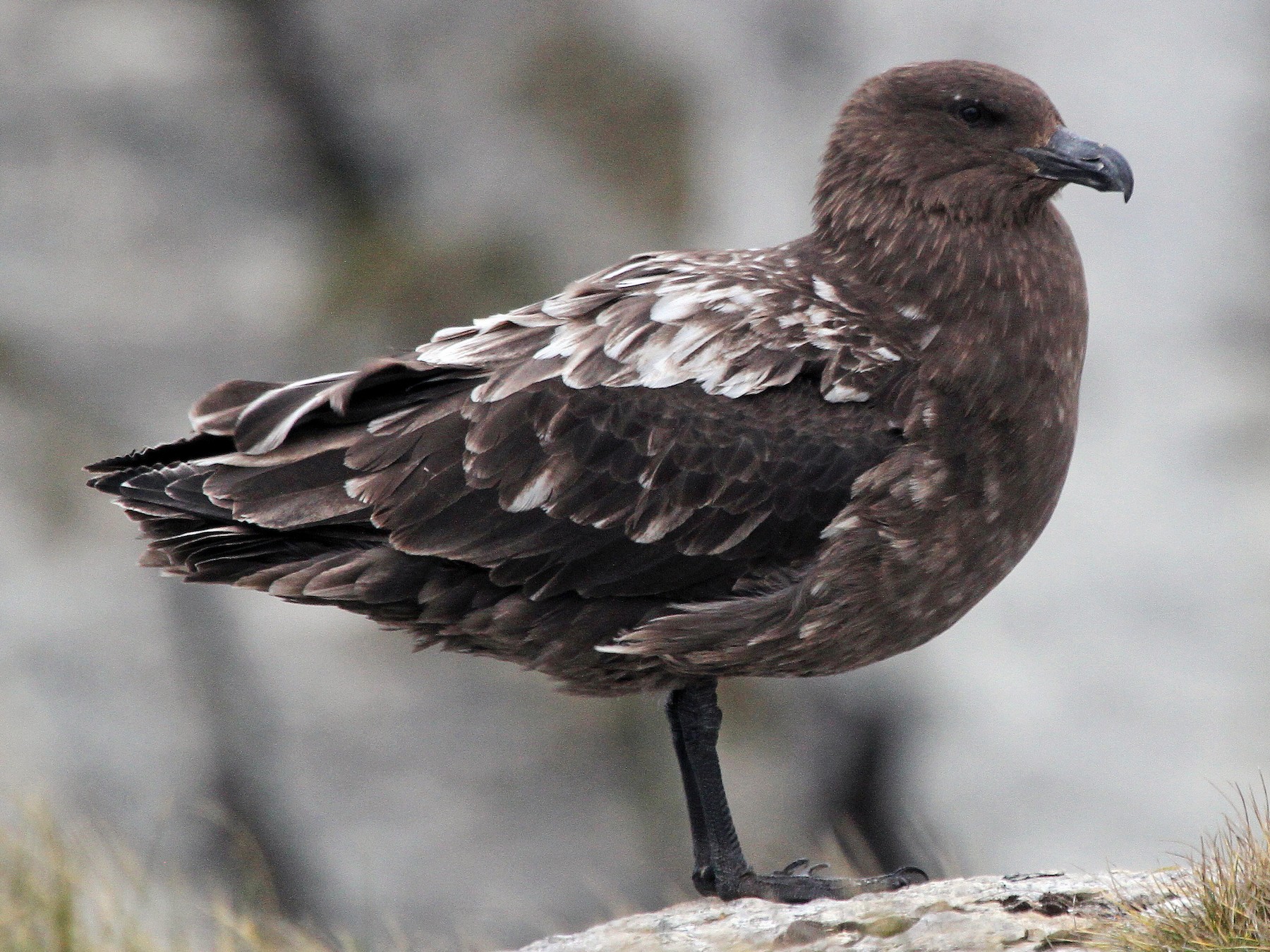
Now have you ever watch a flock of Seagulls fighting over a chip and thought, damn these birds are aggressive? Well, a Skua is to a Seagull as a lion is to a cat. These are big powerful Gulls4 with sharp hooked beaks, clawed toes and strong wings.
You would think that a bird this big and fierce would have no trouble hunting and catching its own meals. But the Skua uses its bulk to bully other birds out of their hard won catch. Whenever it sees a Gull or a Tern with a fish or other tasty treat, it will relentless pursue them, using its size and strength to harass the smaller bird until it drops its dinner. For some species of Skua this strategy delivers 95% of their diet. There is even one species called the Parasitic Jaeger, which really tells you everything you need to know about how it operates. Occasionally they do scavenge the odd corpse, or will try to pick off an unprotected baby Penguin, but this behaviour hardly redeems them. If anything it makes them worse.
Now at this stage I know what you’re thinking. This kind of parasitism has more to do with fancy definitions than anything else. Nate, I hear you say, you’re clutching at straws. Sure, maybe the term ‘parasite’ has a broader definition than what we might normally think of. But at the same time, we all know what a parasite is, and this ain’t it. And I get it, you came here for the real stuff, not some bird that nicked a fish. So let’s get a little freakier.
Brood Parasitism
Let’s turn to one of the most horror-inducing conditions I can thing of. A little something called pregnancy. Naturally, a baby growing in its mother’s womb is a parasite. I honestly can’t think of any other way to conceive of such a thing (pun intended). These terrible little creatures live off their mother, sucking her dry of nutrients so it may grow. During pregnancy the mother’s immune system is even suppressed lest her body recognise the foetus for the intruder it is and kill it dead. If that isn’t proof enough for you … I don’t know what is.
Now, birds don’t do pregnancy. Sure, there is a short period while the egg is developing and fertilised that we could think of the bird as technically ‘pregnant’. But as soon as the mother can lay the egg, she does. She expels that parasite, pronto. You’ve got to respect that. Of course, the reason birds kick the egg out as soon as they can is because they want to keep their weight down. Flying is a taxing business, energy-wise, and every ounce you carry that you don’t have to is energy wasted. But unlike their reptilian cousins who lay their eggs and then bugger off, birds are much more attentive parents and put a lot of effort into incubating their eggs and then caring for the hatchlings. So while pregnancy might be an external affair for birds, it is no less difficult.
However, just like crocodiles buck the reptilian trend and care for their eggs, there are birds who shirk their parental duties and outsource the effort to someone else. These are the brood parasites, you might know them better as Cuckoos. But we should be clear, because not every Cuckoo lays its eggs in someone else’s nest, and there are many birds who do that aren’t Cuckoos. Yeah sorry, as always, life is rather complicated.
So, we all know what Cuckoos do. They’re a bird that decided raising its own children was too much work and instead opts to trick some other bird into doing it for them. It’s something I’m sure every parent has fantasized about at one point or another. Although I suspect fewer parents have fantasized about killing the host’s children and then make them think your changeling child was their own. But hey, what you dream about late at night is your own business; I sure as hell won’t judge.
Either way, not only are their plenty of birds out there dreaming that dream, they’ve also acted on the impulse. There are some 300 or so species that drop their eggs off in an unsuspecting bird’s nest. Of course, sometimes this behaviour can be rather benign. Many birds will lay some of their eggs into a nest that belongs to a member of their own species. Usually they also make their own nest and incubate their own eggs (and maybe some of their neighbour’s too). This is called intra-specific brood parasitism, and many birds do this as a form of insurance policy. Quite literally, not putting all your eggs in one basket. If some disaster befell your nest, and all you chicks died, well … that would suck, but at least there’s a chance that out there somewhere a few of your babies survived under the care of their foster parents. And if your nest survived, there’s always a chance you helped raise your neighbour’s chicks. It’s a mutually beneficial practice, and so naturally we’re not interested in it.
What we’re interested in are parents with no desire in making their own nest, who are instead set on making some other species do all the hard work. This is called inter-specific obligate brood parasitism. There are a lot of big words in that phrase, so let’s break it down.
Inter-specific: the host is a bird of a different species.
Obligate: laying your egg in another bird’s nest is the only method you have of raising your own young.
Brood: your children.
Parasitism: that’s the thing we’ve been talking about since the start.
The number of birds that match this criteria is a little narrower. In the whole wide bird world there are around 100 species that fall into this category, and as I mentioned before, not all of them are Cuckoos. There must be some evolutionary advantage to being a freeloader, because the practice has evolved independently at least seven times.
It evolved independently three times in the Cuckoo family, across 60 species. It evolved twice among the passerines; there are six Cowbirds in the family Icteridae and 20 Indigobirds in the family Viduidae. It evolved in at least 8 members of the Honeyguide family, Indicatoridae. And then finally, it evolved in one lone species of Duck.
Each of these birds has a different strategy for achieving the same goal. Let’s begin with the Duck, the most innocent of the bunch, and then move into the more sinister families. As far as brood parasitism goes, the Cuckoo Duck is probably the best you can hope for.
A rather ordinary looking duck.
This Duck doesn’t destroy any of the host eggs, and when its egg hatches the nestling doesn’t kill any of its foster siblings. In fact, it doesn’t even steal any of their food. You see, ducklings are what we call precocial. When they hatch they start life fully feathered; they can see, they can swim, they can even feed themselves. They’re quite, precocious, and indeed, that’s where the word comes from. This is the opposite to most other birds who are born blind, featherless and helpless – these are altricial chicks.
Because the duckling doesn’t need anything from its host, within a few hours of hatching it will realise the nest it found itself in does not belong to it and will hightail it outta there. Which is maybe a good thing. Cuckoo Ducks have a habit of laying their eggs in Gull nests, birds that have no qualms about eating ducklings should they come across one. That seems like a risky move to me, but hey, it must be working for them. So really, the only thing a Cuckoo Duck steals from its host is a nice nest and a warm butt.
Now, the other 99 brood parasites aren’t so kind.
On the surface it may look like the parasite lives the parenting dream: off-loading the kids and then going off to do whatever it is a no-good parasite does when it isn’t raising children. But this a strategy for passing down genes to the next generation, and just like any other strategy there are pros and cons, advantages and costs. Squeezing an egg into another bird’s nest and then skiving off for the rest of the day may sound easy in theory, but in practice it isn’t as straight forward as you might think.
First you’ve got to find a host. Some of these birds aren’t fussy. A Cowbird is more than happy to lay its eggs in any one of some 170 different host species. Most birds, though, have a single host that they target exclusively. For example, the Village Indigobird only lays its eggs in the nest of Red-billed Firefinches.
The Indigo Bird with their favoured host, the Red-billed Firefinch
The Pacific Koel falls in the middle, with a small handful of hosts that they target, like Friarbirds and Wattlebirds. It takes a bit of work to track down a host, find their nest and then keep tabs on it, waiting until the right moment to lay your eggs.
Which brings us to step two: getting your egg into the nest. Here again there are a number of different approaches a parasite can take. Some will stake out a nest and wait for an opening when the parents are away to quickly swoop in and lay. This can take a little bit of timing, not only to get their opening, but also to lay at the right moment to ensure their egg will hatch first and have a head start over the host’s chicks. A Cowbird might muck up the host’s nest, forcing them to rebuild and start over so that the host is better aligned to the Cowbird’s schedule. A Honeyguide will hold off laying her egg in its favoured host nest, the Bee-eater. Instead she incubates her egg internally for a day before laying to ensure that it has the developmental advantage over the other eggs.
Some parasites, though, take a more active approach when it comes to finding an opening. Males and females will work as a team. Some males will goad the host parents into attacking him, drawing them away from the nest, giving his mate the opening she needs to sneak in and lay their egg. Some other parasites scare the hosts away. This is the Common Cuckoo’s strategy. The Common Cuckoo bears a passing resemblance to a Sparrow Hawk: they have the same grey head and barred chest. When the smaller Warblers see a Hawk circling near their nest they will take cover and wait for the threat to pass, which again gives the Cuckoo the opening she needs.
Note the similarity between the Cuckoo and the Sparrow Hawk.
Some Cuckoos are so adapt at this strategy that the eight birds in the genus Hierococcyx are known as Hawk-cuckoos. In fact, there’s even an actual Hawk, the African Cuckoo-hawk, so named because people think it looks like the Cuckoo. So just try to keep that straight. This is a pretty good strategy, because many small birds have learned that if a Cuckoo turns up in their neighbourhood it’s a bad sign, and they will attack and drive it away. So if they never see it coming all the better for the Cuckoo. This type of mimicry is known as Batesian Mimicry, where the harmless mimic takes on the features of a predator. Although in this case the mimic is far from harmless.
But then there are other parasites that take a different tact with the mimicry and try to disguise themselves as a less threatening bird so they can slip in unmolested. Cuckoos in the genus Surniculus all bear a resemblance to Drongos. This allows the female to get close to a nest without causing alarm. This is known as aggressive mimicry, where the dangerous creature pretends to be something harmless to lull into prey into a false sense of security.
If you can tell the Cuckoo from the Drongo you’re doing pretty good.
Of course, mimicry doesn’t stop here. Once the egg is in the nest, the next step is for it to be accepted by the host. For the host bird, if you fail to hide or protect your nest from the enemy, this is the best chance you’ll get to identify the imposter and reject it. The cost to the host of raising someone else’s egg is mighty high, not only do you miss your chance to pass on your genetic material, but the energy and time you would have devoted to that mission instead gets wasted on raising a filthy freeloader. So naturally, you want to try and stop that.
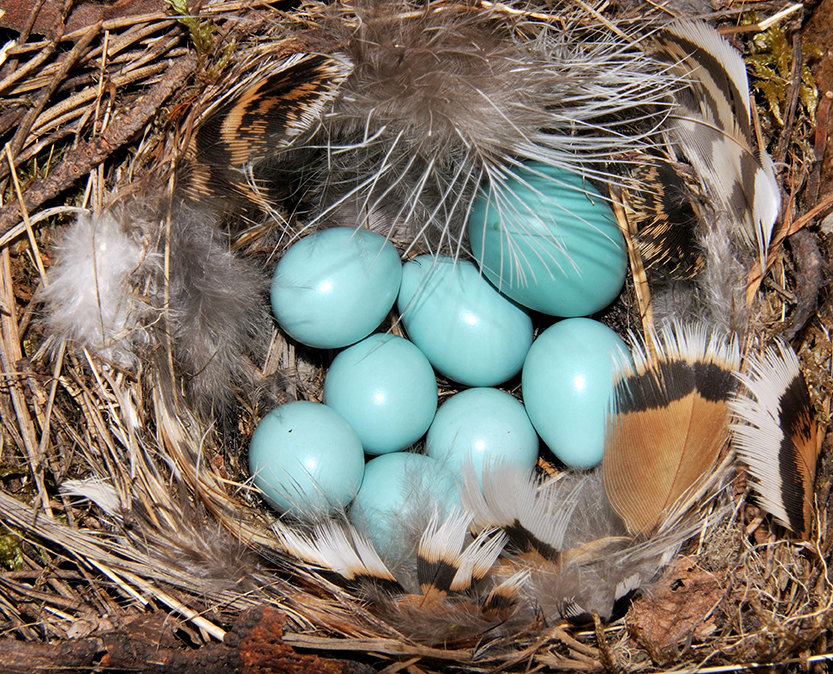
The result has been an evolutionary arms race between parasite and host. A host wants to develop strategies to spot an alien, and the parasite wants to get better at hiding in plain sight. This pressure has produced parasites that progressively lay eggs which better and better resemble those of the host. In turn, some hosts have responded by laying eggs that have different markings or are unique to each individual bird. Curiously, some host species have better rates of rejecting parasite eggs than others, and no-one is quite sure why. Sometimes it could be the case that the parasite has only recently begun to target a new host and they haven’t had enough time to develop defence strategies, but that isn’t always clear.
Here a well disguised Cuckoo egg differs only slightly in size from the host’s own brood.
If a host identifies the invader egg, they have different ways of retaliating. Some birds just kick it out of the nest. Others will abandon the nest and build a new one elsewhere. And yet others will build a new nest right on top of the old one, basically smothering the invader.
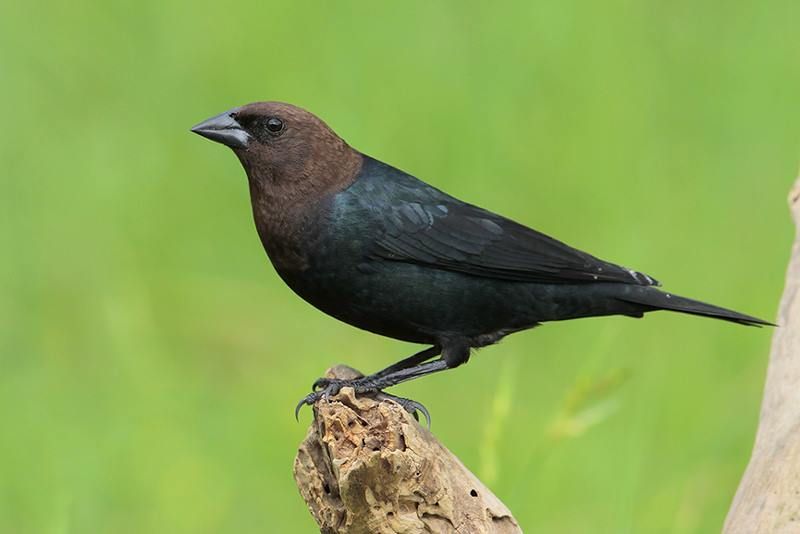
Now, the Cowbird doesn’t take too kindly to this behaviour. To try and “encourage” the hosts to accept their eggs, female Cowbirds will keep tabs on hosts and their nests, swinging by every now and again to make sure her egg is still safe and cared for. If she sees a host reject her egg she will take retaliatory action and destroy the nest herself. It’s believed this tactic teaches the host that it’s better to accept the parasite and do their best to raise it and their own chicks, rather than lose everything. The Cowbird tactic has delightfully been termed, mafia behaviour.
Cowbirds keep tabs on their eggs.
‘We just want you do the right thing. Be a real shame if something was to happen to your nest. Accidents happen all the time, see.’
Now, if the host fails to spot the parasite egg before it hatches, it’s basically game over. No doubt you would have heard stories of Chicken chicks that imprint on humans or dogs if they hatch and that’s the first thing they see. It’s a survival strategy for the chick to quickly identify and then imprint on its parent. Well, the same thing happens to the parent bird. When their chicks hatch, they imprint on them and are then driven to feed, protect and care for their young. This is what brood parasites take advantage of, and it’s the reason why hosts almost always accept the changeling chick even though they usually look nothing at all like their normal young. It seems evolution is unwilling to give up this attribute as well. After all, it’s rather the risky proposition to abandon your young, unless you’re 100% sure the chick isn’t yours.
There is one exception though (there’s always an exception). As far as ornithologists have worked out, Fairywrens in Australia are the only birds capable of identifying a Cuckoo after it’s hatched. Bronze and Fan-tail Cuckoos frequently target these tiny colourful birds, but they have a clever way of sussing out the imposters. While the mother is sitting on her eggs she will sing to them. The song is sometimes described as sounding like a purr. While in their eggs the chicks learn this song, and when they hatch the babies incorporate it into their begging calls. It seems the Cuckoo chicks don’t learn the song while in the egg, and when they fail to produce it upon hatching it tips the parents off that something isn’t right. They will either eject the Cuckoo from the nest or otherwise abandon the nest entirely. In a sense this secret song between mother and chick acts as an identifying password.
Horsfield’s Bronze Cuckoo and their favourite host, the Fairywren.
So it turns out being a Cuckoo isn’t quite as easy as it first seemed. They have to navigate quite a few obstacles before the little leech is even born. But assuming you’re not in a Fairywren nest, if the egg is allowed to hatch you’re basically in the clear. Once hatched, the parent-parasite doesn’t do anything else, and it’s on the baby to enact step three: eliminating the competition.
For the best chance of survival you want the least amount of competition. No point having the hosts waste energy feeding their own young: that would be silly. So the Cuckoo chick quickly gets on with the business of murdering its nest-mates. Although, I should point out that not all parasite chicks do this. Cowbirds don’t, but they have a knack for being bigger, louder and better beggars than the host nestlings and frequently out-compete them, no murder required. In the best case scenario some of the host chicks will survive, but studies have shown that those raised with a Cowbird chick almost always grow up stunted. In the worse case scenario, they slowly starve to death, so maybe murder by another name.
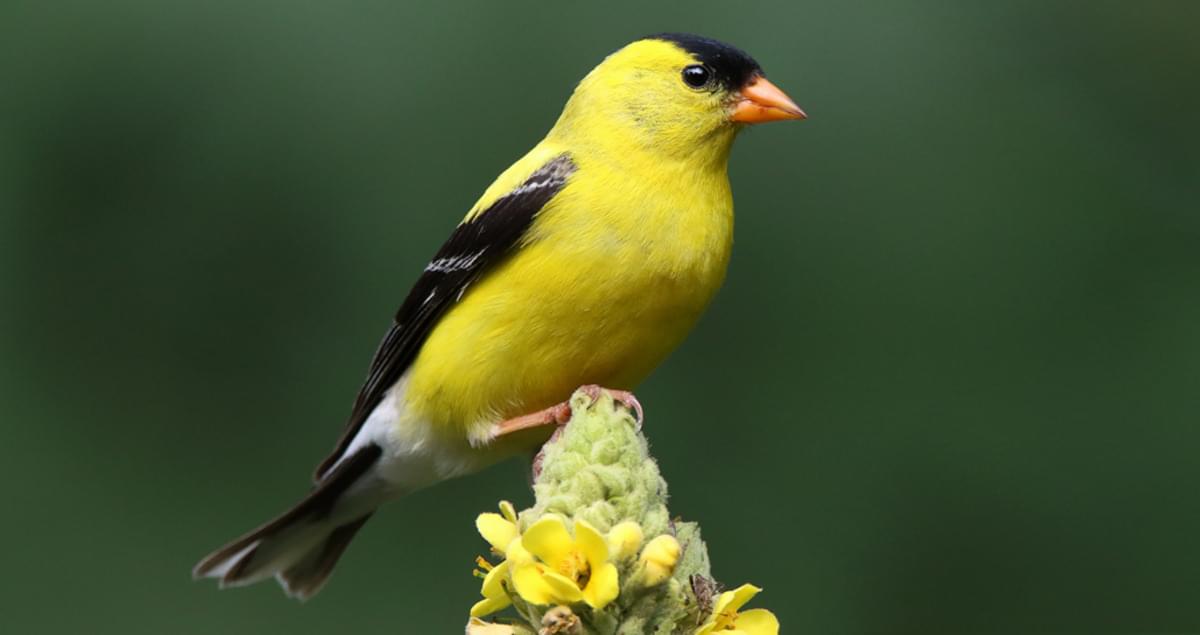
Although, every now and again, the Cowbird does get a taste of its own medicine. There is one bird that Cowbirds will occasionally try to take advantage of, but it never works out too well for them. If a Cowbird manages to slip its egg into an American Goldfinch’s nest, the only thing that awaits their hatchling is starvation. You see, the American Goldfinch has an all vegetarian diet, and they only feed their chicks grass seed. But to survive a Cowbird needs different nutrition, insects and bugs and the likes. So in these cases, no matter how much the dutiful parents feed their false offspring, it doesn’t do them a lick of good, and the Cowbird baby slowly dies of starvation.
The American Goldfinch ain’t no-one’s fool.
Meanwhile, the Common Cuckoo has no desire to be outcompeted by its nest-mates. As soon as the Cuckoo hatches, operating entirely on instinct while still blind and naked, it will work itself under any other eggs in the nest. Then, using a special hollow in its back, it will balance the egg and hoist them up and over the edge of the nest. And if any of its foster siblings are unlucky enough to have hatched before it, no worries, it gets rid of them in the same way. For such a tiny new born, it’s quite the feat of strength to eject its nest-mates, but they are dogged in their desire to kill anything sitting next to them.
Here you can see how the Common Cuckoo chick uses its back to push the other eggs in the nest up and out.
For chicks sharing a nest with a Greater Honeyguide, their fate may be even more gruesome. Honeyguide chicks are born with a needle sharp hook on their beak. They lose this as they grow, but when they’re fresh out of the egg it serves an important function: stabbing their nest-mates to death. The blind baby Honeyguide will prowl its nest seeking anything small and warm, which it will then bite repeatedly. This is not a quick death either. It often takes hours, sometimes days, with the Bee-eater hatchlings dying of internal bleeding. It’s probably the most violet death that awaits any chick unlucky enough to have a parasite in the nest. Compared to being pushed out while still an egg, the Cuckoo is almost kind by comparison.
Here you can see the needle sharp weaponry a Honeyguide has to work with.
Whatever the method may be, once the competition has been taken care of the alien baby is now free to focus on making the hosts work as hard as possible to get it as much food as can fit down its gullet.
Here too, a parasitic nestling has a number of strategies to make sure its hosts work as hard as possible to feed it. Common Cuckoos have begging noises that mimic a whole nest of babies, and these calls motivate the parents to feed them. Likewise, Honeyguides have markings insider their mouths that mimic those of the Bee-eater chicks, again producing the same effect. And the chicks of Horsfield’s Bronze Cuckoo have patterns on the underside of their wings that look like the open mouth of a baby Fairywren. The match is so close that they even reflect ultraviolet light, just like the real thing. It’s pretty dark. The chicks grow quickly and soon become bigger than the hosts, but by this stage the game is well and truly over. No matter how grotesquely oversized their babies become, the hosts will continue to feed the chick until it fledges and leaves the nest, without so much as a thank you.
Now, we asked before why the host accepts the chick even as it grows into a gigantic horror that bears no resemblance to itself? This has to do with how parents imprint on their young. But now we have another question. How does the parasitic baby know that it’s a Cuckoo and not a member of the host’s species? Why don’t Cuckoos think they’re Warblers? These are the birds that raised them after all. Turns our that’s rather a tricky question, and ornithologists don’t have a good answer.
There is some anecdotal evidence that species like the Pacific Koel, a large migratory Cuckoo from New Guinea and Australia, will visit their young while they’re being raised by the host, but this hasn’t been widely studied and most of the evidence seems to suggest that parasitic birds never show any interest in their chicks once the egg has been laid. The best theory is that it comes down to vocalisation. Studies on Cowbirds have shown that their chicks take far greater interest in the calls of their own species. It could be that when they hear the calls of their own kind it awakens something inside them that tells them they’re a Cowbird. The same could be true for other parasites. Whatever the reason, the young of Cuckoos and Cowbirds and Honeyguides, not to mention that Duck, don’t imprint on their foster parents in the same way other birds do.
Although, there is at least one way the Common Cuckoo imprints on its hosts. You see, throughout its range there are some 100 different species that the Cuckoo can parasitize. As I mentioned, one of the best ways for a Cuckoo to sneak its egg into a host nest is to disguise it as one of the host’s eggs. But each of these host species has a different coloured or patterned egg, so how does the Cuckoo match its egg to the host’s? Well the coloured egg that a female Cuckoo lays will always be the same, so for each individual female there is a specific host it will always target, and it won’t go near any other potential hosts. It learns how to target that host by imprinting upon them as a chick. So that means there are some Common Cuckoos that only target Reed Warblers, other that only target Meadow Pipits and others that only target European Robins. Each group of Cuckoos are known as gentes, and they will only target that one host species throughout their entire life, because that’s the type of egg they lay. A female can mate with any male, but she will always lay her egg in that host species’ nest. This works because the genetic information that encodes for egg appearance is only carried on the bird’s W sex chromosome, which females have and males don’t. So Cuckoos inherit the type of egg they’ll lay from their mothers, so the nest they were born in will be the type of egg they’ll lay in the future. And that’s why its important for them to imprint on the host. It’s a pretty clever trick.
Now, it may be tempting to think that the Cuckoo and other brood parasites are complete freeloaders, living an easy life. But in reality they put a tremendous amount of energy into sneaking an egg into someone else’s nest. Evidence has shown that they spend a lot of time scoping out a suitable host. They make decisions on which parents they want to raise their chicks based on similar information that goes into birds choosing their mates. The Cuckoo wants their egg to go to a good home after all, so they try to pick good parents. They might make this decision based on the host’s physical appearance, how well they’ve built their nest, or even how successful they were at raising chicks in the past, which would require the Cuckoo to retain that information over at least a year. They have to do all of this stakeout work in secret. Then they need to find an opening to get their egg into an unattended nest, at the right time so as to not raise suspicions, and then hope like hell that their egg doesn’t get rejected. To maximise their chance of having a chick make it to maturity, they’ll lay eggs in multiple nests, which means they now have to keep tabs on numerous nests all over town. It’s quite a mental feat to say the least. After doing all the math, maybe it would be easier to raise the damn thing yourself. No doubt that’s probably the reason why the vast majority of birds do. But to call the Cuckoo a lazy freeloader is to ignore a lot of what makes them a successful bird. It’s a lot of hard work being lazy.
Kidnappers
For a lot of birds, their children are a burden. At least, this is how the Cuckoo sees it. All the better to off load that energy draining leech onto someone else. But for one bird, their children are a valuable resource. So much so that they’ll even steal another bird’s fledgling and raise it as their own. These birds are the anti-Cuckoos. They’re an Australian bird known as the White-winged Chough.
A Chough’s white wings are only visible while it is in flight
Choughs are highly social and hang out in large family groups. They also have a distinct feeding habit. They will spread out and systematically make a sweep of the ground, like a police search line looking for evidence to a grisly murder. Being a social bird, each member of the family has an obligation to help raise the next generation. As we’ve already seen, feeding a baby is hard work. All the easier when there are many hands … rather beaks, to help.
In any family group only one pair of birds will breed, while everyone else works together as a single unit to feed the chicks. The bigger the family the greater chance of success they’ll have. And here’s where things get a little dark. If one Chough family comes across a rival family, they will attempt to kidnap the rival’s fledgling – those young birds that have already left the nest. An adult Chough will approach a youngster and flash its white wings at it, luring it away and into the new family group. Not unlike a creepy dude in a van holding out a lollipop to an unsuspecting toddler.
Not a great picture of the display, but it gives you an idea.
The Choughs do this to grow their family, in anticipation that the new recruits will help raise the next generation of chicks. In this sense, Choughs see young birds not as a resource drain, but rather an investment in the future to make their flock bigger and stronger. But stealing is stealing, and although its the polar opposite of the brood parasites, they are no less parasitic.
Avian Mosquitoes
Now, we’re not quite done yet. I’ve saved the two most disturbing birds for last, because let’s face it, I know you want some real, hardcore, honest to god examples of birds behaving like parasites.
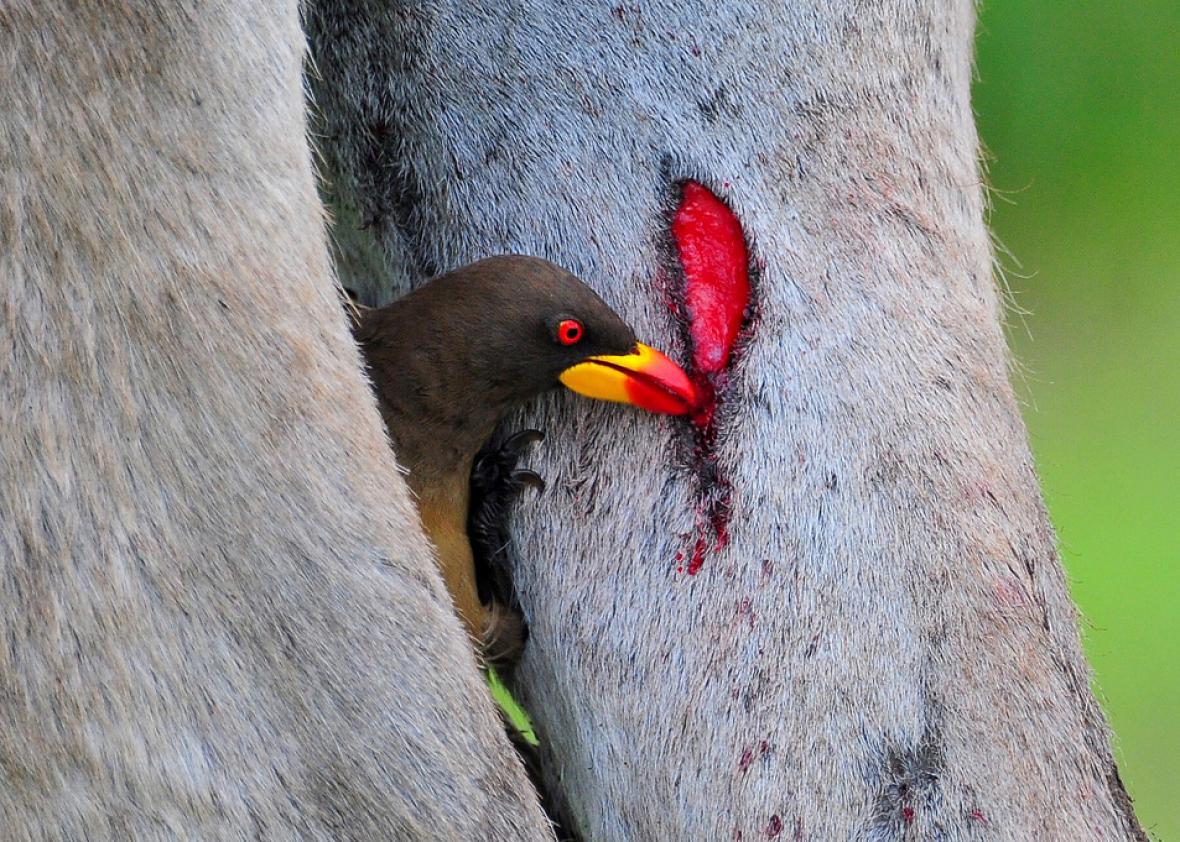
Our first bird is the Oxpecker. You’ve probably heard of these birds without even knowing it. They’re the ones that live in Africa and spend all their time riding big game animals, pecking at their mites, ticks and other ectoparasites that infest them. You know, they’re grooming birds.
Oxpecker on … not an ox.
Hold on, I hear you say, these birds aren’t parasites, they’re helping their hosts, they’re removing the real blood suckers and making their lives better in exchange for a free feed. Isn’t this a mutualistic relationship? For a long time ornithologists thought that was the case. But in recent years new research has revealed that these relationships might be a little more one sided than we originally thought.
Now, first it must be said that yes, Oxpeckers do eat ticks, mites and other blood sucking pests that infest their hosts. But they only do this to get at their own favourite food: blood. An Oxpecker will only eat a tick once it is engorged with blood, so what benefit that is for the host is a little debateable, after all, the damage has already been done.
Second, because blood is the Oxpecker’s favourite food, they’re not shy about getting it via other means. If the animal has a cut or wounded itself somehow, the birds go straight to the source and start drinking. They’ll even bite and scrap at the wound to keep it from healing so they can continue to feed. If blood and ticks aren’t on the menu, the Oxpecker will turn to other food sources, sweeping the animal for dandruff, or eat earwax or any other tasty things they might find lodged in the animal’s ears or nose.
In effect, they’re no better than any other ectoparasite. An Oxpecker spends its entire life on the back of its hosts. They eat, sleep and even mate all on the back of other beasts. And when the time comes to leave and make a nest for their eggs, they make it out of the hair they pluck from their hosts. All in all, they’re pretty awful little birds.
The last bird I want to mention takes things to a whole other level. It is even named after one of the most famous parasites from fiction – the vampire. We all know that there are Vampire Bats, but there is also the Vampire Ground Finch.
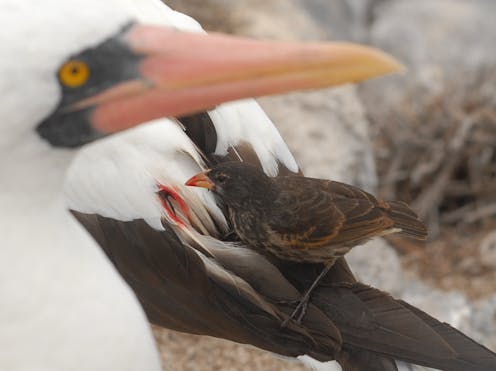
These wee little cuties live on the ominous sounding Wolf Island in the Galapagos, and are in fact one of Darwin’s famous finches. How this family of birds evolved from a common ancestor to specialising in monopolising their own favoured food source served as an inspiration for Darwin’s theory of evolution. Well, these little guys found one hell of a niche: Booby blood. The Blue-footed Booby is their victim of choice. When the Boobys come to Wolf Island they are visited upon by these finches. Our vampire jumps on the Booby’s tail and pecks at the base of their wing until they break the skin and the blood begins to flow.
The finches have become quite skilled at walking the line between getting enough blood from their victims without causing so much pain that the Booby chases them away. It’s a bit gruesome, but the good news is the finches don’t seem to do any long-term damage to their flying meals (although they have been known to kill the odd chick or two).
So why do they do it? Well, Wolf Island is the driest of all the Galapagos Islands. Originally these finches ate grass seeds like their close relatives, and normally this is where they would get all of their water needs from: direct from their diet. But because of near constant drought conditions they have been forced to find moisture in other places. It just so happened that turning to a life of vampirism seemed like the best choice at the time. To me, it’s one of the best examples of evolution doing its thing to help animals carve out a niche and survive. And hell, if it means you have to turn into a blood sucking parasite, is that really the worst thing?
So as it turns out there are some dark corners in the bird world. It’s a place of vampires and thieves, parasites and changelings, horrors beyond reckoning. But that’s what you find when you scratch beneath the surface. You find a richer, complex, forever fascinating world, and for me at least, I think that’s pretty neat.
Notes
[1] Parasites that live on the outside of an animal are called ectoparasites, whereas those that live inside an animal are endoparasites.
[2] If you count viruses as being alive … it’s complicated.
[3] That is wrong for a number of different reasons, but we don’t have time to dive into how plants defend themselves. This isn’t Plant of the Week after all.
[4] Skuas aren’t technically Gulls, although they are closely related. Gulls are in the Family Laridae whereas Skuas are in the sister Family Stercorariidae.
Here’s something a little different to chase away the lockdown blues. Have you ever seen a bird without a tail?
They look kinda weird, hey. Almost like they’re a little baby bird, and maybe they are…
Except, there’s another reason why a bird might be lacking a derrière. You’ll no doubt be familiar with the fact that a lizard can drop its tail as a getaway strategy if something tries to eat it. Well, as it turns out, many birds can too. It’s called a ‘fright moult’.
If you’re a stalking carnivore, instead of ending up with a delicious plump-breasted pigeon named Speckled Jim, you’re left with a mouthful of feathers. Not only is it unappetising, but the bird gets away and looks humorous as well. Everyone’s a winner … well, except the predator.
Some research has even suggested that when being pursued in mid-air a bird may eject its feathers to act as a smoke screen to get away, like an octopus squirting ink. So … that’s a thing birds do.
Smoke screen deployed
But if I’ve piqued your interest with some missing feathers, then why not pop over to listen to the latest podcast where we discuss the mystery of the Lost Birds-of-Paradise, and how some plucky feather collectors first found and then lost them (Apple, Spotify).
Now, obviously this bird sells itself. It has the most splendid moustache that ever adorned the face of man or bird. They’re essentially the Salvador Dali of the bird world. From the name I’m sure you’ve guessed they come from South America. And indeed, they inhabit the western coastline of Chile and Peru.
Males and females are equally moustachioed, and when picking a mate each is drawn to a partner with the longest moustache they can find. It turns out that the longer the stache the healthier the bird, so in this case a fine handlebar is a good indication of a bird’s health.
Having a moustache also comes in handy if one wishes to twirl it in a villainous fashion.
For you see, the Inca Tern is a thief. Oh sure, they’re happy to hunt for food. But they’re not below stealing a quick meal. They’re known to follow Sealions around to snag a snack straight from their jaws. They’ll even follow fishing boats and nick their catch right off the deck.
So devious. But then, that’s why they have the stache.
The lockdown bonus birds are back! This week I want to tell you a story about the USA and guano. But first, let’s meet a bird, the Masked Booby (Sula Dactylatra).
This is one of the more widespread Boobys, inhabiting tropical waters pretty much the world over. Their hilarious name aside, their most impressive feature is their hunting technique. To catch prey they plunge-dive into the ocean on an almost vertical trajectory sometimes from as high as 100 metres in the air. It’s quite spectacular. They hit the water like a torpedo, going up to three metres deep in search of fish and squid.
Nature Picture Library
But the real reason we’re meeting this bird is to talk about their poop.
Have you ever looked at a map and seen some tiny spit of land in the middle of the Pacific Ocean and thought, huh, I wonder why the United States owns that speck of nothing? No…? Is it just me?
Well, there are many tiny specs of nothing the United States owns, and they own them all for one reason: bird poo.
You see back in the mid-1800s, the USA had a problem. Their once fertile farms were struggling. For some reason the soil could no longer support crops. The problem was that as plants grow and are harvested, they remove important nutrients like phosphorous and nitrogen from the soil, making it harder for new plants to grow. Guano, though, is pack full of those nutrients. If you sprinkle a bit on the land, it replenishes the soil and can improve crop yield by up to ten times. But where did this miracle excrement come from? Why from bird butts on tiny islands in the middle of nowhere. Birds, like the Masked Booby, had been nesting on these islands for centuries, and as a result they were more or less built-up banks of sun-baked, hardened poop — delicious.
“Guano Island” by dbrgn That white rock is basically thousand-year-old solidified bird poo
The United States was enamoured with the results, and so in 1856 congress passed the delightfully named Guano Islands Act, which gave any US citizen the legal right to claim any island for the US for the purpose of establishing guano mines. And claim islands they did. At the height of the land grab they had nearly 100 islands churning out tonnes of precious precious poo. Today, many of those claims have lapsed, but there are still about ten islands scattered around the Pacific and Caribbean that the US administers, mostly as bird sanctuaries now.
We don’t use guano in agriculture anymore, we use fertiliser. But it was through the process of dropping droppings onto crops that we came to learn about phosphorus and nitrogen and how plants need them to thrive, which in turn led to the development of modern fertilisers that we now rely on to feed the world. And we’ve never had any problems with those…
Anyway, thank you, Masked Booby, thank you for all the poo.
As I’m sure many of you know, voting for The Guardian’s Australian Bird of the Year will soon be underway (still time to nominate a bird for the short list).
Now, I’m not here to tell you which bird to vote for, you don’t need me for that. I want you to vote for the bird that’s in your heart. But when it comes to the far more important New Zealand Bird of the Year, I have strong opinions. As far as I’m concerned, there can be only one winner for 2021: the Takahe (Porphyrio hochstetteri).
This bird has a cool story. Before anyone (from the West) had seen a living one, their preserved bones were found in the fossil record, leading scientists to think they were long extinct. But then, just two years later in 1850, some sailors found one. Naturally, they killed it and ate it. By chance, though, they happened to run into the chap who had first studied their fossils and it soon came out that the bird was alive and well. Except it wasn’t. Only a handful of living ones were sighted after that, and in 1898 they were declared extinct.
It would be 50 years before they were again dramatically rediscovered in the Murchison Mountains in the deep south of the country. Since then, a great deal of effort has gone into saving the bird. Breeding populations have been established on a collection of remote islands that are predator free, and today there are about 500 individuals.
Now, that back story aside, the Takahe is also a freak. Anyone who has caught the pod on island birds will know that when birds end up islands, evolution can really have its way with them. And if you haven’t caught the pod … what are you doing with your life?
To begin, the Takahe is the world’s largest Rail and flightless to boot. It displays two traits of island syndrome, flightlessness and island gigantism: that’s a tendency for small animals to grow large when isolated on islands. Now, they may remind you of a Swamp Hen, and indeed that’s the family they belong to. But these beefy blue and green silky birds gave up life in the wetlands and instead live in the high mountain grasslands. They’re also picky eaters. They favour the tender new growth of grass shoots. They’ll pull up grass, eat the tender bit and toss the rest away.
Is that the most efficient way to eat? No. They’re kinda like the panda of the bird world.
The Takahe is long lived and slow growing, which means they’re slow to mature and slow to breed. This has made rebuilding their numbers difficult. But while their population is still small, I believe their future is in good hands. They’ve never been crowned New Zealand’s bird of the year, and I think the time has finally come for more people to learn about these flightless swamp chickens that live in the mountains.
Now, these Magpies aren’t related to the Australian Magpie. The humble Australian Magpie is actually a misnamed bird. They are so-call because they reminded early European settlers of their own birds from back home. True Magpies, like this Magpie, are all members of Corvid family, and are closely related to Crows.
These birds do have one thing in common with our Australia Magpie, though. They are completely unafraid of humans, live comfortably in suburbia, and are highly protective of their nests. They will swoop and attack anyone they deem to be a threat, swiping intruders with their wings.
Of course, it’s always important to remember that what we sometimes see as aggression, should really be thought of protection. All they want to do is keep their nests and chicks safe; and really, being mistrusting of humans isn’t the worst decision a wild animal can make.
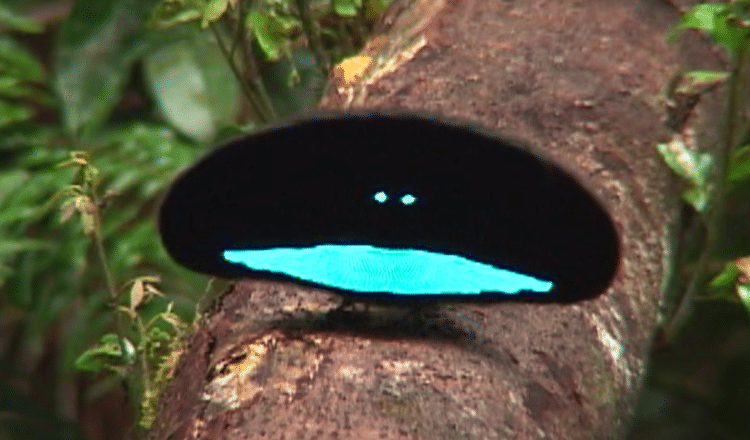
So as the perpetual lock down rolls on, let me offer you one of the most incredible birds on earth. But before I tell you its name, first take a look at this:
Tim Laman
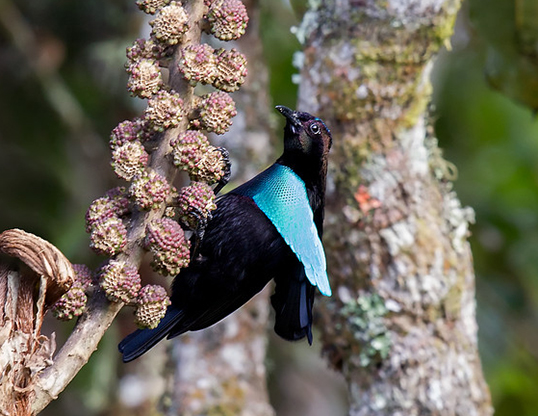
What in the blue blazes is that? Is it even bird, or is it an alien that hasn’t quiet worked out how to smile? Worry not, a bird it be: this is the Superb Bird-of-Paradise (Lophornia superba). And when they’re not looking like a drug induced fever dream, they are much more bird-like in appearance.
So what’s the story? Well, this is one of the morphing Birds-of-Paradise. The Superb Bird hails from the jungles of New Guinea, and the first picture you saw was the male in its mating display. Compared to the female, which is rather normal looking, the male is straight up insane.
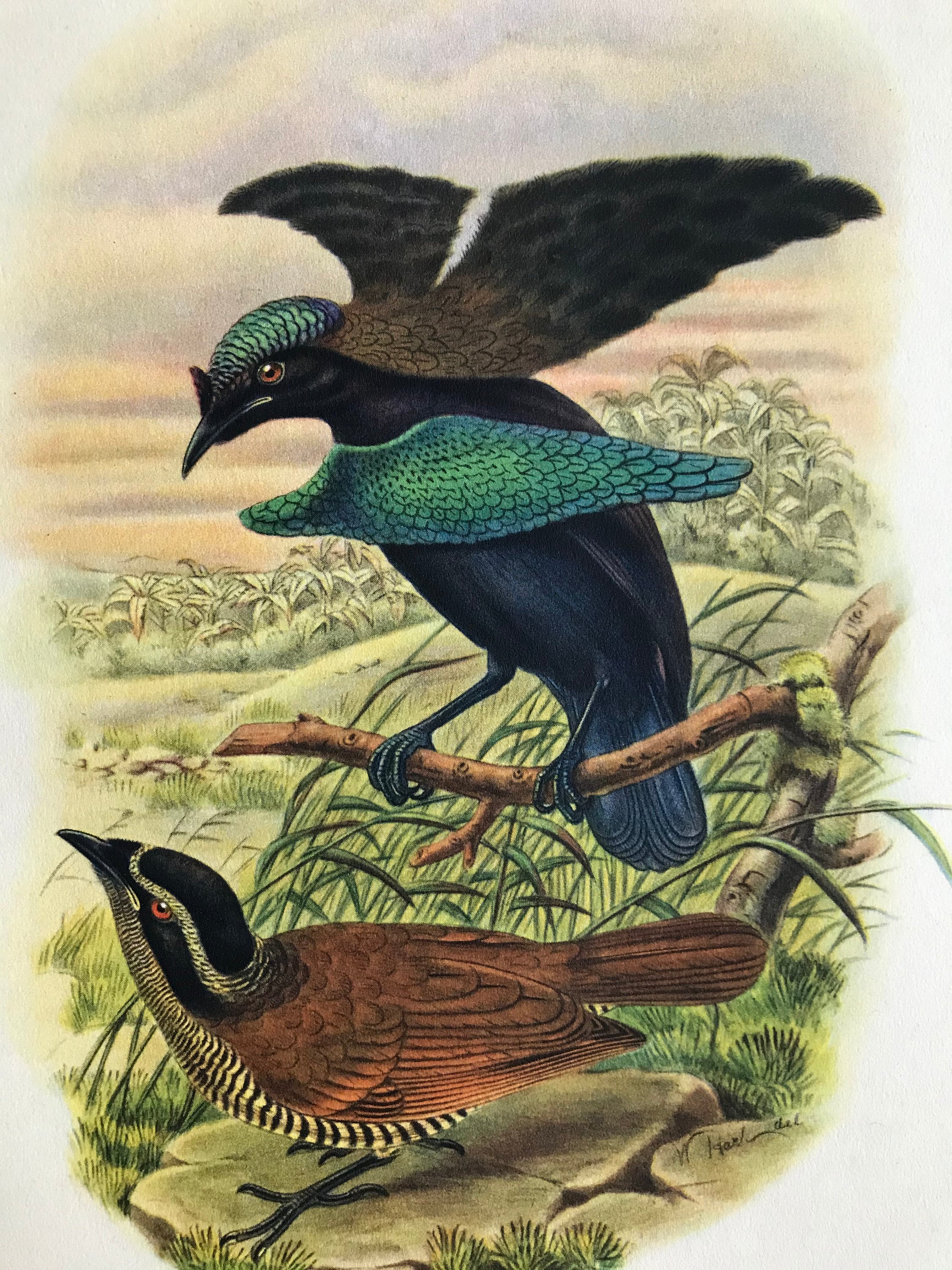
When their dried remains first arrived in Europe, people didn’t know what to make of them. They have a brilliant iridescent breast shield, which is all well and good. But extending off their neck is a kind of cape. Why did the bird have this, and how did they hold it? Scientists of the day had no idea, so they did their best to depict the bird as they may have appeared in life.
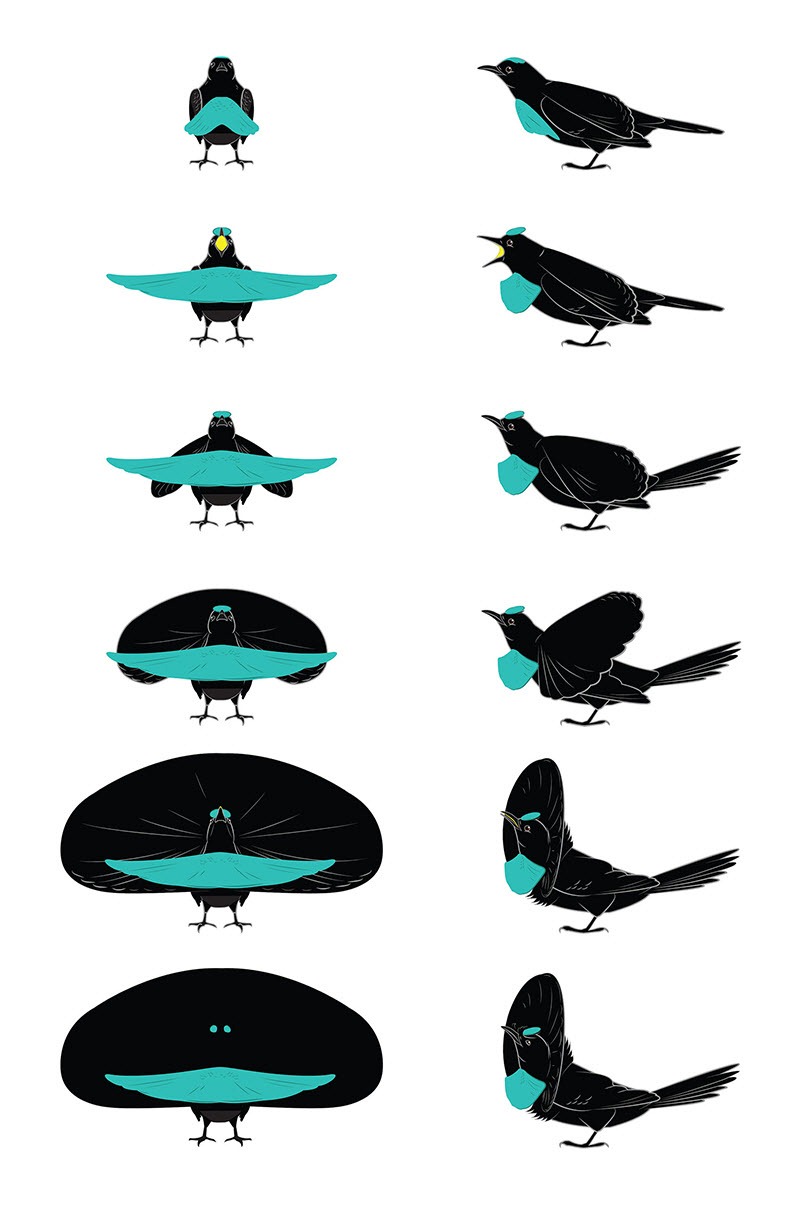
As you can see, they were a bit off the mark. Instead, the bird flairs out its shield and rolls up its cape until it frames its whole body in a black oval. Then it raises its bill, such that from the female’s perspective it bisects another matching patch of iridescent feathers on the crown of its head, creating the impression of two flashing eyes. When combined with the shield that looks like a mouth, the result is sometimes referred to as the ‘psychedelic smiley face’.
Cornell Lab of Ornithology
Once this posture is adopted the male then bounced vigorously around the female, emitting a cracking noise which it makes by flicking its wings. Who can say why the females find this display appealing, but don’t judge, we all have our kinks.
Tim Laman
But there are still so many questions: mostly why? and how? and what the…? The Superb Bird-of-Paradise is also just one of over 40 birds in the family Paradisaeidae, and they’re all kinda crazy. So, if you’re in the mood to dig in and get to the bottom of what’s going on, then join me for another audio outing (here, apple or spotify). I mean hey, it’s not like you can go outside…
Alright guys, if you want something to brighten your day, look no further than the Philippine Dwarf Kingfisher (Ceyx melanurus).
Miguel David De Leon/Robert S. Kennedy Bird Conservancy
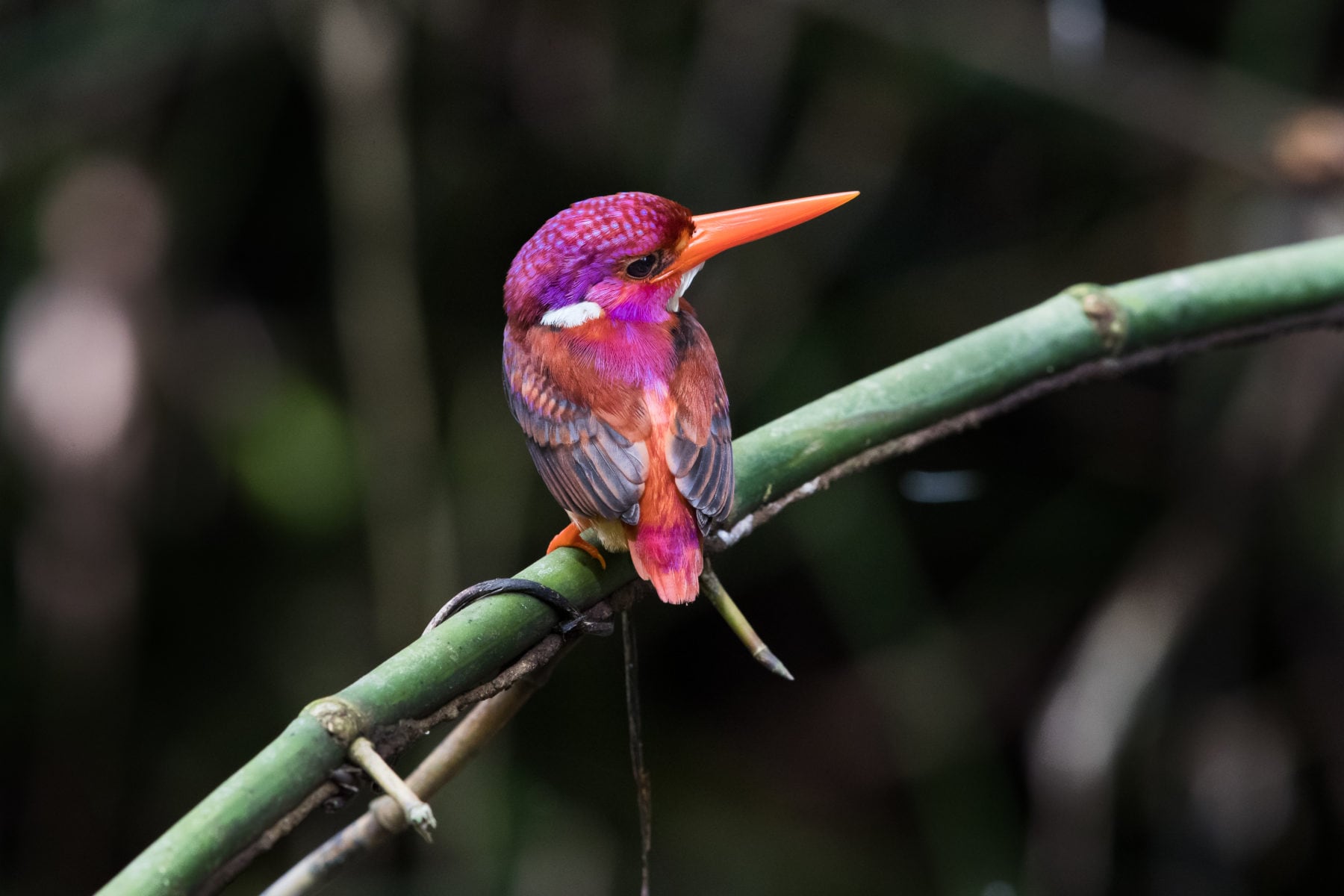
This is the itsy-est, bitsy-est Kingfisher that ever did live. And you just don’t get colours like that. I mean, for God’s sake, it’s a lilac bird! And look at its little head, it has fluoro purple spots! How is that even a thing?
Miguel David De Leon
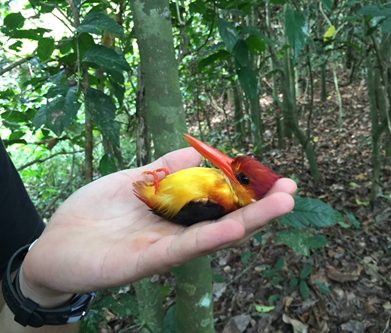
Just how small is this bird? Well, here is the closely related Black-backed Kingfisher lying in a person’s hand to give you a sense of how lazy these birds can be.
This pint-sized Kookaburra is elusive, though. They hang out in the forests of the Philippines (as you probably guessed from their name), but because of their tiny size, flighty habits and the fact that they’re also endangered, it has made them rather hard to capture on film. But when they do sit still long enough for a photo shoot, they deliver the goods.
Miguel David De Leon
Like all Kingfishers they’ve got an almost comically oversized beak, and an equally comically undersized tail. Despite the name, these tiny fishing birds, don’t go after fish. After all, most fish are big enough to eat them. Instead, they mainly eat insects, spiders and small lizards, but if there’s something tiny in water like a tadpole, they might scarf that down too.
Mohit Kumar Ghatak
They’re rather at risk thanks to deforestation, so here’s hoping these little guys get the protection they need so more people can find and appreciate the living heck out of them.





/hummer-pollen-58a6d2b05f9b58a3c90885df.jpg)















 Bird of the Week