Bird 236 – Standard-winged Nightjar

When it comes to the Standard-winged Nightjar, the first thing we need to address is its name, both common and scientific (Caprimulgus longipennis).

First, lets handle the long penis. This is a compound Latin word, and while the ‘long’ part does mean long, the ‘pennis’ part is from the word penna, which means feather. This is a long-feathered bird, so while it is certainly well endowed, it just isn’t in the area you might have guessed. It’s always important to remember that the vast majority of birds don’t even have a penis.

Second, the standard wing part. As you can see from the pictures, this bird has anything but a standard wing. Let’s be honest, it’s rather extraordinary. Was the person who named this bird trolling it, ‘Yeah, it’s pretty big, I guess. Seen bigger. Standard, if you ask me.’

The word standard here refers to the pennants and flags armies once carry into battle: their standards. Flags held aloft on the end of a long pole, which kinda looks like what’s going on here.

Like all Nightjars, these little guys are nocturnal hunters. They rely on their cryptic plumes to keep them camouflaged through the day. They hide on the rocky, barren terrain of their African home, and at night become silent stalkers of moths and other flying insects. 

But what about those ridiculous wing feathers? They only belong to the males, and they grow them for the mating season. Throughout the rest of the year they look just like the females. The flashiest males can grow feathers longer than the rest of their body: you can get a 38cm feather on a 20cm bird, longipennis indeed.

During normal flight the display feathers trail behind the bird. But when they go into wooing mode they lift the feathers up over their body, just like a standard being taken into battle (hence their name).

Because they display at night, footage is rather rare, but here’s a video of their mating display. It looks almost like a marionette suspended on string. 

06/03/22

Bird 235 – Black Skimmer

Today we have a true freak of the bird world, the Black Skimmer (Rynchops niger).

At first glance you may wonder what failed medical experiment they were part of, what with their intense underbite. Skimmers are the only birds whose lower mandible is longer than their upper mandible. If you were to take an even closer look you would also discover that they have vertical slit pupils, like a cat. Again, they are the only bird with this feature. Like I said, they’re freaks. 

Black Skimmers are relatives of the Gulls and Terns. So, in some regard they’re not all that different. They live on the coast, dine out on seafood, and make little scrape nests on the sandy shore.

But it is their strategy for hunting that has turned them into freaks. They favour calm water and will fly just above the waves, dipping their lower bill into the water as they fly, skimming it across the surface (hence their name).

When they feel something make contact with their bill they quickly snap it shut and fly up, capturing their prey. They’re the only bird that hunts this way, and apparently having a longer lower mandible is just the ticket.

So wait, are you telling me they just fly along the surface of the water, hoping to bump into a fish by chance…? Yes, that’s exactly what I’m saying. They live by the motto: ‘sooner or later you always run into a fish.’ Wise words.

It also isn’t easy to tell, but their bills are very narrow. When viewed front on they look almost like a knife. Perfect for slicing through water with minimal resistance.

But what about them eyes? Why is this bird cat-eyed? When flying low across the water reflected glare can be a bit of an issue. But their vertical slit eyes act like inbuilt sunglasses, filtering out that dazzling light and allowing them to see where they’re going.

Oh also, when they sleep they just flop face down in the sand. They kinda look like they’re dead, but hey, you spend all day skimming across water with your lower lip submerged hoping to run into a flounder and see how tired you get.

“Three Sleeping Black Skimmers” by Channel City Camera Club

27/02/2022

Bird 234 – Flame Robin

Today we’re going to look at one of Australia’s favourite birds, the Flame Robin (Petrocia phoenicea). Hey, hang on here. European Robin, American Robin, Flame Robin? What’s going on; who are all these Robins and are any of them related?

No, of course not, because there is no consistency in avian nomenclature. It’s all madness, madness I tell you!

No, the Flame Robin belongs to its own family, the Australasian Robins. But unlike the American Robin (which is really a Thrush) and the European Robin (which is really an Old World Flycatcher), at least all the Robins in Australia actually belong to a Robin family. So maybe they’re the truest, most pure of all the Robins … even though they’re named after the European bird …? You know what, just don’t think about it.

But like the other Robins we’ve met, they possess a bright (some people might call it flame red) breast. This is a feature of the males, which they use to guard their territories. They puff up their flame red feathers in a show of mighty prowess to ward other Robins away. It’s an adorable display, but to a bird it must be truly fearsome.

The Flame Robin favours the high mountains of the Great Dividing Range, where they nest and raise their young. The male does the important job of selecting the nesting site, and then the female takes care of the more minor task of building the nest by herself. Once the chicks hatch they share feeding duties.

These little guys are classified as Near Threatened, so seeing one is always a special treat. If you’re not afraid of hiking up a mountain or two, they can be found atop the odd peak in the Canberra region, where you might see them seeking insects, sallying back and forth from their favourite hunting perch.

20/02/2022

Bird 233 – American Robin

Today we have one of the United States’ favourite birds, the American Robin (Turdus migratorius).

Now, the first thing we need to clear up is, no, the American Robin is not related to the European Robin. Our little friend from last week is a member of the Old World Flycatcher family, while its Yanky cousin is a Thrush, so it’s more closely related to Blackbirds and the likes. The American Robin earned its name because of their striking red breast, which colonial settlers found reminiscent of the bird they knew from back home. But those fools were wrong and now we’re stuck with it.

But of course, the American Robin is delightful in its own way. They’re a migratory bird, which you might have guessed from their scientific name, migratorius. Many people see them and their cheerful song as a sign of spring, as they’re one of the first birds to return and nest as the weather warms.

Speaking of nests, Robin eggs are famous in their own right. You’ve probably heard of the colour ‘egg-shell blue’ or ‘Robin’s-egg blue’. It is so named for the distinctive, soft cyan blue hue of the American Robin’s egg.

Being such a well-liked and common bird, the American Robin has a long history in folklore, both ancient and modern. But I think the most scandalous and unforgivable use of a Robin in any media ever, and I do not exaggerate, is Marry Poppins. No doubt you will remember the song A Spoon Full of Sugar. A line in the song says, ‘A Robin feathering his nest has very little time for rest while gathering his bits of twine and twig’ (never mind the fact that only female Robins make the nest). But famously, this film is set in London, and what bird do we see when Poppins looks out the window — an American Robin. Outrageous! Your childhood is a lie. THE BIRD IS A LIE! 

But then I guess Dick Van Dyke was another American unsuccessfully posing as an Englishmen in that film, so maybe it’s appropriate. 

06/02/2022

Bird 232 – European Robin

Today we have the UK’s favourite bird, the European Robin (Erithacus rubecula).

The Robin is a distinctive and spunky bird. They’re easily identified by their bright orange face and breast, as well as the melodious songs they sing.

While it might sound like a cheerful tune to our ears, to other Robins it is a war cry. This is a bellow of warning, letting everyone know that it is the biggest, meanest Robin that ever did live, and if you come anywhere near its territory you are going to get messed up. No kidding either, Robins are known for their fighting ways, and will push out all other Robin interlopers. Both males and females set up territories which they guard vigorously. Their song is the first line of defence. 

I am Fierce, Fear Me!
“European Robin” by jd.echenard 

For people though, the Robin is a welcomed companion and is sometimes known as the Gardener’s Friend. Robins feed primarily on the ground, and they like investigating recently disturbed soil for insects or grubs that have been flushed out. At some point Robins began following gardeners around, picking over the soil as we humans dig, weed and plant. I guess people liked the company, because it became a UK tradition to never harm a Robin. As a result, they become increasingly tame in the British Isles. 

This is not the case on the mainland, where the French, ever ready to eat whatever strange thing crosses their path, regularly hunted the tiny bird. Mainland European Robins are much more skittish and tend to favour the cover of woodlands over more open areas.

Maybe the most remarkable thing about the Robin though is their ability to sense magnetic fields. Now, “hold on there”, I hear you say, “can’t most birds do that?”. You are right my friend. But it seems, for the Robin, they don’t so much feel magnetic fields, as they literally see them. This is still a poorly understood phenomenon, and a story for another time, but it seems they can detect how a magnetic field interferes with light. Which makes no sense to me, but apparently it works best when there’s plenty of blue light… 

30/01/2022

Bird 231 – White Stork

Today I have a famous bird for you: the White Stork (Ciconia ciconia).

Not only are these log-legged, black and white birds the iconic embodiment of stork-i-ness, but because of their habit of living close to human habitation they have featured heavily in folklore for centuries. Most famously, White Storks are said to deliver babies to new mothers. If only that were true; a Stork-delivered baby sounds much more charming and delightful than the rigmarole of traditional child birth.

It’s assumed the myth started because Storks show up in Europe around the time when a lot of babies were born following weddings that traditionally happened around the summer solstice. From there, the myth grew as a way for parents to explain the arrival of a newborn to young children without going into the whole birds and bees discussion. Wait … is that where that expression comes from? But then how do the bees come into it…? Questions for another time.

Storks have a broad range across Europe and Africa, they nest in the north and migrate south during the winter (more on that in a minute). Because a Stork was generally seen as a good omen (what with the babies and all), people were happy for them to nest atop buildings and other human structures. They make massive nests, and favour elevated locations. Thanks to industrialised farming practices their populations declined for much of the 20th century, but recent efforts to boost their numbers across Europe have been largely successful. People even set up special nesting poles to encourage them into the neighbourhood. 

Storks are also almost incapable of making any vocal noise. Songbirds they are not. Instead, Storks communicate with each other by clattering their bills. It’s sometimes described as sounding like a machine gun. Personally, I think it sounds more like an idling motor boat… but I’ll let you decide.

The Stork played an important role in the history of bird migration. For a long time, Europeans didn’t know where birds went when they migrated. But in the early 1800s a special Stork turned up in Germany with a memento of its African holiday. It seems while minding its own business, a local hunter had tried to kill it. They’d thrown a spear which hit its mark, but somehow the bird not only survived and fled, but managed to make it all the way back to Europe with the spear still lodged in its neck. This was one of the first solid pieces of evidence ornithologists had that Storks, and indeed many birds, winter in Sub-Saharan Africa. 

Zoologische Sammlung der Universität Rostock – Zoologische Sammlung der Universität Rostock, https://commons.wikimedia.org/w/index.php?curid=66997013

While the bird escaped its African foe, it wasn’t so lucky with the Germans. They caught it, killed it, stuffed it, and put it on display at the Rostock University. Germans: they’re efficient.

The history of how we learned about avian migration is a long and fascinating one, peppered with all sorts of interesting experiments. If you’d like to learn more then you are in luck my friend, because by sheer coincidence that is the exact subject of our latest audio story (what are the odds). So why don’t you join me for a tale and I’ll step you through the centuries-long discovery of how avian migration came to be understood (Apple, Spotify). 

Oh, and if you haven’t caught Part I of the Avian Migration story now would be the perfect time.

23/01/2022

Bird 230 – Torrent Duck

There are many excellent ducks in the world, and we’ve featured a few of them over the years. But today, we’re going to look at possibly the greatest one of all, the Torrent Duck (Merganetta armata).

Many birds are poorly named, the Torrent Duck is not. These handsome quackers live high in the Andes Mountains. They make their homes in the rugged streams that tumble down the steep cliffs, forming rapids with fast flowing, foaming water. Most animals can’t navigate the treacherous rivers, but for the Torrent Duck white water rafting is their speciality. 

These ducks are equipped with strong feet and long stiff tails that help them power through chaotic, churning currents. They make short dives to forage between rocks and in tiny crevices for insect larvae. You might think they’d retreat to calmer waters to raise their chicks, but no. A Torrent Duckling is pushed straight into the deep end and has to contend with eddies and waterfalls from day one. The little tykes learn fast though, and soon life on the turbulent river becomes second nature. 

There is a distinct difference between the males and females. The males have striking white heads with black racing stripes down their side, while the females have a handsome orange underside. Torrent Ducks generally mate for life. They display to each other by splashing water into the air while swimming and then raising their tails. I guess when you live where water is always flying everywhere, being able to splash in an aesthetically appealing way is an artform that can only be appreciated by someone who has water constantly flung in their face.  

Just another calm lazy day by the pool.

16/01/2022

Bird 229 – Bar-tailed Godwit

Today we present a bird that is all beak, the Bar-tailed Godwit (Limosa lapponica).

They’re a type of Sandpiper, a bird that spends its life in tidal zones, estuaries and mudflats. In these squelchy places, it uses its overgrown beak to probe the sand in search of worms and crustaceans. 

But I know what you’re thinking: what does the word ‘Godwit’ mean? And that’s a great question, the answer to which no-one really knows. Sadly, it doesn’t have the wit of a deity. There are two leading theories: it could refer to the sound they make; or it could be derived from the Old English ‘god whit’, meaning good creature, which could be a reference to how tasty they are. Apparently back in the day, they were a delicacy on English dinner tables.

The Bar-tailed Godwit is rather cosmopolitan, and can be found throughout Africa, Asia, Europe, Australia and New Zealand. But each summer they all converge on the Artic Circle to breed and raise their chicks. And this is where the truly remarkable part of their story begins.

Not only is the Bar-tailed Godwit a migratory bird, but they are the superstar of migratory birds. The ones that live in New Zealand hold the record for the longest non-stop flight. Each year these birds that are no bigger than a football make one non-stop flight from their breeding grounds in Alaska clear across the Pacific Ocean to New Zealand. It takes them nine days of non-stop flying to cover 11,000 kilometres. 

During that flight they rest by sleeping one hemisphere of their brain at a time so they don’t need to stop. While these birds are super strong (I’ve heard them once described as flying bricks) they combine this strength with morbid obesity. To fuel their journey, they pack on the pounds, literally doubling their weight before the flight. If a human tried to prepare for a marathon by doubling their weight in fat, you’d say they were insane, and yet a plump Godwit is in peak physical form. 

The way birds pull of their migration is mind blowing, and no two species do it in the same way. I’ve taken a deep dive to explore the mysteries of avian migration, so if you’d like to learn more about the Godwit and the hundreds of other birds that have their own incredible journeys then why not join me for a story (Apple, Spotify).   

09/01/2022 

Bird 228 – Northern Rockhopper Penguin

So, I was reviewing the accounts from 2021 and I realised we never featured a penguin. Well, to start off 2022 we will rectify the situation with the Northern Rockhopper Penguin (Eudyptes moseleyi).

PsBattle: glamorous northern rockhopper penguin : r/photoshopbattles
Tui De Roy

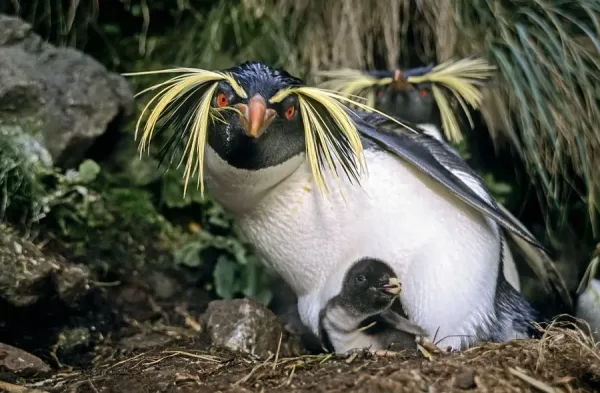
The Rockhopper Penguin is the most dramatic of all the penguins with their flowing yellow crest, blood red eyes and photogenic attitude.

Northern Rockhopper Penguin Facts -

Just look at this handsome devil. They have a face that demands the camera’s attention. 

Unlike what you would normally expect from a penguin, Rockhoppers live in subantarctic waters, and may go their whole life without ever seeing a piece of ice. Rather than skidding on glaciers, they stay true to their name and hop on rocks. In fact, they don’t really have a classic penguin waddle, but almost always hop wherever they travel (on land). 

At first glance, the Rockhopper may not look like much of a mountaineer, but when it comes to scrambling up steep and slippery stone surfaces, they’ve mastered the craft. I mean … yes, there are a lot of slips and tumbles, but these penguins are persistent and attack that slop over and over until they find a way up.

The fact they aren’t overly graceful on land should be expected, seeing they only come to land to nest. When they do nest the Rockhopper is met with something of a quandary. On the one hand there is safety in numbers, and they cluster into huge colonies to collectively protect their eggs. On the other hand, Rockhopper doesn’t like anyone getting close to their nests and they spend most of their time bickering, attempting to steal their neighbours’ nesting material, pecking each other on the scruff of the neck and knocking them about with their powerful flippers. If another penguin even walks … ah, rather hops … too close to their friend’s (sworn enemy’s) nest they’re liable to getting a beak in the butt.

Northern rockhopper penguin (Eudyptes moseleyi (Print #19310227)
Tui De Roy

I mean, look at that penguin, you know it’s got a killer instinct. Do not look sideways at its baby or it is going to mess up your day.

02/01/2022

Bird 227 – Christmas Frigatebird

Christmas has arrived, so I thought I’d offer up the most festive bird I could find:

Janos Hennicke

Ah yes, there are few birds that evoke a greater season of holly-jolliness than the Christmas Frigatebird (Fregata andrewsi). I mean, it’s all in the name. It is said that Saint Nicholas himself experimented with Frigatebirds as an option for sleigh-pulling duties. That was until he naturally moved on to the far more sensible and frankly obvious option of flying reindeer.

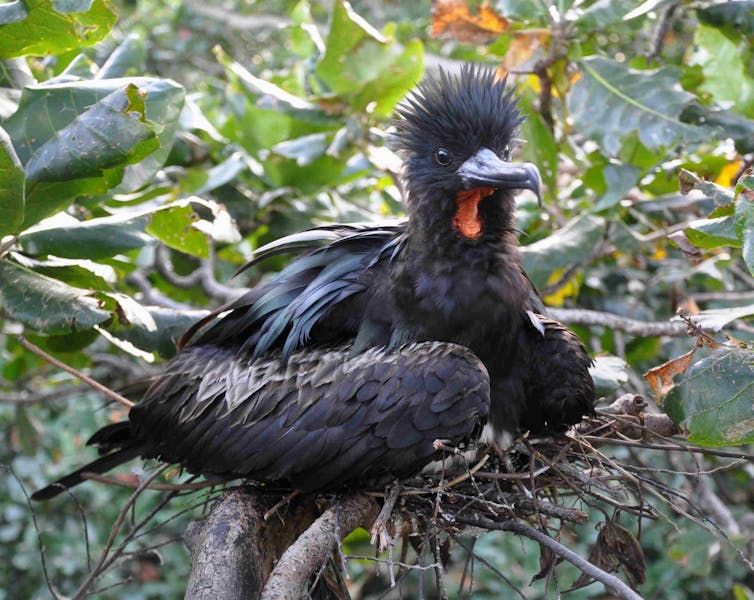
But no, sadly these birds have nothing to do with Christmas, rather they are so named because they breed only on Christmas Island. Instead of a glowing red nose the Frigatebird is renowned for its inflatable, frog-like, red throat-pouch. During the mating season the males inflate these pouches (technically called a gular sac) while the females fly overhead surveying the displaying males. After all, only the rosiest sack of inflated air will do.

For a sea-going bird, the Frigatebird doesn’t care much for water. They almost never enter the sea, because in a strange move their feathers aren’t waterproof. If they do, they quickly become saturate and unable to fly. They also have rather weak feet making them clumsy on land. So, if they struggle on land and water, where do they spend all their time? 

Why, in the air of course. They have the highest ratio of wing surface area to body weight of any bird, which makes them fast, nimble flyers. They can stay on the wing for days on end and can even sleep while flying by resting one side of their brain at a time.

Magnificent frigatebird - Wikiwand

To catch their prey, they fly close to the surface of the ocean and snatch up fish or squid that come to close. They also use their superior flying skills to harass other sea birds, relentlessly chasing them until they drop their meal. Now, I don’t know if there’s a Christmas lesson in there or not, but I want you to make sure that if anyone eyes off your ham, you don’t back down. Be like the Frigatebird, pursue your enemy relentlessly until they drop your ham.

Boas Emmanuel

And that is our final bird of the year. To say goodbye to 2021 I have one final Christmas gift for you, a short story about the birds featured in the song The 12 Days of Christmas, you’re welcome. So, check that out (Apple, Spotify) if you’d like some festive avian action.

26/12/2021      

Design a site like this with WordPress.com
Get started