Every now and again I come across a bird that raises questions. For example, the Jamaican Mango (Anthracothorax mango). This cute, little Hummingbird is native to Jamaica, as the name suggests.

But then … there’s that second half of its name: mango. What’s up with that? Well, you might think to yourself, it probably has something to do with mangoes. So, you do a little googling and discover mangoes aren’t native to Jamaica. You dig deeper and learn they weren’t even introduced to the island until after the bird was officially named. And suddenly, right there, my friend, you’ve got a mystery on your hands.
Now, I’m not here to talk about the Jamaican Mango. I solved that riddle some time ago and you can find the answer here. No, the mystery I want to talk about begins with a different bird, the Many-colored Rush Tyrant (Tachuris rubrigastra).

It has one hell of a name, and it is one hell of a cutie. And really, its name says it all: they have many colours, they live in rushes, and they’re … tyrants?
Hmm… Nothing about them is really indicative of a tyrant. They’re a South American bird, they live mainly in marshlands and build adorable little mud-nests that attach to the reeds and rushes.

I guess, they do have intense, really arched eyebrows which suggests a shifty nature, but surely that ain’t it.

And so, with questions aplenty, I set out in search of answers.
Anyone who has read my previous essay on how birds are named will know that generally a bird’s last name will point to the larger family group it belongs to. In this case, the patterns holds. Our many-coloured friend belongs to a family of birds known as Tyrannidae, or more colloquially, the Tyrant Flycatchers.
Now, this family is massive. In fact, it is the single largest family of birds, with well over 400 individual species. So that means, there are all sorts of tyrants kicking around. You’ve got the Great Shrike-tyrant, the Short-tailed Pygmy Tyrant, the Streamer-tailed Tyrant; hell, I’ve even previously featured the Cattle Tyrant as a Bird of the Week.

There’s even one known as the Yellow Tyrannulet… I’m sorry, Tyrannulet? Is that like a little baby tyrant? I love it.

So okay, our bird is called a tyrant because it belongs to this family. But that just kicks the question up another level and now the problem is even bigger. Now we have hundreds of birds known as tyrants and they’re all tiny and cute. In fact, you can go another step up the taxonomic tree and there you find the suborder Tyranni. Now, we are talking about over 1000 birds that belong under the umbrella of this broad family. Why? Why is this a thing? I couldn’t for the life of me find the answer anywhere.
Usually, it’s quite straight forward to see why birds have the names they do. Take for example the family Oriolidae. That’s an odd word, right. But it derives from the Latin ‘aureoles’, which means golden. And lo and behold, if we look into this family we find some really golden birds. Mystery solved. (They’re also a key player in the Jamaican Mango riddle as well.)

We have a similar situation here. Tyrannidae comes from the Latin, Tyrannus, meaning tyrant. But still … why are these birds tyrannical? Like … are they just jerks to other birds? Do they see a Tyrant Flycatcher heading their way and think, great there goes the neighbourhood, it’s time to move before they subjugate us to their will? I mean … maybe?
Because usually, it makes sense, right. The animal we naturally think of when we hear the word tyrant is the Tyrannosaurus Rex. They are (were?) the tyrant-lizard king. We’ve all seen Jurassic Park, they terrorise everything that crosses their path. Name earned.

Funnily enough, as theropod dinosaurs, they are distant cousins to birds. Sadly, T-rex’s linage didn’t lead directly to birds, though. You can tell, because the T-rex famously only has two digits on its forelimb, whereas modern birds have three. Birds are more closely related to the Allosaurs or Velociraptors, their fellow three-fingered brethren. But I seem to have strayed from my point…

By this stage I was defeated. I had googled everything I could think to google, I had read every page I could find on the Tyrant Flycatchers, and nowhere did anyone at any point say why that family had the name it did.
But maybe it was time to pause and approach the problem from a different angle. I said this group of birds belongs to the suborder Tyranni. What happens if we move one more step up the taxonomic tree? Here we finally hit something different. We reach the order Passeriformes. Within the world of birds there are about 40 or so different orders. Pigeons belong to the order Columbiformes, Ducks to the order Anseriformes, Chickens to the order Galliformes and so on and so on. Now, the Passerines are far and away the biggest order of birds. Half of all birds belong to this huge group. Crows, Magpies, Butcherbirds, Honeyeaters, Warblers, Wrens, Tits, Finches, and yes, even Tyrant Flycatchers … we’re talking over 6000 birds here.
Guys, that’s a lot of birds.
To try and organise this mess, they are split into two groups. On one side we have our mystery birds, the Tyranni, and on the other we have the Passeri. These two groups do differ from each other. Passeri are colloquially known as song birds. They have specially developed vocal organs that allow them to make the sweet twittering sounds we associate with birds. The Tyranni don’t have this and they kinda just squawk. So I guess we could ask the same question: why are song birds known as Passeri, and does that word even mean anything?
Well, if we descend the taxonomic tree we find the family Passeridae and if we go down another step we find the genus Passer. And so … where does that get us? What bird has the high honour of being the representative of the largest group of birds? Who is the standard bearer for over 6000 diverse, beautiful and unique species? It’s the House Sparrow (Passer domesticus).
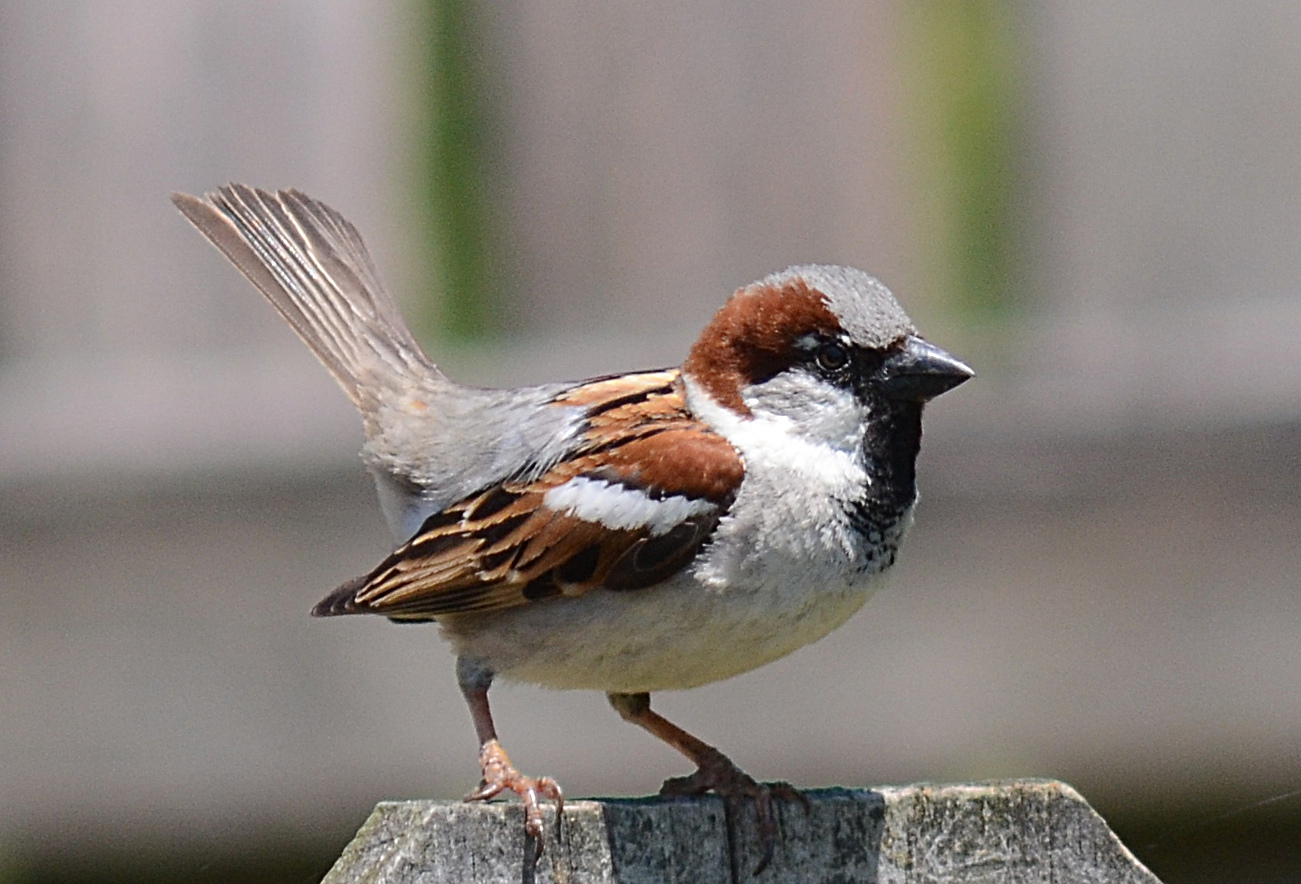
And indeed, the word ‘sparrow’ translates directly into the Latin passer. And so Passeriformes means, that which has the shape of a Sparrow.
So … that got me thinking. Does that mean, out there somewhere, there’s a bird whose Latin name has somehow gotten attached to this broad group and now they’re all known as tyrants? And if so, is that bird tyrannical?
If we go back to our family Tyrannidae we will find that there are over 100 genera of birds in this single family. But after going through each in turn, I found one known simply as Tyrannus. In theory, our representative bird should be in that genus somewhere.
Following the trail, I discovered that this smaller group of birds are known as Kingbirds. Ah-ha, here the penny dropped. Maybe I had been thinking of the word in the wrong way. Did they mean tyrant as a type of leader…? A king if you will. There are 13 birds in this genus and one of them, the Easter Kingbird, has the taxonomic name, Tyrannus tyrannus. So here, we have found, finally, the bird responsible for this whole family’s name. And here it is:
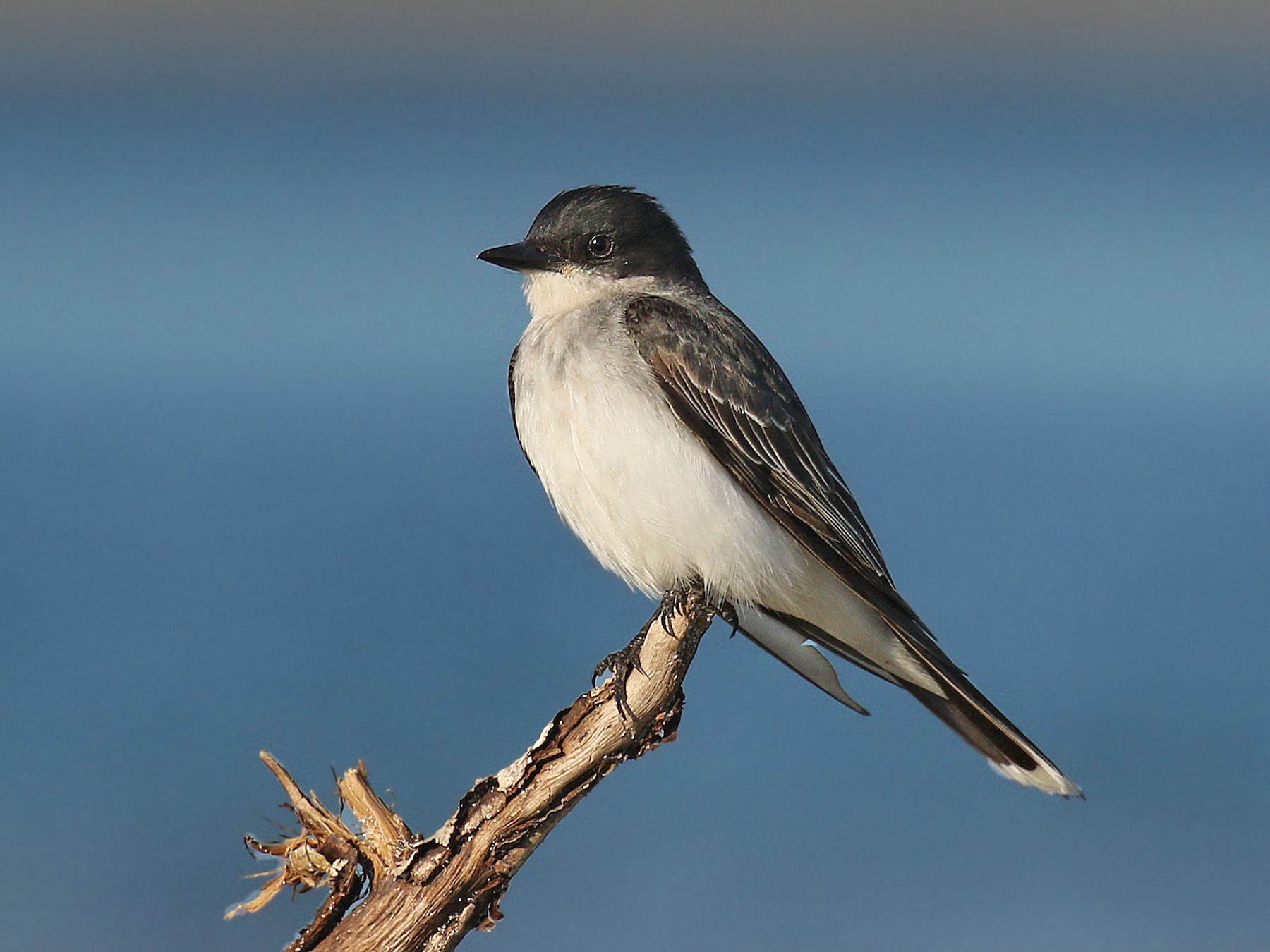
I’m not going to lie, on first glance it’s a little disappointing. We have a rather plain looking flycatcher. Why would this bird be known as a king? Well, it has a secret feature. Although it may look plain, it does in fact have a crown. It’s just hidden. When the Easter Kingbird becomes excited it can flare apart the feathers on top of its head to reveal a brilliant red or orange crown.

It’s a really odd feature and I can’t think of another bird that has something similar. But do you know what else is amazing? These birds, these little, pint-sized birds are major jerks. Yes! That’s right, they actually have a tyrannical nature. I have never been so happy to find out an animal is a dick in all my life.
Eastern Kingbirds are highly territorial and they will attack pretty much anything that comes anywhere near them. Crows, Hawks, Herons, anything. Even Squirrels, why not, take them down, too. They don’t care how big or mean it is, they are going to attack it, and chase it out of their land because no-one messes with an Eastern Kingbird.
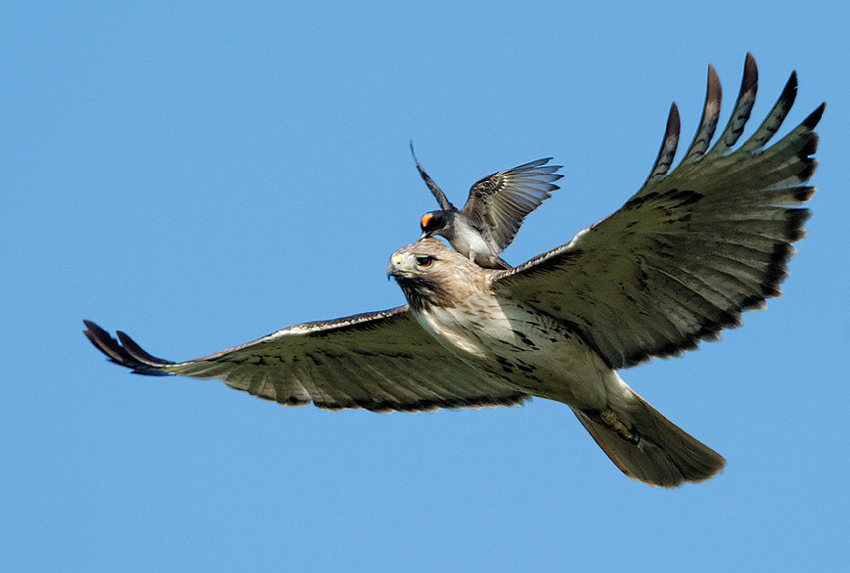
They have been known to dive-bomb unsuspecting Blue Jays and knock them off branches, flashing their bright head flare all the while just to make sure everyone knows who’s boss.

So there’s the answer as to why so many little birds are known as tyrants. They just happen to be related to this massive jerk. All hail the king!
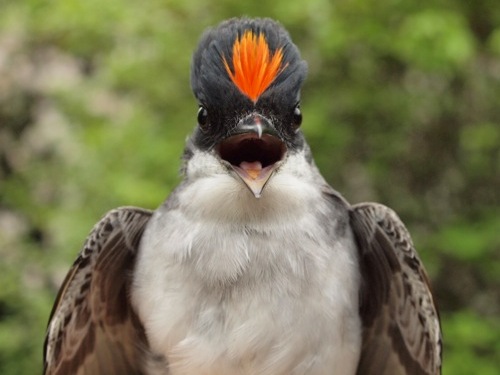
Is that an anticlimax…? I think it’s a fun bird. Shut your face.
19/02/2021
 Bird of the Week
Gold. Make my Monday!
LikeLike